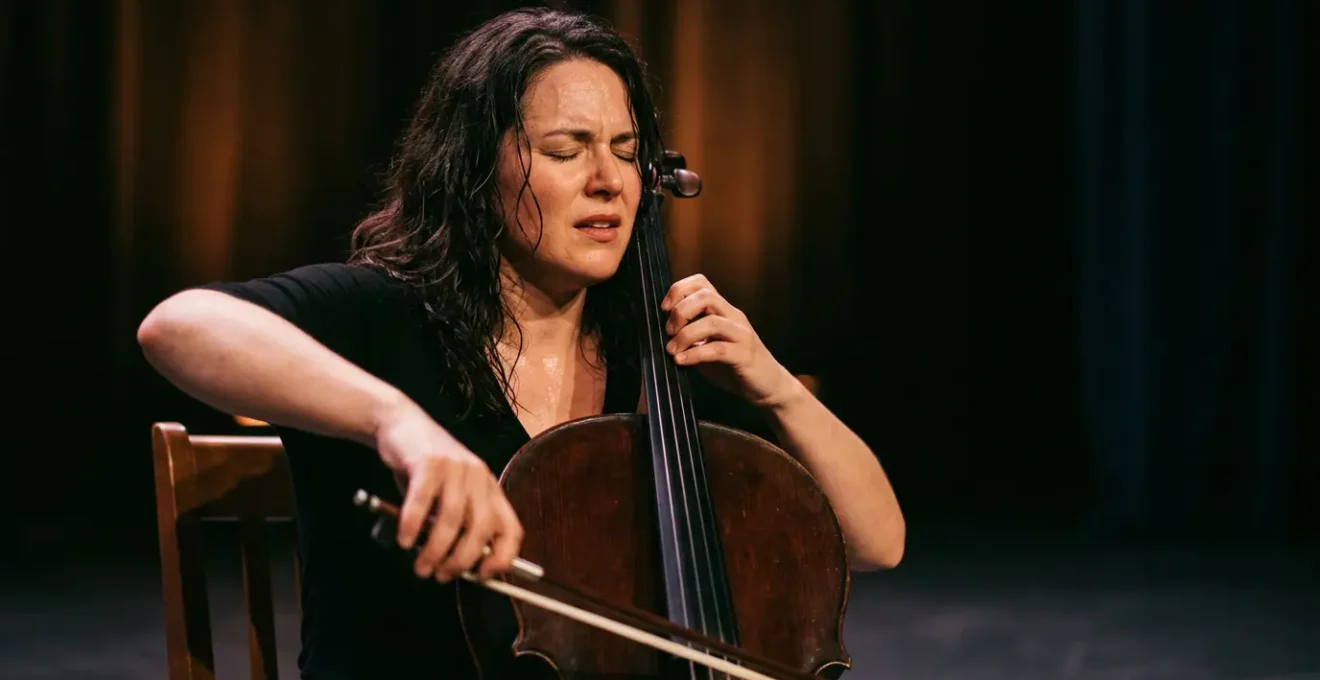
The persistent belief that expressive playing is an unteachable ‘feeling’ is the biggest barrier to your artistic growth; in reality, it’s a technical skill set based on the scientific manipulation of sound.
- Emotional connection with an audience is not magic; it’s a neurological event, driven by brain-to-brain synchrony that you can learn to initiate and control.
- The space *between* the notes—the micro-dynamic shifts and elastic timing—carries more emotional information than the notes themselves.
Recommendation: Stop trying to ‘feel more’ and start practicing the physical craft of dynamic architecture and temporal elasticity with the same rigour you apply to hitting the right notes.
You’ve spent thousands of hours in the practice room. Your scales are clean, your intonation is precise, and you can execute the most demanding passages with technical accuracy. Yet, when you perform, you feel a disconnect. The audience is polite, but not captivated. You listen back to a recording and the truth hits you: it sounds correct, but lifeless. It’s a deeply frustrating experience for any dedicated musician, the sense that despite your best efforts, your performance remains stubbornly mechanical, a flawless blueprint devoid of soul.
The conventional advice you’ve received is likely well-meaning but frustratingly vague: « play from the heart, » « connect with the music, » « just feel it. » This implies that expression is a mystical gift, something you either have or you don’t. It treats the symptoms, not the cause. It overlooks the craft of performance and the deep science of how humans perceive and react to sound. While understanding the composer’s intent is vital, it’s only half the equation.
But what if the key to unlocking expressive, captivating performance wasn’t in some abstract emotional space, but in a learnable, tangible set of skills? What if emotional impact could be designed and executed with the same precision as your technique? This is the transformative shift in mindset we will explore. We will move beyond platitudes and dive into the mechanics of emotion in music—the psychoacoustics of dynamic control, the neurology of audience connection, and the craft of building intensity. This is not about faking emotion; it’s about mastering the language your instrument uses to communicate it directly to the listener’s nervous system.
This article will deconstruct the elements of expressive playing into concrete, actionable principles. We will examine why technically perfect performances can fail to connect, how to develop the subtle control that audiences feel viscerally, and how to build a dynamic architecture that ensures your musical climaxes are truly powerful. Prepare to change the way you think about, and practice, your art.
Summary: Why Does Your Playing Sound Mechanical Even When Every Note Is Technically Perfect?
- Why Do Audiences Lose Interest During Your Performance Even When You Play Well?
- How to Develop Dynamic Control So Subtle That Listeners Feel Without Noticing?
- Chamber Hall or Festival Stage: How Should Your Dynamic Approach Change?
- The Dynamic Mistake That Makes Your Quiet Passages Inaudible and Loud Sections Harsh
- When Should You Start Building Intensity So the Climax Lands Perfectly?
- Why Does Moving Notes Off the Grid Make Your Beat Sound Better?
- Why Do « Messy » Live Performers Often Captivate More Than Precise Ones?
- Why Does Your Live Show Fall Flat Despite Playing Every Note Correctly?
Why Do Audiences Lose Interest During Your Performance Even When You Play Well?
The uncomfortable truth is that an audience doesn’t listen with a metronome and a tuner; they listen with their entire nervous system. When a performance is technically perfect but dynamically flat, it provides no new information for the brain to process. It becomes predictable, a sonic wallpaper. The listener’s brain, wired for novelty and change, simply disengages. This isn’t a failure of their attention span; it’s a failure of the performance to provide the necessary stimulus. True engagement is a form of conversation, and a monotone delivery, no matter how grammatically correct, will always cause the listener to drift away.
The connection is more than a metaphor; it’s a measurable neurological event. Groundbreaking neuroscience research demonstrates that as an audience becomes more engaged, their brain activity patterns begin to synchronise with those of the performer. This « inter-brain coupling » is the physical manifestation of a shared emotional journey. A mechanical performance fails to initiate this synchrony. It speaks *at* the audience, but never creates the resonant feedback loop that defines a captivating live experience. You are not just playing notes; you are sending out a complex neurological signal, and if that signal is unvarying, it will be ignored.
This is because the brain is hardwired to respond to the very elements that mechanical playing lacks. As Dr. Edward W. Large and his colleagues found in their research for PLOS One, it’s the expressive qualities that activate the brain’s emotional and reward centers.
Limbic and paralimbic brain areas responded to the expressive dynamics of human music performance, and both emotion and reward related activations during music listening were dependent upon musical training.
– Dr. Edward W. Large et al., PLOS One Journal – Dynamic Emotional and Neural Responses to Music
In essence, a dynamically rich performance doesn’t just sound better—it triggers a fundamentally different, and more profound, neurological response in your listener. Without these dynamic cues, the brain has no emotional roadmap to follow, and it inevitably loses interest, regardless of your technical flawlessness.
How to Develop Dynamic Control So Subtle That Listeners Feel Without Noticing?
The secret to profound dynamic control lies in shifting your focus from macro to micro. Most musicians think of dynamics as distinct levels: piano, forte, crescendo. A truly expressive performer thinks of dynamics as a constantly shifting texture. This is the realm of micro-dynamics: the subtle swell within a single held note, the slight decay of intensity before a phrase change, the minute variations in attack that differentiate one note from the next. These are the changes too small for a listener to consciously label, but which their nervous system registers as vitality and presence. A study comparing expressive and mechanical piano performances found that the expressive version, with its natural variations, activated emotion-related brain structures like the amygdala, while the mechanical version showed almost no such activity.
This microscopic control gives your music a tactile quality. It’s the difference between a perfectly smooth, computer-rendered surface and the rich, complex texture of hand-planed wood. The illustration below visualises this concept, showing how even a single sound wave can contain a world of subtle variation and detail.

This image isn’t just an abstraction; it represents the sonic detail you must learn to control. To develop this skill, you must practice it as diligently as you practice scales. Instead of practicing a crescendo from piano to forte over four bars, try practicing a crescendo from ppp to pp over a single semibreve. Practice holding a single note and, without altering its pitch, making it feel like it is moving closer to the listener, then further away. This is the work of a performance coach: moving you from a two-dimensional understanding of volume to a three-dimensional mastery of intensity and sonic presence.
Your Action Plan: Practising Micro-Dynamics
- The Single Note Swell: Choose one comfortable note. Your goal is to play it for 10 seconds, starting as quietly as possible, swelling to a medium volume (mezzo-piano) in the middle, and decaying back to silence, all without any perceptible « steps. » Focus on a perfectly smooth arc.
- Phrase Contouring: Take a simple four-note melodic phrase. Instead of playing all four notes at the same volume, create a tiny « story. » Perhaps the second note is the most intense, or maybe the fourth note fades into nothing. Record yourself and listen back, not for right or wrong notes, but for the clarity of your dynamic shape.
- Attack Variation Audit: Play a simple C major scale, but give every single note a different attack. One note might have a sharp, percussive start (a ‘hard consonant’), another might ‘bloom’ out of silence (a ‘soft vowel’). The goal isn’t to sound musical, but to expand your palette of available note beginnings.
- The Static Dynamic Challenge: Choose a passage and decide to play it entirely at what you perceive to be a mezzo-piano level. Your task is to make it sound interesting and expressive *without changing the overall volume*. This forces you to rely entirely on micro-dynamic shaping and timbral changes within that narrow band.
- Listening & Mimicry: Find a recording of a performer you admire (a singer like Dietrich Fischer-Dieskau, a cellist like Jacqueline du Pré). Isolate one single phrase. Listen to it ten times, focusing only on the tiny dynamic shifts. Now, try to replicate that exact contour on your own instrument.
Chamber Hall or Festival Stage: How Should Your Dynamic Approach Change?
The idea that you can perform a piece with the same dynamic approach in every venue is a common misconception among developing musicians. The acoustic space itself is an extension of your instrument, and it fundamentally alters how your dynamic intentions are perceived. What sounds like a breathtaking, pin-drop pianissimo in an intimate 200-seat chamber hall will simply be inaudible on a vast festival stage or in a cavernous cathedral. Conversely, a powerful fortissimo that feels commanding in a large hall can be painfully harsh and overbearing in a small, reflective room.
Your first task upon entering any performance space is to conduct a « dynamic calibration. » You must test the extremes. How quietly can you play before the sound loses presence and clarity at the back of the room? How loudly can you play before the sound becomes distorted, harsh, or loses its musical core? This isn’t just about volume; it’s about the perceived dynamic range of the room. A dry, acoustically treated studio has a very wide perceived dynamic range—every subtle detail is audible. A reverberant church has a much narrower one, as the natural reverb will « lift » your quietest passages and « smear » your loudest ones. You must adapt your dynamic architecture to fit the container you are in.
Furthermore, the context of the performance dictates the role of visual information. In a large venue, the audience may be hundreds of feet away. Your physical gestures—the dip of a shoulder before a quiet passage, the sharp intake of breath before a climax—become a crucial part of your dynamic communication. Your movements amplify your sonic intentions, telegraphing the emotional arc to those who are too far away to perceive the most subtle audio details. A fascinating 2025 study in the Annals of the New York Academy of Sciences found that audio-visual performances lead to higher heart rate synchronisation in the audience compared to audio-only, especially at key moments. In a large space, you are not just a musician; you are a physical performer, and your body must be as dynamically expressive as your sound.
The Dynamic Mistake That Makes Your Quiet Passages Inaudible and Loud Sections Harsh
The most common and damaging dynamic mistake is not a lack of range, but a failure to establish a clear and consistent dynamic floor and ceiling. Many performers, in an effort to be expressive, allow their quietest passages to become so soft they are effectively silence, lost to the ambient noise of the room or the listener’s ear. At the other end, their loud sections are pushed to the absolute physical limit of their instrument, resulting in a sound that is not powerful, but merely harsh, strained, and stripped of musicality. This creates a performance that is tiring to listen to, alternating between inaudibility and aggression.
The solution is to think of your dynamic range not as absolute silence to maximum noise, but as a carefully defined musical space. Your true « piano » is not the quietest sound you can possibly make; it is the quietest sound you can make that still possesses presence, clarity, and tonal core. It must be a sound that can carry to the back of the hall and still be perceived as a deliberate musical statement. Similarly, your « forte » is not the point where you are playing as loudly as possible; it is the point of maximum power and resonance *before* the tone begins to break down or become harsh. Anything beyond this is just noise, not music. This controlled range is everything. Indeed, psychoacoustic research on mastering reveals that an overly compressed dynamic range, where the contrast is squashed, makes music feel lifeless and emotionally flat even to untrained ears.
Visualise your performance space as a canvas of light and shadow. Your job is not to plunge the audience into total darkness or blind them with pure white light. Your job is to use the full spectrum of greys in between to create depth, contour, and focus. A well-defined dynamic range gives your music this three-dimensional quality.
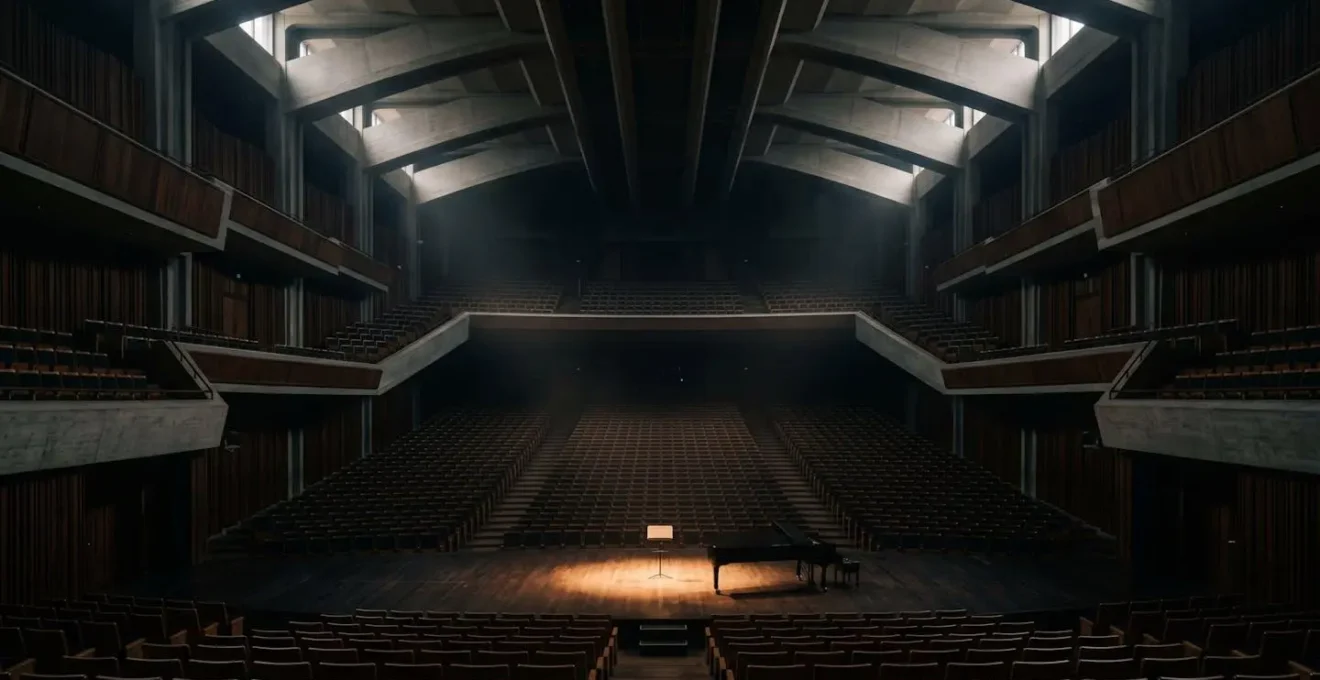
This image perfectly represents the concept. The illuminated area is your forte—bright, clear, and focused. The deep shadows are your piano—rich, mysterious, but still full of visible detail, not just an empty void. Your performance must inhabit this entire space, using the contrast not as a blunt instrument, but as a tool for architectural and emotional design. By establishing a reliable floor and ceiling, you give your audience a consistent framework, allowing them to relax into the music and trust that you will guide them, never abandoning them in silence or assaulting them with noise.
When Should You Start Building Intensity So the Climax Lands Perfectly?
The most common reason a musical climax feels unearned or ineffective is simple: the build-up started too late, rose too quickly, or peaked too early. Crafting a powerful climax is an act of dynamic architecture. It requires long-range planning and a deep understanding of psychoacoustic tension. A crescendo that spans eight bars is not a linear increase in volume; it is a carefully managed escalation of intensity, where each bar must feel like a greater step than the last. If you give away 80% of your dynamic increase in the first four bars, the remaining four will feel stagnant, and the arrival will be anticlimactic.
The key is to think in terms of perceived effort and expectation. The beginning of a long build should feel almost effortless, with only a subtle hint of growing intensity. You are planting a seed of expectation in the listener’s mind. With each subsequent phrase, you must increase not just the volume, but the perceived emotional and physical energy. This can be achieved through subtle increases in vibrato, a more focused bow speed, a deeper key attack, or a slight quickening of the pulse—a concept known as temporal elasticity. The listener’s brain tracks these changes, and their anticipation builds in direct proportion to the perceived energy you are investing.
A critical study on this topic, « Temporal dynamics of expressive timing predict emotional arousal, » analysed how skilled pianists manipulate timing and intensity to create emotional responses. The research found that fluctuations in the music’s timing, especially those that defied a strict metronomic pulse, were powerful predictors of the listener’s perceived emotional arousal. The performer’s physical movements and subtle temporal shifts create a sense of forward momentum that the listener’s brain mirrors, building a shared tension that is released at the climax. It’s an empathetic response, built on the perception of movement and the artful violation of expectation. Your job is not just to get louder, but to make the journey to the climax feel inevitable and deeply satisfying.
Why Does Moving Notes Off the Grid Make Your Beat Sound Better?
A perfectly quantised, metronomically exact performance is the sonic equivalent of the uncanny valley. It is so close to human, yet its robotic perfection feels alienating and lifeless. The very quality that makes a performance feel human and groovy is its subtle deviation from the mathematical grid. This is not about playing out of time; it is about manipulating time with intention, a skill we call temporal elasticity. It’s the fractional hesitation before a downbeat that gives it weight, or the slight rush of a series of quavers that gives a phrase a sense of urgency. These are the micro-timing nuances that separate a drum machine from a master percussionist like Elvin Jones.
Our brains are exquisitely sensitive to these small temporal shifts. When we listen to music, we are constantly generating an internal pulse, a set of expectations for when the next beat should arrive. An expressive performer plays with these expectations. By pushing slightly ahead of the beat (a ‘push’) or lagging slightly behind (a ‘pull’), you create a feeling of tension and release that is deeply engaging on a physical level. It’s what makes us want to tap our feet or nod our heads. A performance that sits squarely on the grid offers no such tension; it is predictable and, therefore, unengaging. It is the controlled ‘imprecision’ that breathes life into the rhythm.
This isn’t just an artistic theory; it’s grounded in how we perceive and produce music. Research into the motor control of musicians reveals that expert performers don’t achieve consistency by being metronomic. Instead, dynamical systems research on musical performance shows that skilled musicians achieve expressive consistency by precisely replicating the *physical movements* that produce these micro-fluctuations in timing and dynamics. The ‘groove’ is not an abstract concept but the audible result of a repeatable, expressive physical gesture. Therefore, to improve your rhythmic feel, you must shift your focus from « where the note lands on the grid » to « what physical motion creates the right kind of temporal tension. »
Why Do « Messy » Live Performers Often Captivate More Than Precise Ones?
We have all witnessed it: the technically flawless conservatory student whose performance is pristine but leaves us cold, followed by the « messy » blues guitarist or folk singer who misses notes, sings slightly off-key, but holds the entire room in the palm of their hand. Why does this happen? The answer lies in the perception of risk and authenticity. The « messy » performer is often operating at the very edge of their abilities, taking musical risks in real-time. The audience perceives this. The occasional cracked note or fumbled passage is not a sign of incompetence, but proof of the high-wire act they are witnessing. It signals that the performance is a living, breathing event, not a sterile recitation.
This perceived risk-taking creates a powerful form of neurological empathy. When the performer is pushing their boundaries, the listener’s brain mirrors that sense of tension and excitement. The performance feels dangerous and unpredictable, forcing the audience to lean in and pay close attention. In contrast, the overly precise performer, who has practiced all risk out of their music, often communicates a sense of control and safety. While technically impressive, this can feel emotionally distant. There is no perceived vulnerability, and therefore, less for the audience’s empathy to latch onto.
This doesn’t mean that sloppy playing is a virtue. The captivating « messy » performer is almost always a musician with a deep foundation of technique, but one who chooses to prioritise emotional communication over note-perfect execution. Their « messiness » is not random; it is the by-product of their commitment to the emotional arc of the moment. They are willing to sacrifice a small degree of polish for a large gain in authenticity. They understand, intuitively, that an audience will always forgive a wrong note, but they will never forgive being bored. The ultimate lesson is that perfection is a tool, not a destination. It should serve the emotional narrative, not constrain it.
Key Takeaways
- Expressive playing is not a mystical feeling but a learnable skill based on controlling micro-dynamics and temporal elasticity.
- Audience engagement is a measurable neurological event (inter-brain synchrony) that is triggered by dynamic variation, not technical perfection.
- True dynamic control involves establishing a clear floor and ceiling for your sound—ensuring quiet passages have presence and loud passages have musicality, not just noise.
Why Does Your Live Show Fall Flat Despite Playing Every Note Correctly?
If you have mastered your technique, planned your dynamics, and honed your phrasing, yet your live performance still fails to connect, the final barrier is often a misunderstanding of the live contract. A studio recording is a document of perfection. A live performance is a ritual of shared experience. Playing every note correctly fulfils your side of the technical bargain, but it does not automatically create the emotional communion that defines a great show. Your live show falls flat because it remains a monologue when the audience is craving a dialogue—even a non-verbal one.
The energy in a room is a real, palpable thing. It flows from performer to audience and back again. A performer who is trapped inside their own head, focusing solely on execution, creates an invisible wall. The audience can admire what is happening on the other side, but they cannot feel a part of it. The key is to shift your focus from internal accuracy to external communication. This means using your eyes, your body, and your intentionality to acknowledge the presence of the audience. It means performing *for* them, not just in front of them. This act of offering up the music, of making it a shared gift, is what ignites the feedback loop of a live show.
This is the ultimate goal: creating a moment of collective emotional experience. Recent research using EEG hyperscanning during live concerts shows that the moments of highest reported musical pleasure in an audience are directly correlated with high levels of inter-brain synchrony. Emotional cohesion between individuals in the audience literally enhances their brains’ ability to sync up. As the performer, you are the catalyst for this mass synchronisation event. Your mastery of dynamic and temporal expression is the signal that allows hundreds of individual brains to lock onto a shared emotional wavelength.

Ultimately, a live show is not a demonstration of your ability. It is an act of connection. Your technical perfection is the foundation, the essential grammar and vocabulary. But it is not the story itself. The story is told in the spaces between the notes, in the shared breath before a climax, in the collective silence after the final note fades. It is told when you stop just playing notes and start communicating humanity.
To put these principles into practice, the next logical step is to begin a rigorous, mindful audit of your own playing, focusing not on right or wrong notes, but on the expressive potential you are currently leaving untapped. This is the work that transforms a good musician into a captivating artist.