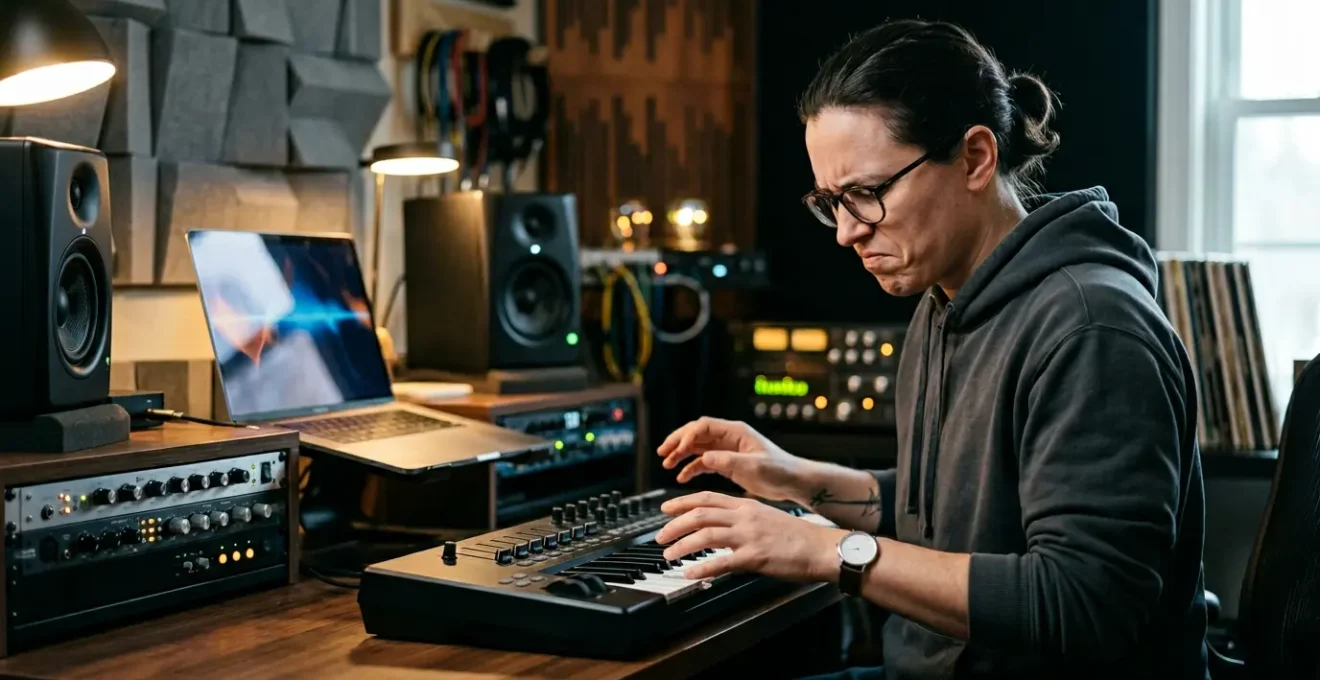
Your production doesn’t sound amateur because of a technical flaw, but because of a missing creative vision that fails to unify your skills.
- Professionals prioritise ‘macro’ skills like songwriting and emotional arc before ‘micro’ skills like EQ and compression.
- Finishing tracks quickly comes from « decision velocity »—making confident choices guided by a clear goal—not just from knowing your DAW inside and out.
Recommendation: Stop chasing isolated techniques and start building a holistic production framework, moving from a strong core idea to a finished track with intention.
You’ve put in the hours. You’ve watched hundreds of YouTube tutorials, you understand signal flow, and you can probably explain the difference between a VCA and an optical compressor. You are technically competent in mixing, arrangement, and even sound design. Yet, when you listen back to your own tracks, something is missing. They sound flat, disjointed, and unmistakably amateur, a frustrating shadow of the professional records you admire. You’re following all the rules, so why isn’t it working?
The common advice trail has likely led you to familiar dead ends: « get better samples, » « use more reference tracks, » or « buy this new plugin. » While these elements have their place, they are symptoms, not the cause. They are micro-adjustments on a foundation that is fundamentally unstable. The frustration you’re feeling doesn’t stem from a lack of technical knowledge. Many producers can create a perfectly clean mix or a complex synth patch in isolation.
But what if the problem isn’t another missing technique? What if the real gap isn’t technical, but strategic? The missing link is a holistic, guiding vision. A professional track is not just a collection of well-executed parts; it’s a single, cohesive statement where every element serves one central idea. Your problem isn’t that you’re bad at mixing; it’s that you don’t know *what* you’re mixing for.
This guide will deconstruct the myth that more tutorials lead to better music. Instead, we will build a new framework focused on developing the holistic skills that truly matter: the taste to know when a track is done, the strategic order to learn your skills, and the workflow habits that foster creativity and decisive action, turning you from a technician into an artist.
To navigate this shift in perspective effectively, this article is structured to identify each gap in your process and provide a clear, actionable solution. The following summary outlines the key areas we will explore to bridge the divide between your current skills and a professional sound.
Summary: From Technical Skill to Artistic Vision
- Why can’t you make good songs despite being good at mixing, good at arrangement and good at sound design?
- How to develop the production taste that knows when a track is finished?
- Music production degree or self-teaching: which path creates better producers?
- The YouTube tutorial habit that keeps you from developing your own style
- What production skills should you master in what order for fastest growth?
- In what order should you build a production to stay creative for 8 hours?
- Why switching DAWs won’t fix your production problems?
- Why does your DAW workflow take 10 hours when professionals finish in 2?
Why can’t you make good songs despite being good at mixing, good at arrangement and good at sound design?
The core of the issue lies in a common misunderstanding: the belief that a great track is the sum of great individual parts. You can have the punchiest kick drum, the most intricate bassline, and a perfectly balanced mix, but if these elements don’t serve a unified purpose, the result is a collection of sounds, not a song. This is the ‘skill-stack fallacy’—the assumption that stacking more technical abilities on top of each other will eventually result in professional quality. In reality, without a guiding vision, these skills often work against each other, creating a polished but soulless product.
This lack of a core idea is not just a creative problem; it’s a technical one. An industry analysis reveals that producing without a strong core idea is one of the most frequent and damaging mistakes. When you don’t know the intended emotion or energy of the final track, every decision becomes arbitrary. Do you make the synth brighter or darker? Does the reverb need a longer or shorter decay? Without a destination, you have no map, and every fork in the road leads to hesitation and, often, overproduction.
Richard Hilton, a seasoned producer, perfectly diagnosed this paralysis that occurs when the foundational ‘why’ is missing. He noted how sessions can spiral out of control when the creative direction is not established from the outset.
There is a particular kind of session paralysis that hits when nobody in the room has agreed on what the finished record is supposed to feel like. Tracks get added, the arrangement grows in all directions, and somewhere in the middle of it, the people making the record lose the thread entirely, because there was never a thread to begin with.
– Richard Hilton, Production Expert
This is precisely what happens when you work in silos. Your ‘sound designer’ brain makes a cool patch, your ‘arranger’ brain finds a place for it, and your ‘mixing engineer’ brain tries to make it fit. But the ‘artist’ brain, the one that should be directing the entire process with a clear vision, has been sidelined. The solution is not to get better at mixing, but to get better at deciding what the song needs to feel like before you even touch an EQ.
How to develop the production taste that knows when a track is finished?
Knowing when a track is finished is not a technical measurement; it’s a matter of taste and judgement. ‘Taste’ in this context is your internal compass, honed by critical listening, that tells you when a track has successfully achieved its intended emotional impact. Amateurs often chase a vague notion of ‘perfection,’ adding layers and tweaking parameters endlessly because they lack a clear metric for completion. This leads directly to the dreaded ‘perfectionism paralysis,’ where a track is never finished because it could always be ‘better’.
Developing this taste requires shifting your goal from technical flawlessness to what can be called ‘intentional fulfilment’. Does the track do what you set out for it to do? Does it evoke the specific feeling you envisioned? A track can be technically imperfect—with a bit of noise or a slightly unbalanced element—and still be a powerful piece of music because it successfully communicates its core idea. Professionals understand this; they know that the last 10% of polish often yields diminishing returns and can even strip the life out of a production.
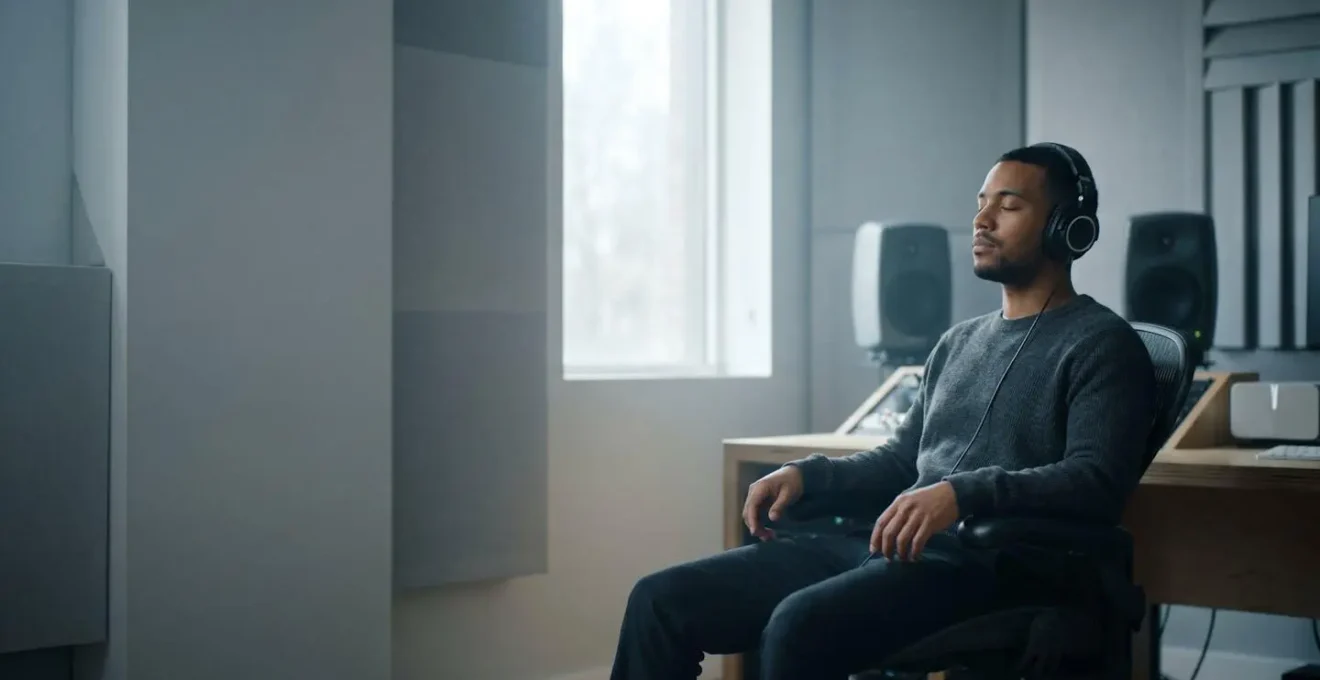
This is the moment of truth: stepping back from the controls and evaluating the work not as a technician, but as a listener. The key is to define your intention *before* you start. Is this a high-energy dance track designed for peak time in a club? If so, the metric for ‘finished’ is simple: does it make you want to move? Is it a melancholic ambient piece for late-night listening? The metric is: does it create a contemplative atmosphere? By setting a clear emotional or functional goal, you give yourself a finish line.
Case Study: The Shift from Perfection to Intention
Research into producer workflow highlights that perfectionism often leads to endless, non-productive adjustments. A study on the topic revealed that successful producers don’t aim for a flawless product. Instead, they redefine ‘completion’ as the point where the music effectively conveys its intended emotion. They recognise that the relentless pursuit of technical perfection often results in tweaks that don’t genuinely improve the track’s impact. Their metric for success shifts from ‘is it technically perfect?’ to ‘has the track’s core purpose been fulfilled?’ This mindset is crucial for breaking the cycle of paralysis and actually finishing music.
Ultimately, taste is built through a feedback loop: produce, listen critically against your initial intention, identify the gap, and repeat. It’s less about knowing every plugin and more about knowing your own mind.
Music production degree or self-teaching: which path creates better producers?
The debate between formal education and self-teaching often misses the point. The question isn’t which path is « better, » but which environment best provides the essential ingredient for growth: structured, intentional learning. A music production degree offers an obvious curriculum, deadlines, and direct access to mentors and collaborators. This forced structure is its greatest asset, guiding students through a logical progression of skills and providing consistent feedback. With the industry expecting a 7% projected growth in music producer jobs from 2023 to 2033 according to the US Bureau of Labor Statistics, having a structured path seems appealing.
However, the self-taught route offers unparalleled flexibility and the freedom to develop a unique voice, uncoloured by academic dogma. Many of the most innovative producers are famously self-taught. As Grammy-winner Finneas O’Connell states, « There’s no right or wrong thing as long as you like the way it sounds. » This freedom, however, is also its greatest danger. Without a plan, self-teaching can become a haphazard journey through random YouTube tutorials, leading to significant gaps in knowledge and a portfolio of half-finished, stylistically inconsistent ideas.
The Hybrid Path: Simulating a Degree’s Benefits
Analysis of successful self-taught producers reveals a common pattern: they don’t just « learn, » they systematically create their own curriculum. A study detailed on Drey Andersson’s blog shows these producers dedicate focused time to mastering their tools, analyse the processes of admired artists without merely copying them, and—most importantly—actively seek structured feedback from peers or mentors. They effectively simulate the core benefits of a formal degree. The research concludes that whilst self-teaching can lead to a deeper, more personalised understanding, it demands immense discipline. Without a self-imposed structure, learning becomes inefficient, and verifying the quality of information found online presents a major challenge.
The conclusion is clear: neither path guarantees success. A degree can produce uninspired technicians, and self-teaching can produce directionless hobbyists. The producers who succeed are those who embrace structure, whether it’s imposed by an institution or meticulously built by themselves. The path you choose is less important than your commitment to a deliberate, goal-oriented learning process.
The YouTube tutorial habit that keeps you from developing your own style
YouTube is an incredible resource, but for many aspiring producers, it has become a crutch that actively hinders growth. The habit of ‘tutorial-bingeing’—passively watching hours of content without applying it—creates the illusion of progress while building zero practical skill. You may learn the five best ways to sidechain a bass, but unless you immediately open your DAW and experiment with those techniques on your own material, the information remains abstract and is quickly forgotten. It’s the difference between reading a book about swimming and actually getting in the pool.
This passive consumption fosters dependency. Instead of solving a creative problem by listening and experimenting, your first instinct is to search for a tutorial that provides a pre-packaged solution. This robs you of the single most important experience in skill development: productive struggle. It’s in the moments when you’re forced to figure something out for yourself that true learning occurs and your unique style begins to emerge. By constantly seeking external answers, you are training yourself to be a follower, not a creator.
The key is to flip the ratio of consumption to creation. As producer Kaizar Raja advises, the vast majority of your time should be spent making music, with tutorials serving as a supplementary tool, not the main activity.
I have spent countless hours watching YouTube tutorials on music production and learned nothing substantial. A much better approach is to spend 80 percent of your time producing and messing around in your DAW and the rest watching tutorials. You may have come across many valuable tips and tricks online, but unless and until you don’t apply them in your productions, they won’t register in your memory.
– Kaizar Raja, Medium
A healthy approach is to treat tutorials like a library. Don’t browse aimlessly; go in with a specific question you need answered for a track you are *currently working on*. Find the answer, then immediately close the tab and apply the knowledge. To maintain this balance, production efficiency research recommends you spend at most 20-30% of your music time watching tutorials. The other 70-80% should be dedicated to the hands-on work of creation. This is how you move from being a collector of techniques to an artist with a point of view.
What production skills should you master in what order for fastest growth?
The fastest path to a professional sound is not random; it’s hierarchical. Aspiring producers often make the mistake of focusing on ‘micro’ skills—like advanced compression techniques or stereo-widening tricks—before they have mastered the ‘macro’ skills that form the foundation of a great song. No amount of mixing prowess can save a track with a weak arrangement or a non-existent emotional arc. The order in which you build your skills is therefore paramount.
Think of it as building a house. You would never start by painting the walls and choosing furniture (micro-decisions) before you have laid the foundation and built the frame (macro-decisions). In music, the macro-skills are critical listening, songwriting, and arrangement. These are the skills that determine a track’s core identity, energy, and journey. Once this ‘frame’ is solid, the micro-skills of sound design, mixing, and mastering serve to enhance and decorate it, bringing the initial vision to life with clarity and impact.

This ‘macro-first’ approach is more efficient because it makes downstream decisions easier. A well-arranged track almost ‘mixes itself’ because every element has a clear purpose and its own space. In contrast, a poorly arranged track requires constant mixing ‘surgery’ to force elements to coexist. By focusing on the big picture first, you solve 80% of the problems before you even reach for an EQ.
Action Plan: The Holistic-First Learning Order
- Critical Listening & Analysis: Before touching any tools, develop your ability to hear professionally. Compare your work to reference tracks, actively identifying differences in loudness, stereo width, depth, and frequency balance. This is your foundation.
- Songwriting & Arrangement (Macro): Master song structure, emotional arc, and the strategic introduction and removal of elements. Focus on building tension and release. A song with a solid arrangement is already halfway to being a great mix.
- Sound Design & Production: With a strong arrangement in place, create the unique sounds and textures that will give your track its character. It’s often effective to separate this from arrangement to maintain creative flow.
- Mixing & Refinement (Micro): Now, apply EQ, compression, and spatial effects to enhance the balance and clarity of your multitrack. This stage should support the macro-decisions you’ve already made, not fight them.
- Mastering & Finalisation: The final 20% of polish. This stage ensures your track translates well across different playback systems and meets commercial loudness standards. It is the last step, not a tool to fix fundamental mix issues.
By mastering skills in this order, you ensure that your technical abilities are always in service of a strong musical idea, which is the defining characteristic of a professional producer.
In what order should you build a production to stay creative for 8 hours?
Maintaining creative momentum over a long session is one of the biggest challenges in production. The common approach of building a track linearly from a kick drum upwards often leads to creative burnout after a few hours. You get stuck perfecting a hi-hat pattern or tweaking a synth sound, losing sight of the overall song. A far more effective method is to separate the creative and logical stages of production to protect your most valuable resource: your creative energy.
Professionals often use a ‘sprint’ methodology to front-load the most demanding creative work. Instead of building piece by piece, they focus on creating a complete, cohesive 8-bar loop that contains the track’s core DNA within the first 20% of the session. This is not just a drum loop; it’s a microcosm of the entire track, with the fundamental drum, bass, chord, and melodic elements all working together. Once this core idea is proven to be strong, the rest of the session becomes a far less cognitively demanding task: arranging and expanding on that solid foundation.
The 80/20 Production Sprint in Practice
Documented professional workflows show that spending the first 90 minutes of an 8-hour day to create a full 8-bar loop dramatically increases completion rates. This loop acts as the ‘thesis statement’ for the track. The remaining 80% of the time is dedicated to arranging this proven idea—extending it, creating variations, and building transitions. This approach prevents the creative drain that comes from hours of fruitless experimentation with an unproven concept. It ensures you are always working with material you are confident in, which is key to maintaining momentum and avoiding burnout.
This separation of tasks is critical for managing your brain’s different modes of thinking. The faculty at Icon Collective, a prominent music production school, explain this well.
Separating the different stages of music creation works incredibly well at improving workflow and reducing the need to rework various things. Moreover, jumping between creative tasks and logical tasks means that your brain is continually switching between two ways of thinking which makes it hard retain momentum.
– Icon Collective Music Production Faculty, Icon Collective
By getting the core creative idea locked in early, you free yourself to focus on the more structured, logical task of arrangement for the remainder of the session. This protects your creative spark and turns an 8-hour marathon into a sustainable and productive process.
Why switching DAWs won’t fix your production problems?
In moments of creative frustration, it’s tempting to blame your tools. The belief that a different Digital Audio Workstation (DAW) will unlock your potential is a pervasive myth in the producer community. You see your favourite artist using Ableton Live and think, « That’s the secret. » Or you hear that Logic Pro has better stock plugins and convince yourself that a switch is the key to a more professional sound. This is known as the ‘magic bullet’ fallacy—the hope that an external solution can fix an internal problem.
The reality is that all modern DAWs are more than capable of producing world-class, professional music. The fundamental principles of audio—EQ, compression, arrangement, synthesis—are the same regardless of the software you use. Switching DAWs doesn’t teach you how to write a better chord progression or how to hear when a kick drum is clashing with a bassline. Instead, it forces you to re-learn basic functions and key commands, costing you your most valuable asset: workflow momentum. You trade the frustration of not finishing a track for the new frustration of not knowing how to open a plugin.
Even established workflow ‘hacks’ within a single DAW can become creative traps. As veteran producer Russ Hughes points out, relying too heavily on templates and presets can stifle innovation and lead to generic-sounding music. His experience shows that true creativity often flows best from a blank slate.
DAW templates can stifle innovation with their rigid structures, presets can lead to generic sounds and hinder skill development, and colour coding can become a cumbersome distraction. While DAW templates, presets, and colour coding tracks have their merits, I often find that starting from scratch is faster and more conducive to creativity.
– Russ Hughes, Production Expert
The problem is not the canvas; it’s the artist. Your production challenges are almost certainly rooted in your decision-making, your ear, and your creative process, not in the software’s feature set. Instead of spending weeks learning a new DAW, invest that time in mastering the one you already have. More importantly, invest it in developing the foundational skills—like critical listening and arrangement—that are transferable to any platform. A great producer can make a hit on any DAW; a mediocre producer will sound mediocre on all of them.
Key takeaways
- A professional sound comes from a unified creative vision that guides every technical choice, not from a collection of isolated skills.
- Focus on ‘macro’ skills (songwriting, arrangement, emotion) first. ‘Micro’ skills (mixing, effects) should only serve to enhance this solid foundation.
- Workflow speed is a result of ‘decision velocity’—making confident choices quickly. This is a skill you build by finishing many tracks, not by endlessly perfecting one.
Why does your DAW workflow take 10 hours when professionals finish in 2?
The staggering difference in speed between an amateur and a professional producer is rarely due to technical proficiency. It’s not that the pro can click the mouse faster or knows more key commands. The difference lies in a concept called ‘decision velocity’—the speed and confidence with which creative and technical choices are made. While an amateur spends hours in ‘decision paralysis,’ endlessly auditioning snare samples or tweaking a synth patch, a professional makes a good-enough choice in seconds and moves on, maintaining forward momentum at all costs.
This velocity is not reckless; it’s enabled by the clear, guiding vision we’ve discussed. When you know the emotional target of your track, most decisions become simple. That high-pitched, aggressive snare sample? It doesn’t fit the ‘chilled, lo-fi’ vibe you’re aiming for. Decision made. Move on. This decisive mindset prevents the endless tweaking that kills both time and creativity. Professionals commit to decisions, often by ‘printing’ MIDI to audio, which forces them to move forward rather than keeping their options infinitely open.

Case Study: How Professionals Cultivate Decision Velocity
An analysis of professional versus amateur workflow on Mastering.com reveals that speed comes from intentional habits. Professionals start with clear emotional goals that act as a filter for every choice. They use templates not just for routing, but as ‘creative starting points’ pre-loaded with their favourite decision-making tools, like go-to synth patches or A/B referencing plugins. Crucially, they commit to choices by bouncing MIDI to audio, which prevents the option paralysis that plagues amateurs who lack a clear vision. As one surveyed pro noted, the biggest time-waster is starting without direction, which leads to hours of aimless experimentation.
So how do you build this skill? By finishing a high volume of tracks. Instead of spending two months perfecting one song, challenge yourself to finish eight. This approach provides more opportunities for feedback and forces you to make decisions faster. As workflow optimisation research demonstrates, finishing 8 songs in 2 months provides 7 more feedback opportunities than the single-track approach. Each completed track, regardless of its quality, is a workout for your decision-making muscles. It’s through this repetition that you build the confidence and instinct to move quickly, turning a 10-hour struggle into a 2-hour creative flow.
Now that you understand the gaps in your process, the path forward is clear. Stop collecting techniques and start building a holistic framework. Commit to a structured learning path, prioritise macro-decisions in your workflow, and practice making choices with conviction. This is how you will finally bridge the gap between your technical ability and your artistic ambition.
Frequently asked questions about professional music production
How do I know if my song is good enough to release?
Shift your metric from « is it perfect? » to « does it achieve my initial intention? » If you set out to make a high-energy dance track and it makes people want to dance, it’s successful. Compare it to commercial reference tracks not for technical perfection, but for emotional impact and energy. If it holds its own in a playlist with your favourite artists, it’s likely ready.
Can I learn music production on my own?
Absolutely, but it requires discipline. Successful self-taught producers create their own structured curriculum. They dedicate focused time to learning their DAW, analyse the work of others, and actively seek feedback. Without this self-imposed structure, learning can become haphazard and inefficient.
How many hours a day should I produce music?
Consistency is more important than duration. A focused 1-2 hours every day is far more effective than a single, exhausting 8-hour session once a week. The goal is to build habits and momentum. For longer sessions, use methods like the 80/20 sprint to protect your creative energy.