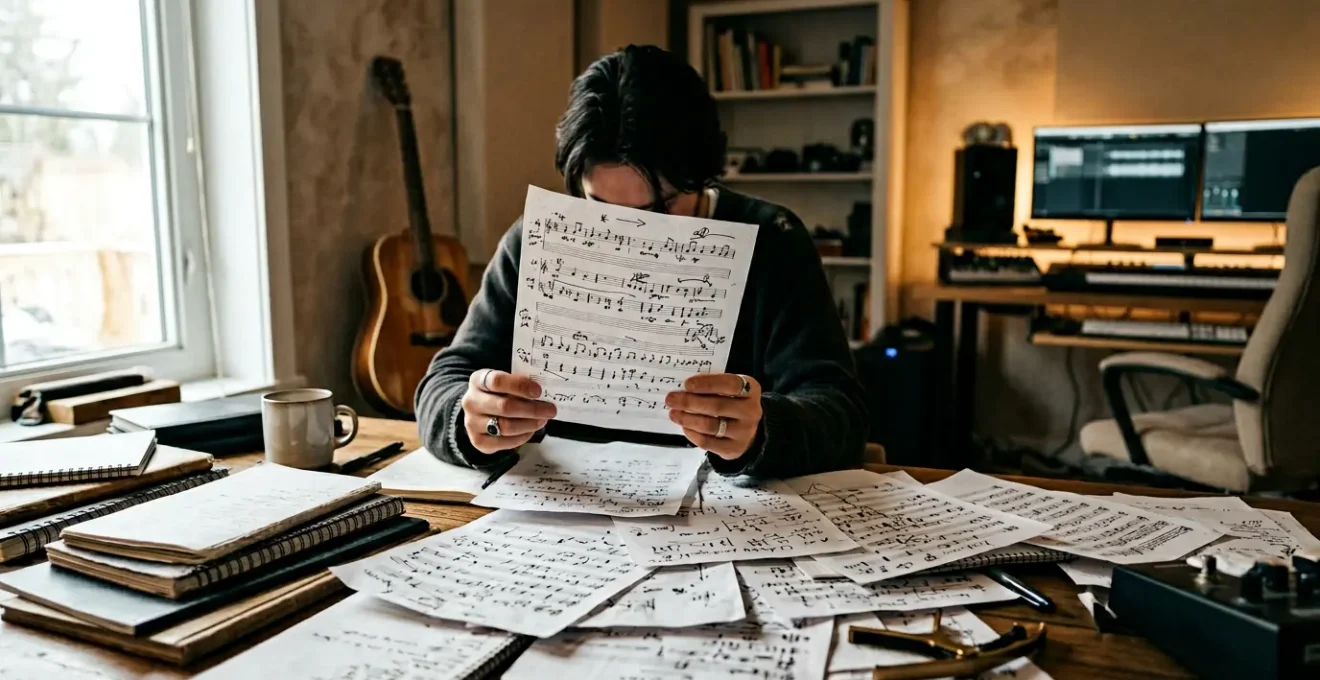
The biggest myth holding you back is that every song idea is precious; the professional reality is that songwriting is a manufacturing process where over 90% of the raw material is discarded to engineer a commercially viable product.
- Success requires a massive volume of output, with hitmakers often writing hundreds of songs for a single release.
- Ego is the enemy of progress; your best work emerges from ruthless self-critique and ego-free collaboration.
Recommendation: Stop treating your songs as diary entries and start evaluating them as assets. Apply objective quality filters to your catalogue today.
If you’re a songwriter, you know the feeling. An idea strikes, you chase it down, and after hours of work, a new song is born. It feels personal, a piece of you. The instinct is to protect it, to add it to your growing collection of completed works. But what if I told you that this instinct, the very pride you take in every finished song, is the single biggest barrier between you and a professional career? As a UK songwriter, you’re competing in one of the most crowded markets in the world. Simply writing and keeping everything isn’t a strategy; it’s a path to obscurity.
The common advice is to « write every day » and « build your catalogue. » While true, this advice misses the most critical step of the professional process: catalogue culling. The world of hit songwriting isn’t about gentle accumulation. It’s about aggressive, industrial-scale filtering. It’s about understanding that your first idea is rarely your best, and that your emotional attachment to a « finished » song is a liability, not an asset. The hitmakers you admire aren’t just more talented; they are more brutal with their own material.
This guide isn’t about making you feel better about your work. It’s about raising your standards to a professional level. We’re going to dismantle the hobbyist mindset and replace it with the disciplined framework that defines the craft. We will explore the staggering rejection ratio pros live by, the mechanics of ego-free collaboration, the hard financial truths of publishing deals, and why feeling « stuck » is often a symptom of holding on too tightly. It’s time to trade pride for progress.
To help you navigate this shift in mindset, this article breaks down the essential pillars of the professional songwriting process. From the raw numbers behind hit creation to the practicalities of earning a living, each section is designed to give you a clear-eyed view of the craft.
Contents: The Professional Songwriter’s Playbook
- Why Do Professional Songwriters Write 100 Songs for Every One That Gets Released?
- How to Write With Another Person Without Ego Killing the Session?
- Independent Songwriter or Publisher Deal: Which Path Earns More Long-Term?
- The Songwriting Pride That Prevents Your Best Songs From Reaching Audiences
- When Should a Songwriter Start Pitching to Publishers Versus Building More Catalogue?
- Why Do Songwriters With Fewer Tools Often Write Better Songs?
- Why Does One Stream Pay £0.003 While Another Pays £0.008 From the Same Platform?
- Why Does Your Songwriting Feel Stuck After Years of Writing the Same Way?
Why Do Professional Songwriters Write 100 Songs for Every One That Gets Released?
The title of this article mentions rejecting 90% of your ideas, but for many top-tier songwriters, that figure is optimistic. The reality of the music industry is a brutal numbers game that rewards volume and relentless quality control. Thinking of your work in terms of a « hit ratio » is fundamental. If you write ten songs and hope one is good enough, you’re operating on a hobbyist’s timeline. Professionals think in terms of hundreds of songs to find the handful of gems that will define a project or an artist’s career.
This isn’t about a lack of confidence; it’s a core business strategy. Every song written is a lottery ticket, and the more tickets you have, the better your chances. More importantly, this high output serves as a development tool. You don’t get good by writing ten perfect songs; you get good by writing 200 mediocre ones and learning from each. The process forces you to move past your first instincts, to solve creative problems faster, and to build a « muscle memory » for structure, melody, and lyrical efficiency. The goal is to make the act of creation so routine that you can focus your energy on the truly exceptional ideas.
The industry is built on this expectation. Publishers and A&R executives don’t want to see your three favourite songs; they want to see that you’re a reliable source of high-quality material. The harsh truth is that most songs, even good ones, will never find a home. In fact, according to industry data, professional songwriters typically see only about 1 out of every 1,000 songs they write get placed with a major artist. This rejection ratio isn’t a sign of failure; it’s the accepted cost of doing business at the highest level. It’s a filter that ensures only the most commercially viable and emotionally resonant work reaches the public.
How to Write With Another Person Without Ego Killing the Session?
If the key to a professional career is a high volume of work, then collaboration is the engine that drives it. Very few writers can sustain the required output alone. Co-writing brings fresh perspectives, fills skill gaps, and doubles the creative firepower in the room. However, it’s also a minefield for the unprepared ego. A productive session can quickly turn into a silent battle of wills, where protecting your own ideas becomes more important than serving the song. This is the fastest way to ensure mediocrity.
The golden rule was perfectly articulated by the legendary songwriter Marilyn Bergman, who advised to « Check your ego at the door. A songwriting session is a collaboration, not a solo write clothed in collaboration. » This means entering the room with the sole objective of creating the best possible song, regardless of whose idea « wins. » It requires a profound mental shift: you are not your ideas. An idea being rejected is not a rejection of you as a writer; it’s a collective decision that a different path serves the song better. This professional detachment is a skill that must be cultivated.
This is where clear communication and session etiquette become paramount. Before a single note is played, establish the ground rules. What is the goal for the song? Who is the target artist? Are we writing for a pitch or for one of the artists in the room? Use diplomatic language. Instead of « That chord is wrong, » try « What if we tried something more open-sounding there? » The goal is to build, not to demolish. A successful co-writing relationship is a partnership built on mutual respect and a shared understanding that the song itself is the only client you need to please.

Ultimately, a great co-write feels less like work and more like play. It’s about a shared sense of discovery, where two minds spark off each other to create something better than either could have produced alone. Learning to facilitate that environment is just as important as learning your craft.
Independent Songwriter or Publisher Deal: Which Path Earns More Long-Term?
Once you’re consistently producing high-quality work, the next question is how to monetise it. For a modern songwriter, the path generally forks in two directions: remain fully independent or sign a publishing deal. There’s a pervasive myth that going independent always leads to higher earnings because you keep 100% of your rights. While you do retain a larger percentage per stream, this view ignores the massive administrative burden and lack of industry leverage that comes with it. A publishing deal, in contrast, involves giving up a share of your copyright in exchange for an advance, administrative support, and access to a network of artists and opportunities.
The financial breakdown is the most critical factor. In a typical co-publishing deal (the most common for developing writers), you split the publisher’s share of the income with your publisher. This means you keep your writer’s share (50% of the total royalties) and half of the publisher’s share (25% of the total), for a total of 75%. The publisher takes the other 25% in exchange for their services. While this looks like you’re « losing » 25%, the publisher’s role is to generate opportunities (like sync placements and cuts with major artists) that you would likely never find on your own. Their 25% is often taken from a much larger pie they helped create.
Furthermore, the administrative side cannot be understated. Collecting all the royalties you’re owed is a complex, global task. In fact, research indicates that as much as 75% of global publishing royalties go uncollected, often because of improper song registration and a failure to track usage across different territories and platforms. A good publisher handles this complex administration, ensuring you get paid from sources you might not even know exist. For many, the value of a publisher lies not just in creative plugging but in expert financial management.
The choice ultimately depends on your goals and entrepreneurial spirit. As this detailed 10-year financial comparison shows, the trade-offs are significant. The independent path offers full control but requires immense business acumen, while a publishing deal offers access and administration at the cost of a percentage of your ownership.
| Revenue Stream | Independent Songwriter (100% ownership) | Co-Publishing Deal (75% retention) | Traditional Publishing Deal (50% retention) |
|---|---|---|---|
| Writer’s Share (Performance) | 50% | 50% | 50% |
| Publisher’s Share (Performance) | 50% | 25% | 0% |
| Total Performance Royalties | 100% | 75% | 50% |
| Mechanical Royalties | 100% | 75% | 50% |
| Sync Licensing Control | Full control | Shared approval | Publisher controlled |
| Upfront Advance | $0 | $15,000-$150,000 | $15,000-$500,000+ |
| Administration Burden | Full (DIY registration) | Shared | None |
| Industry Access | Limited | Moderate (A&Rs, co-writes) | Extensive (A-list artists, camps) |
The Songwriting Pride That Prevents Your Best Songs From Reaching Audiences
The greatest enemy of a promising songwriter is often not a lack of talent, but an abundance of pride. This « precious baby » syndrome, where every created song is treated as a flawless masterpiece that cannot be changed, is a creative death sentence. It prevents you from hearing objective feedback, makes you defensive in co-writing sessions, and, most damagingly, stops you from killing a song that isn’t working. You end up with a catalogue of songs you love personally but that have no chance of connecting with a wider audience or fitting the needs of a recording artist.
This pride manifests as a fear of rejection. You avoid pitching songs because a « no » feels like a personal slight. You resist a co-writer’s suggestion to change a lyric because it was inspired by a real-life event. As hit songwriter Jason Blume states, « The ability to withstand rejection—and even grow stronger from it—is crucial if we are to stay on the path to success. » This resilience is built by separating your self-worth from your creative output. A rejected song is not a rejected person; it’s a product that didn’t fit the market’s needs at that moment.
The cure for this pride is to reframe your role from « artist » to « craftsperson. » A craftsperson’s job is to deliver a product that meets a specific brief. They view their work with a degree of emotional distance, allowing them to make objective decisions in service of the final product. This mindset turns songwriting from a diary entry into an assignment.
Case Study: Taylor Swift and Liz Rose: Professional Detachment in Practice
A prime example of this is the early collaboration between a teenage Taylor Swift and veteran songwriter Liz Rose. Rose described her role not as a co-creator pouring her soul into the music, but as an editor. She moved things around, sharpened lyrics, and helped structure Swift’s raw, brilliant ideas into commercially viable pop-country songs. This professional detachment that, according to her co-writer Liz Rose, was key to their success, led to them writing 20 songs for Swift, including the Grammy-nominated « You Belong With Me. » They treated each song as an assignment, and the results speak for themselves.
Action Plan: Auditing Your Songs for Commercial Viability
- Points of Contact: List every channel where the song could be heard (demo, live, sync). Objectively rate the production quality and vocal performance for each. Is it « pitch ready » or just a sketch?
- Element Inventory: Collect and list the core components of the song: the main hook (lyrical and melodic), chord progression, song structure (e.g., V-C-V-C-B-C), and central lyrical theme.
- Coherence Check: Confront the song’s elements with your target artist or genre. Does the lyrical tone match the musical mood? Is the structure conventional enough for radio but unique enough to stand out?
- Memorability & Emotion: Play the hook for someone and ask them to sing it back 10 minutes later. Is it memorable? Does the core lyrical concept trigger a strong, clear emotional response or is it vague?
- Integration Plan: Identify the single weakest part of the song (e.g., a generic second verse, a clunky pre-chorus). Create a concrete plan to rewrite or replace it. If you can’t fix it, consider killing it.
When Should a Songwriter Start Pitching to Publishers Versus Building More Catalogue?
For many aspiring writers, the idea of getting a publishing deal is the ultimate goal. The allure of an advance and a team dedicated to getting your songs cut is powerful. This leads to a common mistake: pitching too early. Approaching a publisher with a small handful of songs, no matter how good you think they are, is often a waste of your one chance to make a first impression. Publishers aren’t just looking for good songs; they are investing in a writer who they believe can consistently deliver hits for years to come.
Before you even think about pitching, your focus should be on two things: quality and quantity. You need a catalogue, not just a few tunes. A solid benchmark is to have a folder of at least 10-15 « A-grade » songs that are fully produced (even if just with guitar/piano and vocals), professionally recorded, and clearly demonstrate your unique voice and versatility. This shows a publisher that you have the work ethic and creative stamina to succeed in the long term. It proves your first few good songs weren’t a fluke.
Moreover, your catalogue needs to reflect the reality of the modern music industry: collaboration. A publisher will want to see evidence that you can work well with others. If your entire catalogue consists of solo writes, it’s a red flag. It suggests you may lack the collaborative skills essential for writing camps and sessions with major artists. A Hit Songs Deconstructed report highlighted this reality, finding that nearly 90% of top 10 hits were written by two or more writers, with almost half being written by four or more. Your catalogue should include co-writes that demonstrate you can thrive in that environment.
The right time to pitch is when your catalogue becomes your calling card. It should be strong enough to speak for itself, proving not only your talent but also your work ethic, your collaborative spirit, and your understanding of the commercial market. When you can confidently say your body of work represents a reliable, professional-grade songwriting business, you’re ready to start the conversation.
Why Do Songwriters With Fewer Tools Often Write Better Songs?
In the age of digital audio workstations (DAWs) with infinite tracks and thousands of virtual instruments, it’s easy to believe that more tools lead to more creativity. However, the opposite is often true. Many songwriters find themselves paralysed by choice, spending hours searching for the perfect synth patch or drum sample instead of focusing on the core of the song: the melody, chords, and lyrics. This is where the power of creative constraint comes into play. By intentionally limiting your toolkit, you force yourself to be more inventive with the resources you have.
Think of the classic songwriters who crafted timeless hits with nothing more than an acoustic guitar or a piano and their voice. Stripped of production wizardry, they had to ensure the fundamental song itself was bulletproof. The structure had to be solid, the melody unforgettable, and the lyrics emotionally resonant. This minimalist approach fosters a deeper connection to the songwriting craft. It removes the temptation to hide a weak verse behind a complex arrangement or a boring chorus behind a wall of sound.

This isn’t an argument against technology, but a call to use it intentionally. Start the writing process with a limited palette. Write the entire song on one instrument. Once the core idea is strong and can stand on its own, then you can bring in the wider world of production to enhance it. This constraint often leads to a more playful and spontaneous creative process. As author and songwriting coach Robin Frederick notes, this freedom is essential: « Brute force can get you through a mediocre song, but coming up with the perfect inspired lyric idea…depends on a sense of freedom, risk taking, and, yes, playfulness. »
By giving yourself fewer options, you give your imagination more room to run. You stop being a sound designer and get back to being a songwriter. The best songs are born from great ideas, not from great software plug-ins.
Why Does One Stream Pay £0.003 While Another Pays £0.008 From the Same Platform?
For the modern songwriter, streaming is the primary source of long-term income, yet it remains shrouded in mystery. Seeing a royalty statement with wildly different per-stream rates can be confusing and frustrating. The truth is, not all streams are created equal. The payout for a single stream on a platform like Spotify or Apple Music is not a fixed rate; it’s a variable figure determined by a complex mix of factors. Understanding these variables is crucial for any writer looking to maximise their earnings.
The two most significant factors are the listener’s subscription type and geographical location. A stream from a premium, paid subscriber is worth significantly more than a stream from a user on a free, ad-supported tier. The ad revenue generated from a free user is simply lower than the subscription fee from a premium user. Similarly, a stream from a listener in a wealthy region like the US or Western Europe pays more than one from an emerging market. This is because subscription prices and advertising rates are higher in those territories. For example, data shows that Apple Music pays more per stream in the United States than in markets like India or Brazil.
Beyond these two primary drivers, other variables come into play. The specific deal your distributor has with the platform, the total revenue pool of the platform in a given month, and whether you are collecting both your master and publishing royalties all impact your final payout. An independent artist who owns 100% of their rights and has registered with all the correct collection societies (like PRS for Music and PPL in the UK) will see a higher effective rate than an artist signed to a label who has not.
This complexity can feel daunting, but it also presents an opportunity. By understanding the mechanics, you can make more strategic decisions about your marketing and administration to increase your average per-stream rate.
| Variable Factor | Lower Payout Scenario | Higher Payout Scenario | Impact on Rate |
|---|---|---|---|
| Subscription Type | Ad-supported free tier | Premium paid subscription | 2-3x difference |
| Listener Geography | Emerging markets (India, Brazil) | Wealthy regions (US, UK, EU) | Up to 5x difference |
| Revenue Model | Pro-rata pool system | User-centric payment | Fairer to niche artists |
| Distributor Deal | 70/30 split (platform/rights holder) | Direct deal with better terms | Variable retention |
| Rights Ownership | Shared with label/publisher | Independent (100% ownership) | Full vs. partial payout |
| Royalty Type | Master recording only | Master + Publishing combined | Additional 15-20% |
Key Takeaways
- Professional songwriting is a numbers game: high volume and ruthless filtering are the industry standard, not a sign of failure.
- Your ego is your biggest creative liability. Cultivate professional detachment and embrace ego-free collaboration to produce your best work.
- A publishing deal is not « selling out. » It’s a strategic partnership that trades a percentage of ownership for administrative support and crucial industry access.
Why Does Your Songwriting Feel Stuck After Years of Writing the Same Way?
Every songwriter eventually hits a wall. The chords start to sound the same, the lyrical themes feel recycled, and the initial spark of creativity feels distant. This feeling of being « stuck » is incredibly common, especially after years of writing in a particular style or with a specific process. It’s often a symptom of building comfortable habits that have now become creative ruts. Your brain has created such efficient neural pathways for your go-to methods that it struggles to venture into new territory.

Breaking out of this rut requires a conscious and deliberate effort to disrupt your routine. If you always write on guitar, spend a month writing only on a piano or with a drum loop. If you always start with a chord progression, force yourself to start with a lyrical concept or a melodic hook. If you always write alone, seek out a co-writer from a completely different genre. The goal is to introduce unfamiliarity and force your brain to solve problems in new ways. It will feel uncomfortable and inefficient at first, and that’s the point. Discomfort is the catalyst for growth.
This isn’t about abandoning what works, but about expanding your toolkit so you have more options when you feel a block coming on. It’s about treating your craft like any other high-performance skill. As Keppie Coutts and Ben Romalis from the « How To Write Songs » channel state, « Our belief, having worked with thousands of songwriters…is that your songwriting, like all things, can get better with meaningful and deliberate practice. » This means your practice must have a purpose. It’s not just about writing another song; it’s about writing a song with a specific, challenging goal in mind.
Feeling stuck is not a sign that your talent has run out. It’s a signal that your process has become too comfortable. It’s an invitation to challenge yourself, to get playful, and to remember that the core of songwriting is discovery.
The journey from an aspiring writer to a professional one is a transformation of mindset. It’s about learning to treat your creativity as a muscle that needs disciplined, consistent, and strategic training. Start today by applying these professional standards to your own work and your own catalogue.