
The frustrating gap between your technical skill and your musical expression doesn’t come from a lack of knowledge, but from practising the wrong things in the wrong order.
- Musicality is not built by accumulating scales and patterns, but by internalising rhythm and melody on a physical, subconscious level.
- Focusing on speed and complexity often impresses other musicians but fails to create the emotional connection that truly captivates an audience.
Recommendation: Shift your practice priority from ‘what notes to play’ to ‘how and when to play them’. Start by improvising with a single note, focusing entirely on rhythm and feel.
There’s a deeply frustrating moment in every skilled instrumentalist’s journey. You’ve spent thousands of hours honing your craft. You can play faster, cleaner, and more complex lines than ever before. Yet, you listen back to a recording and your solo sounds… sterile. It sounds like a well-executed exercise, a string of impressive but disconnected patterns. Then you hear another player, someone with perhaps half your technical facility, play a slow, simple phrase of just three or four notes, and it’s devastatingly beautiful. It tells a story. Why does their playing feel so profound while yours feels so mechanical?
The common advice is often to learn more scales, more arpeggios, more theory. We’re told that the path to improvisational freedom is paved with an ever-expanding library of harmonic knowledge. We diligently collect licks and patterns, hoping that by having more options, we’ll magically start sounding more musical. But this approach often makes the problem worse, adding more calculations for our conscious brain to juggle and pulling us further away from the raw, emotional core of the music.
What if the entire premise is flawed? The truth is that musicality isn’t an intellectual pursuit; it’s a physical and intuitive one. The goal isn’t to think *more* during a solo, but to arrange your practice so you can think *less*. This isn’t about abandoning technique, but re-contextualising it. Technique should be the servant of your musical ideas, not the master of them. It’s the tool you use to say what you hear in your head, not a script you read from memory.
This guide will deconstruct the common mistakes that lead to robotic playing and provide a clear, hierarchical path to developing genuine musicality. We will explore how to internalise vocabulary instead of just memorising it, why your ear is a more important tool than your eyes, and how the artful placement of a single note can communicate more than a torrent of fast licks. It’s time to bridge the gap between your fingers and your soul.
To navigate this transformation, this article is structured to guide you from the mental approach to the practical application. The following sections break down the core components of soulful improvisation, offering a clear roadmap to finding your own voice.
Summary: Unlocking Musical Expression Beyond Technical Drills
- Why Does « Thinking Less » Often Produce Better Solos Than « Thinking More »?
- How to Learn Jazz Vocabulary Without Sounding Like You’re Playing Memorised Licks?
- Transcribing by Ear or From Scores: Which Builds Better Solo Skills?
- The Technical Solo Mistake That Impresses Musicians but Loses Audiences
- In What Order Should You Develop Solo Skills for Genuine Improvisational Freedom?
- Why Does Playing Exactly What’s Written Sound Nothing Like the Recording?
- How to Make a Single Blue Note Communicate More Than a Dozen Fast Licks?
- Why Does Your Swing Playing Sound Stiff Despite Using the « Correct » Rhythms?
Why Does « Thinking Less » Often Produce Better Solos Than « Thinking More »?
The paradox of masterful improvisation is that it emerges not from intense, real-time calculation, but from a state of deep, non-analytical immersion. When a player is « in the zone, » they aren’t consciously thinking, « Okay, the chord is now G7, so I should use the G mixolydian scale and target the third. » Instead, they are reacting intuitively to the sound, guided by an internal sense of melody and rhythm. This state, often called « flow, » is characterised by a quieting of the prefrontal cortex—the part of the brain responsible for self-monitoring and analytical thought. A state of flow is associated with increased alpha and beta brain wave activity, indicating a mind that is relaxed yet alert, not one that is grinding through theoretical permutations.
This is why « thinking more » during a solo is often counterproductive. Every moment spent on conscious analysis is a moment not spent on deep listening and authentic reaction. The analytical brain is slow and cumbersome compared to the lightning-fast connection between your ear and your hands. As guitar educator Tom Hess notes, this transition from conscious thought to intuitive action is a hallmark of mastery:
Great guitar players think very little about anything except the music they want to play. As they develop their skills, they stop having to think about much of what amateur guitar players have to think about.
– Tom Hess, Guitar improvisation instruction
The goal of practice, therefore, is not to get better at thinking on your feet. The goal is to train your ears, hands, and rhythmic sense to a point where conscious thought becomes unnecessary. You build the foundational « Ear-to-Hand Connection » so thoroughly that your instrument becomes a direct extension of your musical imagination. Thinking less isn’t about being lazy; it’s the ultimate achievement of deep, internalised practice, where the analytical mind can finally get out of the way and let the music speak.
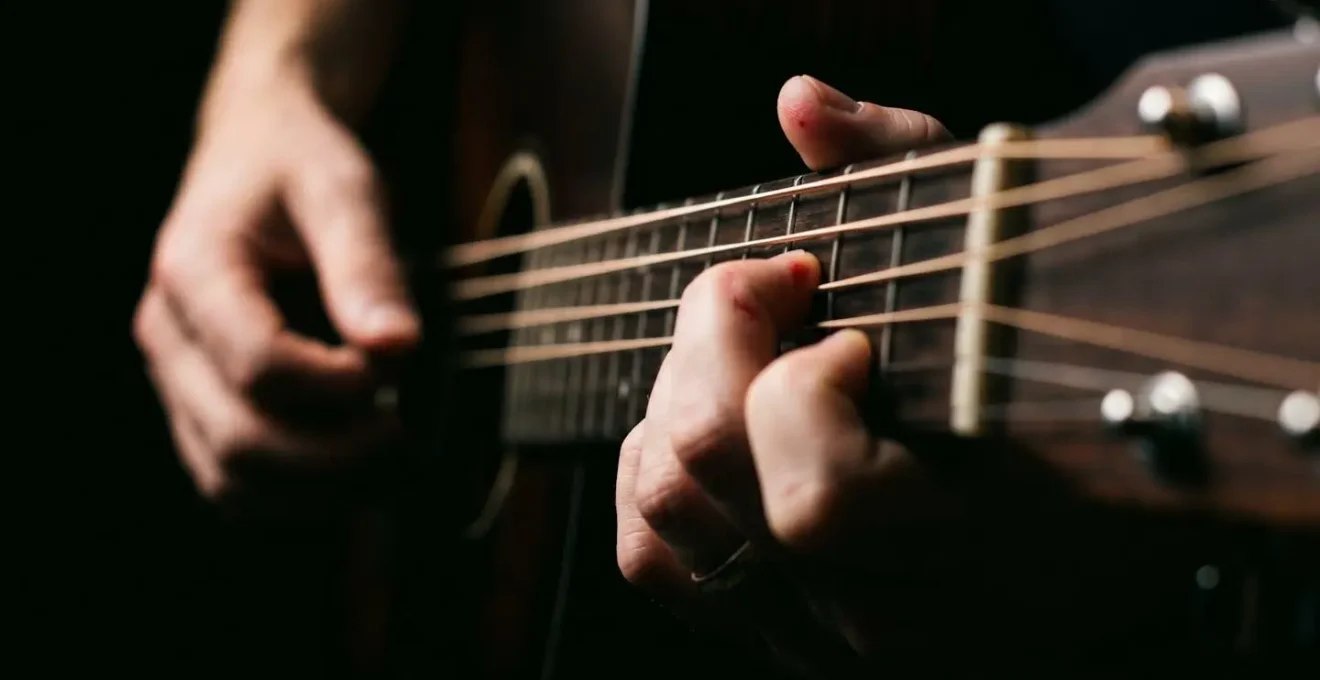
This mental shift is the foundation for everything else. You cannot sound free if your brain is trapped in a cage of self-correction and theoretical analysis. Your practice time is for building the reflexes and internalising the sounds, so your performance time can be for pure, uninhibited expression.
How to Learn Jazz Vocabulary Without Sounding Like You’re Playing Memorised Licks?
One of the biggest traps for aspiring improvisers is the belief that learning vocabulary means collecting and regurgitating licks. You meticulously learn a Charlie Parker phrase, practise it in all twelve keys, and then wait for the right moment in a solo to « plug it in. » The result often sounds forced and disconnected because you’ve memorised a pattern, not internalised a piece of language. It’s the musical equivalent of learning a phrase from a foreign travel guide and dropping it into a conversation—it might be grammatically correct, but it lacks context and authentic inflection.
To make vocabulary your own, you must treat it like a linguist, not a parrot. This means deconstructing a phrase to understand its essence. Don’t just learn the notes; analyse its components. What is its rhythmic character? Where does it sit in relation to the beat? What is its melodic shape or contour? What is its harmonic function—how do the notes relate to the underlying chord? When you break a phrase down into these smaller, conceptual pieces, you move beyond rote memorisation.
The next crucial step is to internalise it through your ear and voice. Before you even touch your instrument, can you sing the phrase accurately? Singing forces you to truly *hear* the intervals and rhythms, creating a much deeper neurological imprint than simply memorising a finger pattern. Once you can sing it, you can truly own it. From there, the key is re-contextualisation. To break the lick’s original identity, you must experiment with it relentlessly:
- Change its starting beat.
- Alter its rhythm from eighth notes to triplets.
- Apply it over a completely different chord or a different part of the form.
- Combine a fragment of the phrase with your own improvised ideas.
This process transforms a static « lick » into a dynamic and flexible conceptual tool. You’re no longer just quoting another player; you’re using a piece of their language to express your own ideas. It’s the difference between reciting a line of Shakespeare and understanding the meaning behind the words so you can use them in your own sentences.
Transcribing by Ear or From Scores: Which Builds Better Solo Skills?
In the quest to build vocabulary, players often face a choice: spend hours painstakingly figuring out a solo by ear, or simply find a pre-written transcription online or in a book. While using scores can seem like an efficient shortcut, it bypasses the single most important skill-building process in a musician’s development: ear training. Relying on written music is like asking for directions instead of learning to read a map—it gets you to one destination, but it doesn’t equip you for future journeys.
Transcribing by ear is a full-spectrum workout for your musical mind. It’s a slow, often frustrating process, but the benefits are immense. Each time you rewind a short phrase, trying to decipher a note or a rhythm, you are actively strengthening the critical pathways between what you hear and what you understand. This process develops multiple, interconnected skills simultaneously: interval recognition, rhythmic acuity, and an intuitive grasp of phrasing and articulation. In fact, research cited by music educator Robert Woody found that of all musical skills, playing by ear was the only one that contributed to the development of all others, including improvising and sight-reading.
When you learn from a score, you are primarily engaging in a visual-to-motor exercise. You see a dot on a page and your brain tells your fingers where to go. While this has its place, it doesn’t guarantee that you have truly *heard* or internalised the music. The ear-to-hand connection is a fundamentally different and more powerful pathway. When you learn by ear, you first internalise the sound, then you hunt for it on your instrument. This search is the training. The moment you find the right note, you create a permanent, visceral link between the sound in your head and the physical action required to produce it.
Scores are a useful tool for analysis *after* you have done the hard work of transcribing by ear. They can help you confirm a tricky passage or understand the harmonic theory behind a line you’ve learned. But they should never be the starting point. The struggle is the point. Every minute you spend developing your ear is a direct investment in your long-term improvisational freedom, building a foundation that will serve you far more than a library of memorised sheet music ever could.
The Technical Solo Mistake That Impresses Musicians but Loses Audiences
There is a type of solo, dense with notes and blazing with speed, that is built to impress. It’s a dazzling display of technical command, full of intricate patterns, substitute harmonies, and blistering scalar runs. Other musicians in the room might nod in appreciation, recognising the difficulty and the hours of practice behind it. But for the average listener, this kind of playing can feel alienating. It can come across as an athletic event rather than an artistic statement—a conversation the musician is having with themselves, with the audience as a mere bystander.
The mistake is prioritising informational density over communicative density. Informational density is about how many notes, chords, and theoretical concepts you can cram into a chorus. Communicative density, on the other hand, is about how much emotion, story, and meaning you can imbue into a single phrase, or even a single note. A technically complex solo is impressive. A communicatively dense solo is moving. It creates a connection.
This connection is what most audiences crave. They want to feel something. As researcher Pauliina Haustein discovered when studying audience engagement during improvisation:
Audience members described feeling like they became part of the creativity themselves when witnessing improvisation and authentic risk-taking, experiencing intense increases in empathy and support. They gained access to a deeper level of meaning and accessibility to the musical experience.
– Pauliina Haustein, Audience engagement research
This « deeper level of meaning » is rarely found in the fastest passages. It’s found in the spaces between the notes, the vocal-like cry of a bent string, the tension of a held note, and the satisfying release of a simple, melodic phrase. These are the moments that feel human and vulnerable. While technical virtuosity can be exhilarating, it’s the moments of authentic, melodic communication that make an audience lean in and listen with their heart, not just their ears. The goal isn’t to dumb down your playing; it’s to use your technique to serve the story, not to be the story itself.
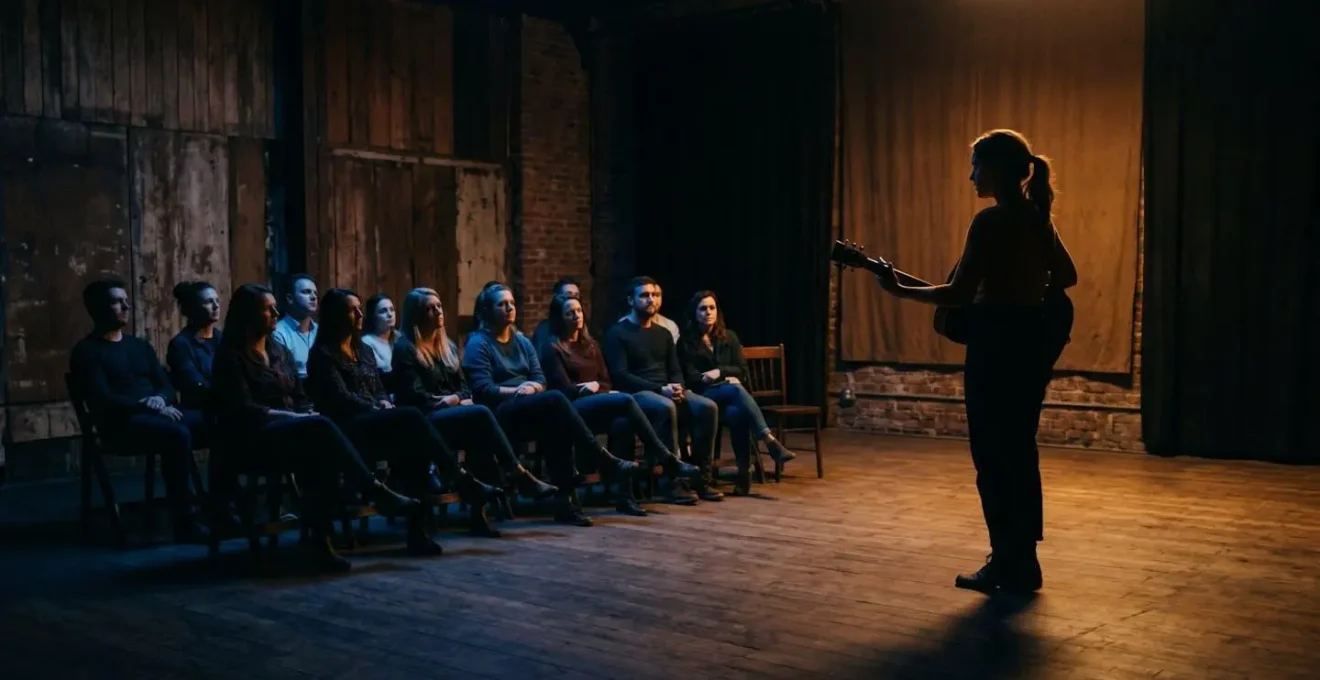
The most respected improvisers understand this balance. They possess the facility to play anything they can imagine, but they have the taste and wisdom to choose the notes that will connect most deeply. They know that sometimes, the most powerful thing you can play is nothing at all.
In What Order Should You Develop Solo Skills for Genuine Improvisational Freedom?
The path to musical improvisation is often taught backwards. Students are loaded up with scales, arpeggios, and harmonic theory before they have developed a fundamental sense of rhythm or melodicism. This « bottom-up » approach produces players who are harmonically correct but musically stiff. To develop genuine freedom, you must reverse this priority, adopting a « top-down, » music-first hierarchy where feel and phrasing are the foundation upon which all other skills are built.
Instead of starting with the question « What notes can I play over this chord? », the first question should be « Where can I place a note to make it feel good? ». This re-frames the entire process, prioritising the two most elemental and communicative aspects of music: rhythm and melody. Technique and theory are not ignored; they are introduced later as tools to better execute the musical ideas you are already beginning to hear and feel. This approach ensures that your playing is always grounded in musicality.
This hierarchy puts the horse back in front of the cart, ensuring that every technical skill you learn has an immediate musical purpose. You learn to play fast not for the sake of speed, but because you hear a fast, exciting phrase in your head that you need to execute. You study harmony not as an abstract set of rules, but to understand why a certain note you discovered by ear sounds so beautiful against a particular chord. This transforms practice from an academic exercise into a creative exploration. Your technical development becomes a direct response to your growing musical imagination.
This method requires patience and a willingness to sound « simple » at first. But by building your house on the solid ground of rhythm and melody, you ensure the entire structure is sound. The freedom you gain will be authentic, not a cheap imitation built on a foundation of memorised patterns.
Your Action Plan for Genuine Improvisational Freedom
- Start with Rhythm & Phrasing (The ‘when’ and ‘how’): Begin by improvising using only one note, focusing entirely on rhythmic placement and dynamic variation to build musicality before complexity.
- Develop Melody & Storytelling (The ‘what’): Expand to three-note improvisations, concentrating on creating memorable, singable phrases rather than running scales.
- Add Harmony Understanding (The ‘why’): Study chord functions and relationships only after you can already create compelling melodic statements, so theory serves your musical ideas.
- Build Technique as Enabler (The ‘how’ refined): Develop technical facility specifically to execute the musical ideas you already hear, using technique as a tool rather than the end goal.
- Practice the Listen-Sing-Play Loop: For any new concept, first internalize the sound by listening, then prove comprehension by singing it, finally find it on your instrument.
Why Does Playing Exactly What’s Written Sound Nothing Like the Recording?
For any musician who has tried to learn a solo from a score, the experience is familiar. You play every note and every rhythm exactly as written, but when you compare it to the original recording, something is profoundly missing. The life, the feel, the soul of the performance seems to have vanished. This isn’t because you are playing it « wrong »; it’s because musical notation, for all its brilliance, is a fundamentally limited technology. It’s a low-resolution snapshot of a high-fidelity event.
The most crucial elements of musical expression—particularly in genres like jazz and blues—exist in the microscopic details that notation cannot efficiently capture. These are the « in-between » things that give music its human quality. Think of micro-timing variations that create a swing feel, the subtle « ghost notes » that are felt more than heard, the infinite timbral variations from changing your pick attack, and the dynamic nuances within a single phrase. A score can tell you *what* note to play and *when*, but it can rarely tell you *how*. As one music education analysis puts it:
Sheet music is an incredible technology, but it has to discard data to be efficient. The data it discards is the ‘feel’: micro-timing, ghost notes, timbral variations, and dynamic nuances. The recording is the uncompressed, high-fidelity file.
– Music education analysis, Transcription methodology discussion
This is why the recording is always the primary text, and the score is, at best, a secondary reference. The recording contains 100% of the musical information. The score contains perhaps 70%. To truly understand and internalise a piece of music, you must immerse yourself in the sound. Relying on notation alone is like trying to appreciate a masterpiece painting by looking at a black-and-white sketch of it.
This reinforces the critical importance of ear training. When you learn directly from a recording, you are forced to engage with all the rich, nuanced data that a score leaves out. You internalise not just the notes, but the articulation, the tone, and the rhythmic pocket. Your goal is to replicate the *sound*, not just the written instructions, which is the only way to capture the true spirit of the performance.
How to Make a Single Blue Note Communicate More Than a Dozen Fast Licks?
The true measure of a soloist’s maturity is not how many notes they can play, but how much meaning they can pack into one. A single, perfectly placed, and expressively articulated note can convey more emotion—longing, joy, anger, or despair—than a frantic, 32-note flurry. This is the principle of « communicative density. » It’s about making every note count, transforming it from a mere pitch into a miniature event. A classic « blue note, » with its inherent tension and vocal quality, is the perfect vehicle for this kind of expression.
Making a single note impactful is an art of nuance and control. It’s not just about the note itself, but everything that surrounds it. You must consider the entire life cycle of the note, from its birth to its decay. This involves a conscious shaping of its character through articulation and phrasing. For example, a slow, deliberate bend *into* the note creates anticipation and drama. A hard pick attack lends it urgency, while a soft touch can imply vulnerability. Adding a wide, slow vibrato makes the note « sing, » mimicking the expressiveness of the human voice.
Sustain and release are just as critical. By holding a note and letting its harmonic tension linger against the underlying chord, you create a psychological need for resolution in the listener. Resisting the urge to immediately fill the space with more notes is a sign of immense confidence and taste. The way you *leave* the note—either by resolving it cleanly to a stable chord tone or by letting it hang unresolved—is the final part of its story. This careful attention to detail is what separates a player who is just hitting notes from one who is making music.

This « less is more » approach is the ultimate antidote to sterile, technical playing. It forces you to focus on the core elements of musical communication: tone, time, and touch. Mastering the anatomy of an impactful note will give you a tool of far greater power than any scale pattern. It’s a direct path to sounding soulful, because it’s a direct path to making your instrument sing.
Key Takeaways
- True improvisational skill comes from internalising sound and feel, not from accumulating theoretical knowledge.
- Prioritise ear training over reading scores; the recording is the definitive source of musical information, including crucial nuances of feel and articulation.
- Musicality is built from the ground up: start with rhythm and melody, then use technique and harmony as tools to express your ideas.
Why Does Your Swing Playing Sound Stiff Despite Using the « Correct » Rhythms?
Many diligent musicians, particularly those with classical or rock backgrounds, struggle with swing rhythm. They learn the theory—that swing eighth notes are often approximated as a triplet figure—and they practice with a metronome, yet their playing remains stiff and unconvincing. It lacks the buoyant, infectious pulse that defines authentic swing. The problem is that swing feel is not a mathematical formula to be calculated; it’s a physical, full-body feeling to be internalised. It’s more of a dance than an equation.
Stiff swing often originates from a metronomic, top-down approach where time is rigidly subdivided. As one jazz pedagogy analysis notes, it often stems from generating rhythm from small muscles, a habit common in classically-trained musicians. Authentic swing, however, is a « full-body, dance-like pulse. » It’s a feeling that starts from your core and extends through your limbs. Great swing players don’t just *play* in time; they *embody* the time. They feel the pulse in their shoulders and hips. Their lines dance around the beat, sometimes pushing ahead, sometimes laying back, but always connected to that fundamental, elastic pulse.
Furthermore, the idea of a fixed swing ratio is a myth. As jazz rhythm research demonstrates that, the ratio between the long and short eighth notes is a fluid continuum. It changes dynamically with tempo. At very fast tempos, the eighth notes become almost even, while at slower tempos, the « swing » becomes much more pronounced and laid-back. A player who applies a rigid 2:1 triplet ratio to every tempo will inevitably sound stiff and unnatural.
The solution is to move from counting to feeling. Practice by listening deeply to the great masters of swing and trying to absorb their rhythmic feel. Tap your foot, bob your head, and feel the pulse physically. Try playing along with recordings without a metronome, focusing solely on locking in with the rhythm section’s groove. This process of rhythmic embodiment is essential. You must internalise the feel of swing so deeply that it becomes as natural as breathing. Only then will your playing lose its stiffness and gain the effortless, forward momentum that makes people want to move.
By shifting your focus from intellectual knowledge to intuitive feel—from the brain to the body, from the eyes to the ears—you begin the real journey toward musicality. The first step on this path isn’t to learn another scale, but to pick up your instrument and explore the profound power of rhythm, starting with just one note. This is the foundation upon which all truly great solos are built.