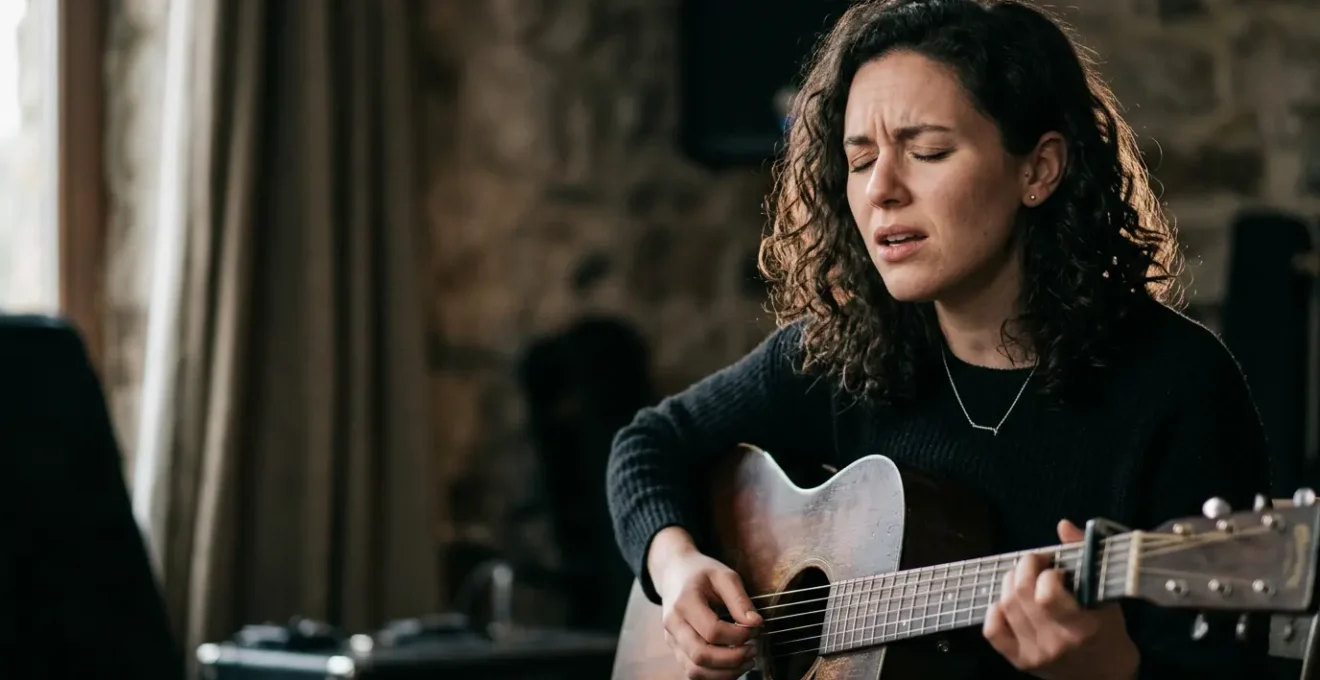
Many songwriters believe dynamics make a ballad captivating. The truth is, the most moving slow songs master internal motion and psychoacoustic intimacy. It’s not about getting louder, but about creating a feeling of progression and closeness through subtle harmony, vocal technique, and arrangement choices, turning stillness into an intense emotional journey for the listener.
You’ve written a ballad from the heart. The lyrics are honest, the melody feels right, but when you play it, the energy just drains from the room. Listeners get restless. The song doesn’t connect; it plods. We’ve all been there, pouring emotion into a slow song only to find it feels static and heavy, rather than intimate and moving. The standard advice is often to « add more dynamics » or « sing with more feeling, » but this rarely solves the core problem and can even make the performance feel forced.
These well-intentioned tips miss the fundamental point. They treat a ballad’s slowness as a weakness to be overcome with volume, rather than a strength to be harnessed. But what if the secret to a captivating ballad has less to do with how loud or soft it is, and more to do with the subtle, invisible forces that create a sense of movement and closeness? The real art lies not in fighting the tempo, but in mastering the concepts of internal motion and psychoacoustic intimacy.
This guide will deconstruct the mechanics of emotionally effective ballads. We will explore why the best slow songs feel like they are constantly evolving, how to create a vocal performance that feels like a private conversation, and how to use harmony and arrangement to build a world of feeling that listeners won’t want to leave. It’s time to stop writing songs that drag and start crafting ballads that breathe.
To navigate this deep dive into the art of the ballad, the following sections will break down each critical component. We will move from the foundational theory of emotional pacing to the specific techniques you can apply in your songwriting, production, and performance today.
Contents: A Guide to the Moving Ballad
- Why Do the Best Ballads Feel Like They’re Moving Even When They’re Slow?
- How to Sing a Ballad So It Feels Like You’re Speaking Directly to Each Listener?
- Sparse or Orchestrated: Which Production Approach Serves Your Ballad Better?
- The Ballad Mistake That Crosses From Emotional to Cheesy
- Where in an Album or Set Does a Ballad Create Deepest Connection?
- How to Write a Major Key Song That Makes People Cry Instead of Smile?
- How to Develop Dynamic Control So Subtle That Listeners Feel Without Noticing?
- Why Do All Your Major Key Songs Sound Cheesy Instead of Joyful?
Why Do the Best Ballads Feel Like They’re Moving Even When They’re Slow?
The core paradox of a great ballad is that it achieves a sense of momentum without speed. This feeling, which we can call internal motion, doesn’t come from the tempo. It comes from the masterful manipulation of harmonic tension, rhythmic phrasing, and lyrical development. A dragging ballad is often harmonically static; it sits on a few comfortable chords and repeats them without a sense of purpose. A captivating ballad, however, uses its chord progression to tell a subconscious story of departure and return, creating an engine of emotional forward momentum.
Think of it as a slow, deliberate walk. The pace is unhurried, but each step takes you somewhere new. In music, each chord change is a step. When a progression feels like it’s resolving, only to introduce a new, unexpected chord, the listener’s brain is pulled along, eager to find out where the journey leads. This is why psychoacoustics plays such a vital role. As one team of researchers on music production notes, our perception of rhythm and timing is highly influenced by context and expectation. A great ballad sets up expectations and then artfully plays with them, making the listener an active participant in the emotional journey.
Furthermore, this sense of movement is reinforced when the rhythm of the vocal or lead instrument works in gentle contrast to the underlying beat. A singer who phrases a line just slightly behind the beat creates a feeling of longing or contemplation—a soulful drag. One who pushes just ahead creates urgency and anticipation. These subtle variations are the invisible currents that prevent the song from feeling like a stagnant pond. Ultimately, research confirms that slower tempos can actually improve listener focus, whereas fast music can sometimes just increase emotional agitation. A ballad that masters internal motion uses its slowness to draw you in, not push you away.
How to Sing a Ballad So It Feels Like You’re Speaking Directly to Each Listener?
A ballad’s ultimate power is its intimacy. To achieve this, the performance must create the illusion that the singer is in the room with the listener, sharing a secret. This is psychoacoustic intimacy, and it’s a technical craft, not just an abstract emotion. The most crucial tool for this is the microphone and how you use it. Working closer to the microphone engages a physical phenomenon known as the « proximity effect, » which boosts the low-end frequencies of the voice, adding warmth, depth, and a sense of closeness.
This technique transforms the voice from a distant proclamation into a confidential whisper. The goal is to capture the subtle, imperfect sounds of human presence: the slight intake of breath, the soft texture of the consonants, the quiet resonance of the chest. These are the sounds we only hear when someone is very near to us. When captured in a recording, they trigger a subconscious feeling of closeness in the listener. Professional recording guidance confirms this, noting that positioning a vocalist 15-20 centimeters from a cardioid microphone yields a 3-6dB boost in the warm 100-200Hz range.
To leverage this, you must think of the microphone not as a tool for amplification, but as an ear you are speaking directly into. The image below captures this precise, intimate relationship between performer and microphone.

As you can see, the focus is on proximity. This isn’t about singing loudly; it’s about controlling your delivery at a close distance. It requires immense breath control and a shift in mindset. Instead of projecting to the back of a hall, you are confiding in one person. This means your dynamics come from subtle shifts in vocal texture and breath pressure, not just volume. By mastering this technical intimacy, your vocal performance stops being a public broadcast and becomes a private, unforgettable conversation.
Sparse or Orchestrated: Which Production Approach Serves Your Ballad Better?
Once you have a compelling song and an intimate vocal, the arrangement must be built to support it. The choice between a sparse arrangement (e.g., just piano and voice) and a fully orchestrated one is not a matter of right or wrong, but a strategic decision about textural density. This density should directly serve the song’s emotional narrative. Does the story move from isolation to connection? From quiet vulnerability to a powerful declaration? Your arrangement should mirror this arc.
A common mistake is to simply add instruments in each section to « build » the song. This can feel formulaic and emotionally blunt. A more sophisticated approach uses texture to control the emotional space. A sparse arrangement creates vast negative space, forcing the listener to lean in and focus on every nuance of the lyric and vocal. It’s the sound of vulnerability and raw honesty. A dense, orchestrated arrangement, by contrast, can create a feeling of being overwhelmed by emotion—love, grief, or grandeur. It’s a sonic embrace that envelops the listener.
As sound designer Myk Eff explains in his overview on orchestration, this is a core principle of effective arrangement. He states, « The manipulation of texture and density is crucial in orchestration for creating contrast and dynamic flow within a piece. A piece might start with a sparse texture, gradually building in density as more instruments enter. » The key is that every added element must have a purpose. Ask yourself: does this string pad add emotional weight, or does it just fill a frequency? Does this extra guitar line enhance the story, or does it distract from the vocal? Silence and space are instruments, too; use them wisely.
Your Action Plan: Auditing Your Ballad’s Arrangement
- Points of Contact: List every instrument and sound in your current arrangement, from the lead vocal to the quietest synth pad. Where does the listener’s ear focus?
- Collecte: For each part, identify its primary role. Is it providing harmony, rhythm, melody, or atmospheric texture?
- Cohérence: Compare the arrangement’s density to your lyrical narrative. Does the texture support the emotion of each section (e.g., sparse for intimacy, dense for overwhelming feeling)?
- Mémorabilité/émotion: Identify which elements are truly essential versus which are « filler. » Does removing an instrument make the song feel empty or more powerful?
- Plan d’intégration: Create a revised arrangement map. Decide where to introduce, remove, or change instruments to better serve the song’s emotional arc, using silence as a deliberate tool.
The Ballad Mistake That Crosses From Emotional to Cheesy
There is a fine line between a ballad that is emotionally resonant and one that feels cheesy or sentimental. The difference rarely lies in the emotion itself, but in its presentation. « Cheesiness » is often the result of predictability and a lack of nuance. It happens when a songwriter relies on well-worn musical clichés—the overly breathy vocal, the predictable I-V-vi-IV progression, the synth string patch from a 1990s keyboard—instead of digging for an authentic, specific expression of feeling.
Authenticity feels earned. It embraces imperfection and specificity. A perfectly polished, auto-tuned vocal singing generic platitudes about love is far less moving than a slightly flawed voice telling a highly specific, personal story. The emotional power is in the details, the cracks, the humanity. This is why a simple, slightly out-of-tune upright piano can carry more emotional weight than a pristine, multi-thousand-pound grand piano sample library. The former has character and history; the latter is a perfect but sterile imitation.
This principle is captured in the image below, where the worn, imperfect keys suggest a history of real use and authentic expression, not manufactured perfection.

To avoid the « cheese » trap, you must challenge your first instincts. If your melody feels too sweet, add a dissonant note. If your lyric feels too general, replace it with a concrete image. If your production sounds too glossy, introduce an element that is more raw and organic. The goal is not to be sad or dramatic for its own sake, but to be honest. True emotion is complex; it’s a mix of joy and sorrow, hope and fear. A ballad that only expresses one simple, primary-colour emotion will almost always feel less genuine than one that acknowledges this beautiful, messy complexity.
Where in an Album or Set Does a Ballad Create Deepest Connection?
Even the most powerful ballad can have its impact diminished if it’s poorly placed. The sequencing of a live set or an album is a critical, often overlooked, part of a song’s emotional architecture. Placing a ballad is not about simply alternating fast and slow songs; it’s about creating a narrative arc that guides the listener’s emotional energy. A strategically placed ballad acts as an anchor, a moment of profound focus that can redefine the entire listening experience.
Rather than thinking of a ballad as a « breather » or a « low energy » moment, consider it a moment of maximum intimacy. Its power is magnified by what comes before and after it. Two classic strategies, often used by professional producers and arrangers, highlight this principle perfectly. They show how contrast and anticipation can be used to make a ballad the emotional centerpiece of a collection of songs.
Case Study: Strategic Ballad Placement for Emotional Impact
Professional arrangers emphasize that song sequencing should prioritize a narrative arc. One powerful technique is to place a ballad immediately after the most energetic track. This creates a « vacuum effect » where the sudden drop in energy and volume forces the audience to recalibrate their attention, pulling them into the song’s intimate space with heightened focus. A second, equally effective strategy is placing the ballad as the penultimate track (second-to-last). In this position, the ballad carries the weight of a final, profound statement before the album’s or set’s resolution. It becomes the emotional core that the entire project has been building towards, leaving a lasting, contemplative impression on the listener.
Both of these strategies use the ballad not as a pause, but as a pivot. They leverage its inherent intimacy to create a moment of deep connection that makes the surrounding songs more meaningful. By thinking about your setlist or album tracklist as a story, you can ensure your ballad lands with the full force of its intended emotion, creating an unforgettable moment for your audience.
How to Write a Major Key Song That Makes People Cry Instead of Smile?
The common wisdom is that major keys are « happy » and minor keys are « sad. » While there’s a basic truth to this, it’s a vast oversimplification. Some of the most heartbreaking songs in history are written in major keys. The secret to achieving this emotional depth is to introduce complexity and subvert the listener’s expectations. A song in a major key that only uses the primary I, IV, and V chords will almost always sound cheerful and straightforward. The tears are found in the chords that live on the fringes.
The key is to borrow from the parallel minor key or to lean heavily on the « secondary » chords within the major scale: the ii (minor), iii (minor), and vi (minor) chords. The vi chord, in particular, is the relative minor and acts as a gateway to melancholy. A progression that moves from the tonic (I) to the relative minor (vi) feels like a sudden moment of doubt or reflection, a cloud passing over the sun. This technique creates a feeling of « bittersweetness » or nostalgia, which is often more emotionally complex and profound than pure sadness.
As experts from Native Instruments point out, « Chord progressions play a significant role in the emotional impact of music, going far beyond simple ‘happy’ major chords and ‘sad’ minor chords. » This emotional nuance is also supported by science. A 2023 psychological research study found that while happy musical elements don’t necessarily promote a « groove, » sad elements actively suppress it. By weaving these « sad » minor chords into a major key progression, you disrupt the cheerful, danceable feel, forcing a more contemplative and emotional response from the listener. Add a slower tempo and a lyrical theme of loss or longing, and you have the recipe for a major key song that is deeply moving.
How to Develop Dynamic Control So Subtle That Listeners Feel Without Noticing?
When most musicians think of dynamics, they think of volume: playing or singing louder or softer. But in a ballad, the most powerful dynamics are often the ones the listener feels without consciously registering. This is the art of micro-dynamics—subtle, nuanced shifts in timbre, timing, and pressure that create emotional texture. It’s the difference between a performance that is technically correct and one that feels truly alive.
This level of control moves beyond simple volume changes and into the very fabric of the sound. Instead of just getting louder for a chorus, a singer might shift their vocal resonance from a breathy head voice to a more grounded chest voice, conveying a change in conviction without a significant jump in decibels. A pianist might play a chord with a slightly harder or softer attack, altering its emotional character from gentle to assertive. These are the details that build a compelling performance from the inside out.
Mastering these techniques requires dedicated practice and deep listening, both to your own playing and to the masters of the craft. It’s about controlling not just the notes, but the space between them. The following techniques are fundamental to developing this subtle yet powerful control:
- Master dynamics of timbre, not just volume: Practice shifting vocal resonance (head to chest voice) or instrumental attack (soft vs. hard touch) while keeping the volume relatively constant. This changes the emotional colour of the sound.
- Apply the « syllable push »: Instead of making whole phrases louder, add a tiny, almost imperceptible amount of breath pressure on key emotional words or syllables, mimicking the natural emphasis of intimate conversation.
- Control the space between notes: Actively manipulate the duration of rests and the decay of notes. A sharp cutoff can create tension, while letting a note ring out can create a sense of space and peace. The song’s « breathing » is controlled here.
- Embrace temporal micro-variations: Experiment with your timing relative to the beat. Playing slightly « behind » the beat can create a soulful, relaxed feel, while playing « on top » of it can generate a subtle forward momentum, all without changing the actual tempo.
Key Takeaways
- A ballad’s power comes from ‘internal motion’—the drive created by harmonic and rhythmic tension, not its tempo.
- True vocal intimacy is a technical skill built on microphone proximity and subtle breath control, creating a ‘psychoacoustic’ sense of closeness.
- An arrangement’s density (sparse vs. orchestrated) should be a strategic choice that follows the song’s emotional arc, not a simple formula.
Why Do All Your Major Key Songs Sound Cheesy Instead of Joyful?
If your major key songs consistently sound cheesy rather than genuinely joyful or poignant, the problem likely lies in a lack of harmonic complexity. Joy is a profound emotion, but cheesiness is a simple caricature of it. This often happens when a song relies exclusively on the three primary chords of a major key: the I (tonic), IV (subdominant), and V (dominant). While foundational, using only these chords is like painting with only red, yellow, and blue. The result is often bright but lacks depth and sophistication.
Research has long confirmed that major keys and faster tempos are associated with happier responses, but this is only part of the story. The real emotional magic happens when you introduce the « secondary » harmonic colours. These are the minor chords naturally found within the major scale: the ii, iii, and vi. These chords introduce shades of melancholy, introspection, and nuance that prevent a major key song from sounding one-dimensionally happy. They add the « bitter » to the « sweet, » creating a richer, more relatable emotional experience.
The following table, based on common principles in music theory, breaks down the different emotional functions of these chord types. It illustrates how moving beyond the primary chords is essential for creating depth and avoiding the « primary colour » problem that leads to cheesiness.
| Chord Type | Function | Emotional Quality | Common Usage |
|---|---|---|---|
| I, IV, V (Primary) | Foundational tonic, subdominant, dominant | Simple, direct, potentially childlike | Basic pop, folk, country foundations |
| ii, iii, vi (Secondary) | Pre-dominant, mediant, relative minor | Adds depth, nuance, sophistication | Prevents ‘primary color’ problem, creates emotional complexity |
| I-V-vi-IV | Most common pop progression | Balanced optimism with subtle melancholy | Cheerful yet emotionally relatable |
| vi-IV-I-V | Starts minor, resolves major | Journey from introspection to hope | Emotional depth with uplifting resolution |
By consciously incorporating these secondary minor chords, you give your major key songs an emotional subtext. You create a journey that feels more like real life—a mix of light and shadow. This harmonic depth is the fundamental antidote to cheesiness, transforming a simple, happy tune into something genuinely joyful or even profoundly moving.
The next step is not to write another ‘slow’ or ‘happy’ song, but to apply these principles of nuance, internal motion, and intimacy to your next composition. Start by listening to your favourite ballads not for their story, but for the subtle shifts in harmony, texture, and vocal delivery that truly make them breathe and connect.