Contrary to common belief, the key to a human-sounding groove isn’t just using « real » drum samples or randomly shifting notes. The stiffness comes from a misunderstanding of ‘feel’. This article reveals that groove is not chaos but a deliberate language of micro-tension and release. We will deconstruct the specific, intentional timing and velocity deviations that professional drummers use to make music feel alive, giving you a systematic approach to programming beats that breathe and move.
You’ve done everything right. You invested in high-quality, multi-velocity drum samples recorded from a vintage kit in a world-class studio. You’ve programmed a solid beat, maybe even using a classic pattern you admire. Yet, when you play it back, something is fundamentally wrong. It’s clean, it’s precise, but it’s lifeless. It sounds like a machine, a robot executing commands, lacking the infectious quality that makes you want to move. This is a deeply frustrating experience for any producer or drummer, leading many to believe the only solution is to hire a live player, an option not always available.
The common advice is often to « humanize » the beat by shifting notes off the grid or applying a swing template. While these are steps in the right direction, they often produce a different kind of bad rhythm: one that’s just sloppy or predictably formulaic. The problem is that these tools are used without understanding the underlying principle. The secret doesn’t lie in the samples themselves, nor in creating random imperfections. The true source of a compelling groove is far more nuanced and intentional.
But what if the robotic feel has nothing to do with randomness and everything to do with a learnable system? What if groove is a language of micro-tension and release, a dynamic conversation between instruments that can be analyzed and replicated? The stiffness in your beats comes from treating the grid as a destination, when professional musicians treat it as a reference point to push against and pull away from with purpose. This creates a powerful emotional effect in the listener, a feeling of anticipation and satisfaction that perfect timing can never achieve.
This guide will deconstruct the DNA of ‘feel’. We will explore the science behind why perfect time feels sterile, analyze the specific techniques that separate rock from funk, demystify the elusive nature of swing, and provide a framework for practicing and programming grooves that have genuine human emotion and undeniable pocket.
Contents: Why Programmed Drums Sound Robotic
- Why Does Moving Notes Off the Grid Make Your Beat Sound Better?
- Why Does Perfectly Timed Music Sound Less Engaging Than Slightly Messy Performances?
- Why Does Playing Exactly What’s Written Sound Nothing Like the Recording?
- How to Develop Deep Funk Feel When You Grew Up on Rock Music?
- Why Does Your Swing Playing Sound Stiff Despite Using the « Correct » Rhythms?
- The Groove Mistake of Adding Too Many Elements to Simple Patterns
- Programmed or Live Drums: Which Creates Better Groove for Electronic Music?
- How Long Must You Practice a Groove Daily Before It Becomes Automatic?
Why Does Moving Notes Off the Grid Make Your Beat Sound Better?
Moving notes off the grid, or « humanizing, » makes a beat sound better because it introduces the fundamental element of groove: micro-tension. A perfectly quantized beat is predictable. Every hit lands exactly where the listener’s brain expects it. While this provides stability, it lacks excitement. Human drummers, however, create a dynamic sense of push and pull by playing slightly before or after this mathematical center. This isn’t random; it’s a form of rhythmic expression. Hitting a snare drum a few milliseconds late creates a « laid-back » or relaxed feel, while hitting it early generates urgency and forward momentum.
This is not about large, noticeable timing errors. The magic happens in a very small window. In fact, research indicates that effective timing offsets typically fall within 5-20 milliseconds. This subtle deviation is what separates a sterile, robotic rhythm from one that breathes. It’s the difference between a straight line and a wave. The grid represents the straight line—the theoretical pulse. The live player’s performance is the wave, oscillating around that center with intent.
When you manually move a snare drum hit 10ms after the beat, you’re not just making it « imperfect »; you’re making a conscious choice to resolve the rhythmic tension a fraction of a second later than expected. This creates a feeling of « pocket » or « drag. » As the iZotope Production Team notes, « Late hits, only by a matter of milliseconds, give off a more laid back feel, while early hits are more urgent in nature. » By understanding this, you move from being a machine operator to a rhythm sculptor, using micro-timing not to create chaos, but to imbue your beat with a specific, intended emotional character.
Why Does Perfectly Timed Music Sound Less Engaging Than Slightly Messy Performances?
Perfectly timed music is less engaging because the human brain is an incredibly powerful pattern-recognition machine that thrives on a balance of predictability and surprise. A rhythm locked to a perfect grid is 100% predictable. After the first few bars, the brain understands the rule and its engagement level drops. It becomes sonic wallpaper. A « slightly messy » performance, however, is rich with micro-variations in timing and dynamics that constantly, yet subtly, defy expectation. This keeps the listener’s predictive faculties engaged, creating a more active and compelling listening experience.
This phenomenon is not about a preference for sloppiness. It’s about the communication of human effort and emotion. A perfectly quantized beat communicates mathematical precision. A performance with subtle fluctuations communicates a living, breathing person interacting with an instrument. These variations—a hi-hat that’s slightly louder, a kick drum that pushes the beat by a few milliseconds—are the sonic equivalent of an artist’s brushstrokes. They contain information about the performer’s energy, mood, and focus.
The term « messy » is misleading. A great groove isn’t truly messy; it’s a highly organized system of deviations that still maintains a powerful sense of pulse. It creates what can be called rhythmic gravity, where the core beats (like 1 and 3) act as a strong gravitational center, and the other notes orbit around them with varying degrees of closeness. This slight instability is what makes the resolution on the downbeat feel so satisfying. A perfect beat has no tension to resolve, and therefore, offers a much lower emotional payoff.
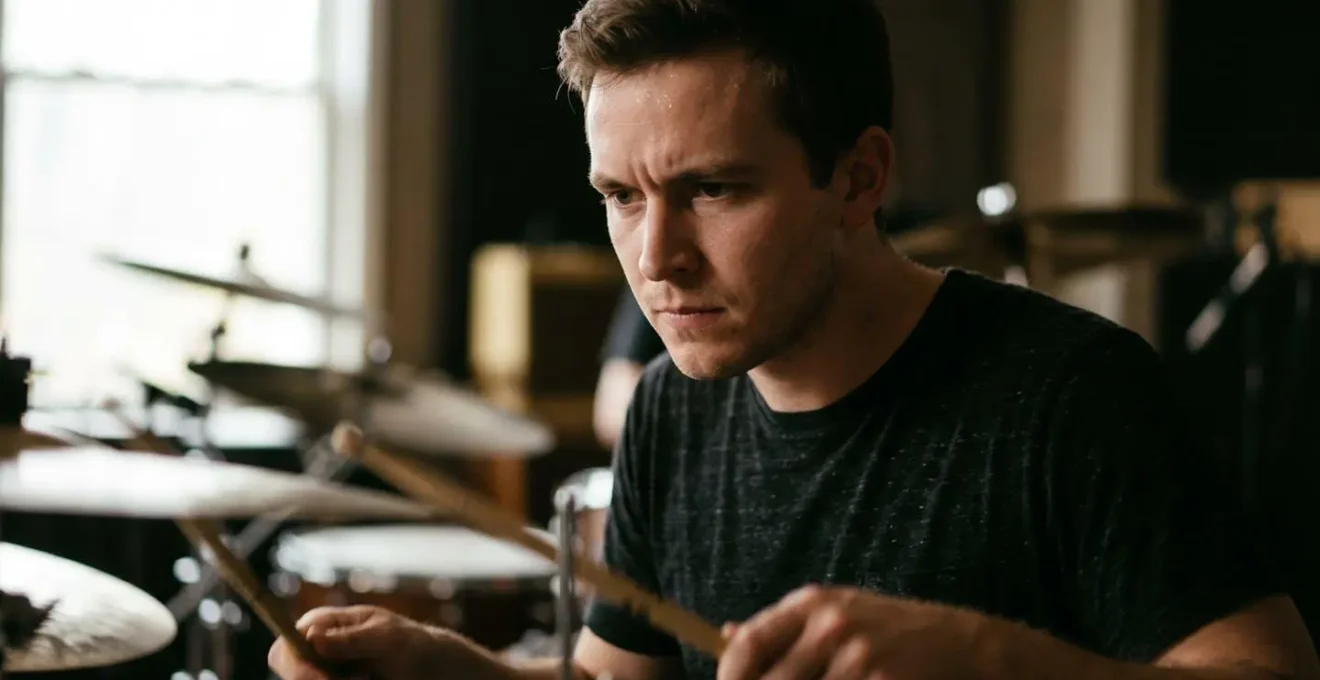
As you can see, the focus and physical effort of a live performer translate directly into the sound. The slight inconsistencies are not mistakes; they are byproducts of human physiology and intention, a key ingredient that machines struggle to replicate authentically. It is this organic quality, this constant dance around the beat, that our ears interpret as « feel » and find so engaging.
Why Does Playing Exactly What’s Written Sound Nothing Like the Recording?
Playing a piece of music exactly as written often sounds sterile because standard musical notation is an incredible, yet fundamentally limited, simplification of a performance. A score can tell you *which* notes to play (pitch) and *when* to play them in a basic sense (rhythm), but it fails to capture the vast, invisible landscape of « feel DNA ». This DNA is composed of thousands of micro-details that give a performance its unique character: the exact dynamic relationship between the hi-hat and snare, the precise push or pull of the backbeat, and the subtle timbral changes in a drummer’s touch from one note to the next.
These elements are collectively known as microrhythm or micro-timing. As researchers at the University of Oslo’s RITMO Centre for Interdisciplinary Studies in Rhythm, Time, and Motion explain:
Music performances are rich in systematic temporal irregularities called ‘microtiming’, too fine-grained to be notated in a musical score but important for musical expression and communication.
– University of Oslo RITMO Centre, There’s More to Timing than Time: Investigating Musical Microrhythm
When you listen to a classic recording, you are not just hearing the transcribed notes; you are hearing the performer’s unique interpretation of those notes—their personal rhythmic signature. The way a jazz drummer swings the ride cymbal or a funk drummer lays back on the snare is a learned, systematic pattern, not just a random fluctuation. This is a skill so nuanced that even non-musicians can perceive it. In fact, research involving 160 participants demonstrated that musically-trained listeners have a heightened sensitivity to these microtiming manipulations, confirming they are a key component of groove perception.
Therefore, when you program a beat based only on a transcription, you are essentially creating a black-and-white sketch of a full-color painting. You have the outline, but you’re missing all the shading, texture, and depth that make it come alive. The recording is the truth; the score is just a map.
How to Develop Deep Funk Feel When You Grew Up on Rock Music?
For a musician raised on the straight-ahead, powerful pulse of rock, developing a deep funk feel requires a fundamental shift in rhythmic perspective. Rock drumming is often about power and driving the beat forward, with the kick and snare acting as unambiguous anchors. Funk, conversely, is a highly syncopated and intricate dynamic conversation. The key is to stop thinking of the drums as a single sledgehammer and start thinking of them as a panel of speakers in a debate, with each limb having its own voice and dynamic level.
The most critical element to master in this transition is the ghost note. In rock, most snare hits are loud backbeats on 2 and 4. In funk, the space between these backbeats is filled with ultra-quiet, barely-there notes played on the snare drum. These are not accents; they are textural elements that create a bubbling, percolating rhythm. They are felt more than heard, and mastering their low volume is paramount. A common mistake is playing ghost notes too loudly, which clutters the groove instead of defining it. The goal is to create a constant 16th-note subdivision, with most of the notes being delicate whispers and only a few being shouts.
This technique demands a high degree of limb independence and dynamic control. One hand must be able to play these quiet « chatter » notes while the other plays the main pattern, creating a complex interplay. The legendary groove of James Brown’s « Funky Drummer » provides a masterclass in this approach.
Case Study: Clyde Stubblefield’s « Funky Drummer » Ghost Note Pattern
In his iconic performance, funk pioneer Clyde Stubblefield demonstrates the power of the ghost note in creating an unforgettable groove. An analysis of the pattern reveals that his technique involves using one hand to play rapid, consecutive 16th notes on the snare, creating intricate « chatter notes. » These notes are played at an extremely low volume, forming a continuous rhythmic texture between the loud, accented backbeats on 2 and 4. This advanced limb independence creates a conversational quality between the hi-hat, kick, and snare that is the very essence of deep funk, a technique that has been sampled thousands of times and studied by drummers worldwide.
Why Does Your Swing Playing Sound Stiff Despite Using the « Correct » Rhythms?
Your swing playing likely sounds stiff because you are relying on a mathematical simplification of what « swing » actually is. Most DAWs and beginner tutorials teach that swing is based on a fixed triplet rhythm, where the first eighth note in a pair is twice as long as the second (a 2:1 ratio). While this is a useful starting point, real, breathing swing is a fluid and dynamic concept where the rhythmic ratio changes constantly based on the tempo of the music.
Applying a rigid 58%, 62%, or even 66% (triplet) swing template across all tempos is a guaranteed recipe for a stiff, mechanical groove. It ignores the fundamental truth of how expert jazz musicians play. As the tempo increases, the swing ratio becomes more even, approaching a straight eighth-note feel (a 1:1 ratio). At very slow tempos, the swing can become much more exaggerated and « lopsided. » In fact, landmark research published in Music Perception revealed that swing ratios in professional performances varied from as high as 3.5:1 at slow tempos down to 1:1 at very fast tempos. The classic « triplet feel » was only truly present in a narrow, medium-tempo range.
Furthermore, the stiffness isn’t just about the ratio; it’s about the placement of the notes relative to the main pulse. A groundbreaking 2022 study confirmed that another key ingredient is the subtle delay of downbeats. Professional jazz musicians systematically delay the strong beats (1 and 3) by a few milliseconds, while keeping the off-beats perfectly synchronized. According to the study published in *Communications Physics*, this combination of a delayed downbeat and a synchronized offbeat significantly enhances the perception of swing. This creates a unique « lay-back » feel that a static swing template, which typically only affects the off-beat, cannot replicate. True swing is a complex relationship between note duration, tempo, and the placement of the entire rhythmic phrase against the underlying pulse.
The Groove Mistake of Adding Too Many Elements to Simple Patterns
A common mistake in the pursuit of a complex, engaging groove is rhythmic overcrowding. In an attempt to make a simple pattern more interesting, producers often add too many percussive layers, fills, and syncopated elements. The result is often the opposite of what was intended: a cluttered, confusing mess with no clear pulse or feel. This is because groove is defined as much by the notes you *don’t* play as by the ones you do. The secret to a deep pocket is often found in aural space.
Think of a groove as a conversation. If everyone is shouting at the same time, no message gets through. A compelling rhythm allows space for each element to speak and be heard. The legendary grooves of artists like James Brown or The Meters are often built on surprisingly simple, interlocking parts. Each instrument occupies its own rhythmic and frequency space, and the silence between the notes is what creates the tension and makes the subsequent hit so impactful. When you remove that space, you remove the groove.
This « less is more » philosophy forces you to be more intentional with each element. With fewer notes to work with, the timing, velocity, and timbre of each one become critically important. A simple kick-snare pattern with a perfectly placed hi-hat can have more groove and impact than a dense 16-part percussion ensemble where nothing has room to breathe. The challenge is to create maximum feel with minimum elements. This means focusing intensely on the micro-timing and dynamic relationship between just two or three core instruments.
Before adding a new shaker, conga, or synth stab, ask yourself: does this serve the groove, or does it just fill a space? Often, the most powerful decision is to subtract an element, letting the remaining parts interact more directly. A sparse arrangement gives the listener’s ear a clear path to follow and allows the core rhythmic pulse to establish a deep, unshakeable foundation.
Programmed or Live Drums: Which Creates Better Groove for Electronic Music?
The debate between programmed and live drums in electronic music often presents a false choice. While a great live drummer can impart a unique and organic feel, modern production techniques offer a hybrid approach that can deliver the best of both worlds: the power and precision of programming combined with the nuanced feel of a human performance. The ultimate goal isn’t to perfectly replicate a human, but to borrow the elements of human feel that make a rhythm compelling and apply them within a controlled electronic context.
The strength of programmed drums lies in their consistency and power, especially in genres that demand a rock-solid low end. A programmed kick drum can hit with identical velocity and perfect timing every single time, creating a powerful, unwavering foundation that is difficult for a live drummer to maintain. However, this same perfection is what can make other elements, like hi-hats and snares, sound sterile. This is where the hybrid approach shines. You can anchor your track with a rigid, quantized kick drum while layering live-recorded or loosely-programmed hi-hats and percussion on top to provide organic variation.
Furthermore, modern DAWs provide powerful « groove extraction » tools. You can take a classic funk break played by a live drummer, analyze its « feel DNA » (the unique pattern of timing and velocity deviations), and save it as a groove template. You can then apply this template to your own programmed samples, instantly imbuing them with the rhythmic signature of a legendary player. It’s like a rhythmic transplant. This goes far beyond a simple swing percentage, capturing the complex, non-linear timing of a real performance. When combined with techniques like round-robin sampling (where each hit triggers a slightly different sample) and subtle filter automation, you can create a programmed beat that is dynamic, evolving, and deeply groovy.
Action Plan: Hybrid Drumming Workflow
- Program a rigid, perfectly-quantized kick drum for sub-bass power and consistency in electronic genres.
- Layer with live-recorded or loosely-programmed hi-hat loops to add organic variation and human feel.
- Use ‘groove extraction’ tools (like Ableton’s Extract Groove) to capture the timing DNA from live breaks.
- Apply extracted groove templates to your programmed samples, imbuing them with the timing of a real player.
- Implement round-robin sample patches and filter automation for an evolving timbral groove across the pattern.
Key Takeaways
- Groove is not random imperfection but a system of intentional micro-timing and dynamic shifts.
- Musical notation is a simplification; the real « feel » of a performance lies in the unwritten details.
- Effective grooves often rely on « aural space » and simplicity, not rhythmic overcrowding.
- Authentic swing feel is tempo-dependent and involves more than just a fixed triplet ratio, including downbeat placement.
How Long Must You Practice a Groove Daily Before It Becomes Automatic?
There is no magic number of hours for making a groove automatic. The time it takes depends less on the duration of daily practice and more on the *quality* and *method* of that practice. Simply looping a pattern for an hour is inefficient. Automaticity is achieved through deliberate practice, a focused approach aimed at building and solidifying muscle memory and internalizing the rhythm so profoundly that you no longer have to think about it. This process is rooted in a cognitive principle known as « chunking. »
As confirmed by research in cognitive psychology, the brain learns complex patterns by grouping small bits of information into larger, manageable « chunks. » Instead of trying to learn a four-bar phrase all at once, the most effective method is to master a single beat. Loop it at a slow tempo until it is flawless and feels completely natural. Then, master the next beat. Once both are automatic, you « chunk » them together into a two-beat pattern. You repeat this process, chunking one-bar loops into two-bar phrases, and two-bar phrases into four-bar sections. This methodical, incremental approach builds a solid foundation and prevents you from practicing and reinforcing mistakes. It’s about building a pyramid from the bottom up, not starting at the top.
Crucially, this practice must extend beyond sitting at your drum kit or computer. To truly internalize a groove, you must embody it. Tap the rhythm on your desk while working. Beatbox the pattern while walking. Use active listening sessions where you loop a target groove and focus only on one instrument per pass—first just the kick, then just the hi-hat. This deconstruction helps your brain isolate and understand the role of each component. By making the rhythm a part of your physical and mental background radiation, you move it from conscious thought to the subconscious, where true, automatic feel resides.
Stop chasing the perfect sample and start sculpting the feel. Begin today by taking a simple beat, focusing only on the snare, and experimenting with moving it just 10-15 milliseconds behind the beat to see how it fundamentally changes the emotional impact of your groove.