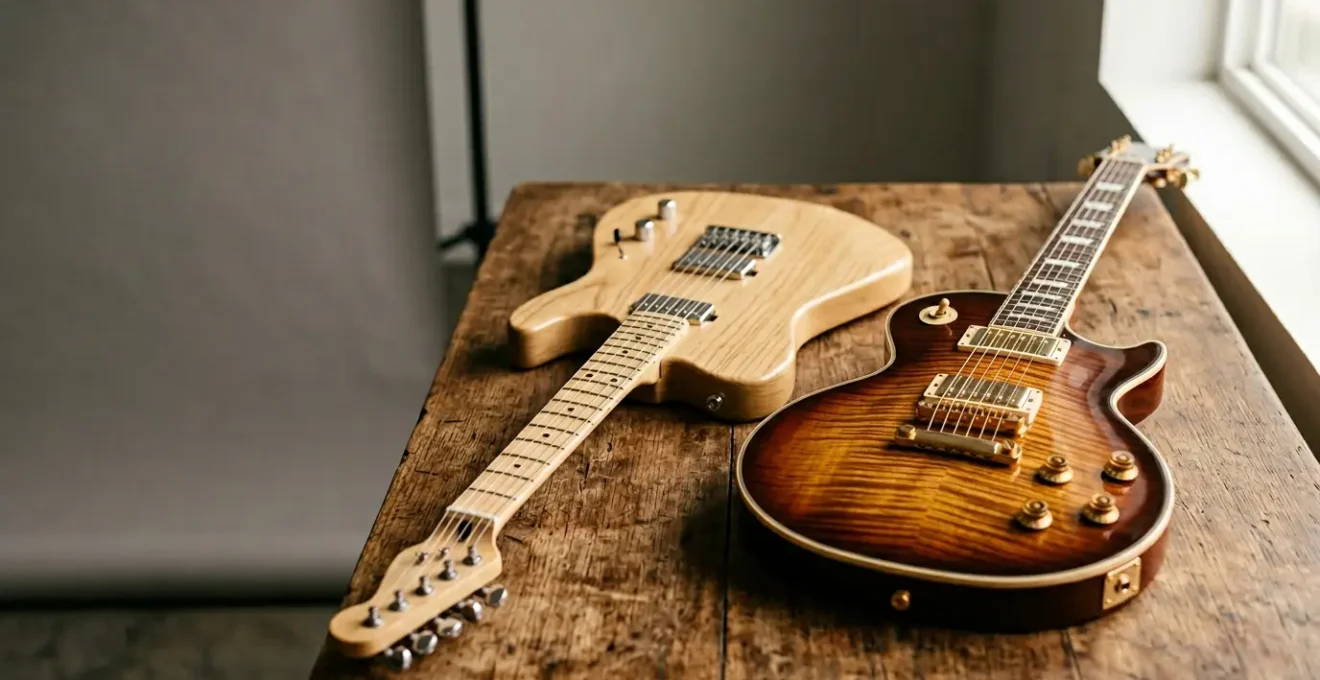
The shocking truth is that a guitar’s price tag has very little to do with its final sound quality; a well-optimised ‘Tone Chain’ is what truly matters.
- An expensive guitar with a single « sonic bottleneck »—like poor setup or cheap electronics—will always sound worse than a budget instrument where every component works in harmony.
- Elements like pickups and professional fretwork offer a far greater return on investment for your tone than a high price tag alone.
Recommendation: Stop chasing expensive guitars and start auditing your existing gear. Identify and fix the weakest link in your Tone Chain to unlock the sound you’ve already paid for.
It’s one of the most frustrating experiences for any guitarist. You’ve saved up, invested in what you thought was a significant upgrade—a beautiful, expensive instrument—only to plug it in and feel… underwhelmed. Meanwhile, your friend’s modest £400 guitar sings with a clarity and punch that yours seems to lack. It’s a common story that leads many players to wrongly conclude it must be their playing, or that they simply have a « bad ear ». The reality is far more straightforward and, fortunately, far more fixable.
The common advice to « just buy a better amp » or the vague platitude that « it’s all in the fingers » misses the point entirely. While those things matter, they are just single parts of a larger system. The final sound you hear is not the product of one expensive component, but the result of a complete system I call the Tone Chain. Every link—from the strings and pickups, through the internal wiring, to the instrument’s physical setup and finally to the amp—contributes to the whole. A single weak or mismatched link can cripple the entire chain, regardless of how much you spent on the guitar itself.
This is where the confusion arises. An expensive guitar is often just a collection of expensive parts, not necessarily a perfectly synergistic system. That cheaper guitar might have, by luck or by a previous owner’s wisdom, a more coherent Tone Chain. This guide will break down that chain, link by link. We will move past the price tag and marketing myths to give you the technician’s-eye-view, showing you how to diagnose the sonic bottlenecks in your own gear and transform the sound of the instrument you already own.
This article will guide you through the critical links in your guitar’s Tone Chain. By understanding each element, you’ll learn why spending less can often yield a better sound and how to make any guitar play and sound like a premium instrument.
Summary: Deconstructing Why a Cheaper Guitar Can Outperform an Expensive One
- Why Does Changing Pickups Transform Your Guitar More Than Buying a New One?
- How to Set Up Your Guitar So It Plays Like a £3,000 Instrument?
- Solid Body or Semi-Hollow: Which Electric Guitar Design Suits Blues Better?
- The Guitar Collection Habit That Prevents Real Playing Development
- When Should You Buy a New Guitar Versus Improve What You Already Own?
- Why Did Your New £800 Preamp Make Your Recordings Sound Worse?
- Why Does a Handmade Guitar Sound Different From a Factory Instrument?
- Why Are Traditional Instrument Makers Disappearing Faster Than the Skills Can Be Passed On?
Why Does Changing Pickups Transform Your Guitar More Than Buying a New One?
If the guitar’s body is its skeleton, the pickups are its voice. They are the first and most critical electronic link in the Tone Chain, converting the physical vibration of your strings into an electrical signal. No other single component has a more dramatic and immediate impact on your guitar’s fundamental character. A £2,000 guitar with muddy, low-output pickups will sound lifeless, while a £400 instrument fitted with a set of high-quality, articulate pickups can sound like a professional-grade tool. This is because many manufacturers, even on pricier models, cut costs on electronics that aren’t immediately visible to the buyer.
As the experts at Seymour Duncan, one of the world’s leading pickup manufacturers, state:
In most cases, upgrading the pickups on your guitar are the single most effective way to improve the overall tone and sound quality.
– Seymour Duncan, The Complete Guide to Guitar Upgrades
Upgrading your pickups isn’t just about getting « more » output; it’s about shaping your sound. Do you want the bright, glassy chime of a vintage single-coil for funk and pop, or the warm, thick saturation of a high-output humbucker for rock and metal? The right pickups can completely redefine what your guitar is capable of. They can add clarity, improve dynamic response, and provide the specific EQ curve that suits your musical style. Instead of buying a new guitar to get a different sound, you can often achieve a more profound transformation for a fraction of the cost by simply giving your current instrument a new voice.
Ultimately, a new set of pickups is the most cost-effective way to get a « new » guitar. It addresses a primary sonic bottleneck and allows the quality of the instrument’s core construction to finally shine through.
How to Set Up Your Guitar So It Plays Like a £3,000 Instrument?
A guitar can have the finest « tonewoods » and the most expensive pickups, but if it plays poorly, it will sound poor. The setup is the bridge between the player and the instrument, dictating how the strings vibrate and how easily you can execute your ideas. A professional setup turns a guitar from a « guitar-shaped object » into a highly responsive musical tool. This is often the single biggest difference between that cheap-but-great guitar and the expensive-but-disappointing one. The former has likely been set up with care, while the latter is still at its generic factory settings.
A complete setup addresses several key areas: neck relief (the bow of the neck), action (string height), and intonation (fret accuracy). However, the secret ingredient that separates a good setup from a world-class one is fretwork. Perfectly levelled, crowned, and polished frets are the foundation of low action without buzz, and clean, clear notes. As veteran luthier Martin Keith notes, this is not a trivial task. His insight, shared in an analysis for Acoustic Guitar Magazine, highlights its central importance:
Fretwork is perhaps the most common job in the guitar repair shop. Whether building an instrument from scratch, restoring a vintage collector’s item, or simply setting up a brand-new entry-level guitar, it’s likely that some amount of fretwork will be required.
– Martin Keith, The Delicate Art of Fretwork – Acoustic Guitar Magazine
Impeccable fretwork allows the strings to ring out with maximum sustain and clarity, a quality often mistaken for expensive wood or pickups. You can feel it instantly. Notes bend more smoothly, chords feel easier to fret, and the entire instrument feels more alive under your fingers.
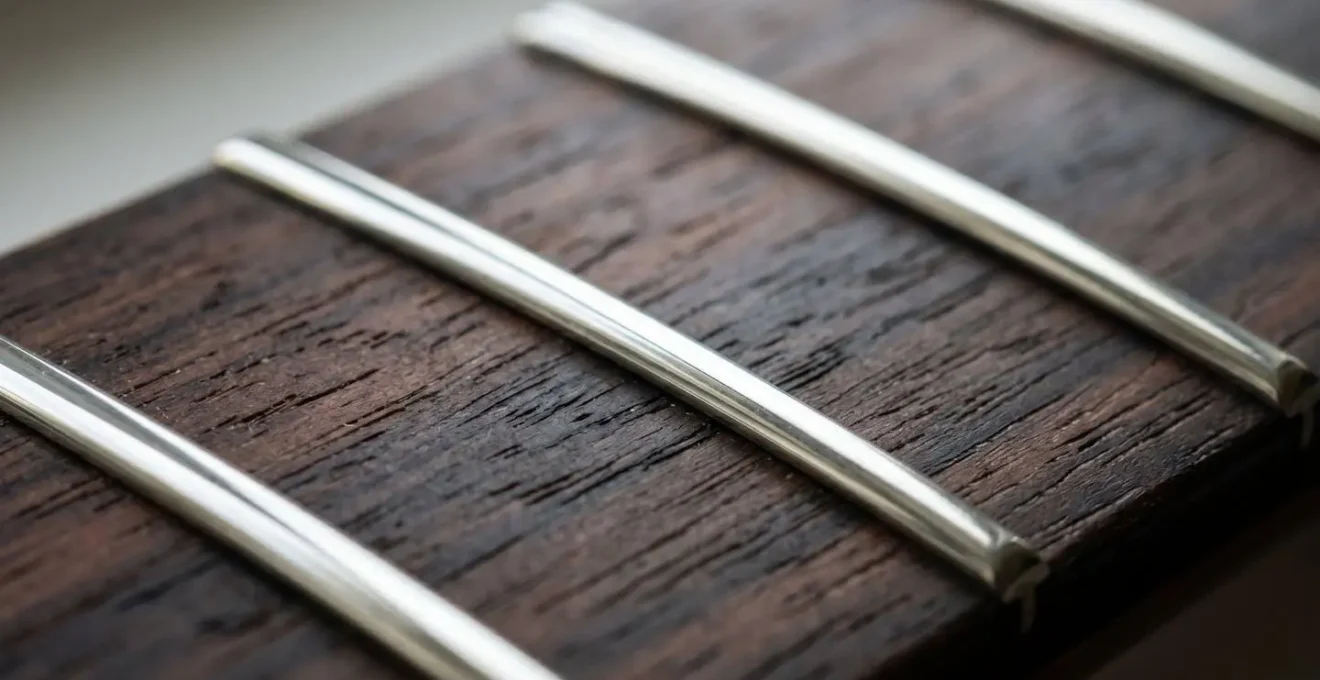
As you can see from the mirror-like finish on professionally polished frets, this level of detail is about removing all friction and imperfection. Investing £100-£200 in a professional setup, including fret polishing, can provide a more significant improvement in playability and tone than spending an extra £1,000 on the guitar itself. It’s the single best investment you can make to elevate the performance of any instrument.
Don’t underestimate this step. A well-set-up £400 guitar will inspire you to play more and sound better in your hands than a £3,000 guitar that’s fighting you every step of the way.
Solid Body or Semi-Hollow: Which Electric Guitar Design Suits Blues Better?
The very construction of a guitar—its « core platform »—is a fundamental link in the Tone Chain that predetermines its sonic signature. When asking why one guitar sounds better than another, the answer is often about a mismatch between the instrument’s design and the player’s musical goals. This is perfectly illustrated in the choice between solid-body and semi-hollow guitars, particularly in a genre like blues, which spans everything from clean, subtle licks to roaring, overdriven solos.
A solid-body guitar, like a Fender Stratocaster or a Gibson Les Paul, is known for its sustain, note-to-note clarity, and resistance to feedback at high volumes. This makes it a reliable choice for many styles. However, a semi-hollow or hollow-body guitar, like a Gibson ES-335, introduces an acoustic-like resonance, adding a « woody » or « airy » quality to the tone. This can create a beautiful warmth for clean blues, but it also makes the guitar more prone to feedback. Many players see this as a flaw, but for some, it’s a feature. The technical analysis from Sweetwater reveals that semi-hollow guitars, with their solid centre block, tame this feedback compared to fully hollow designs, offering a middle ground.
The « better » design, therefore, depends entirely on the player’s approach. Do you want predictable sustain, or do you want to flirt with the edge of chaos?
Case Study: Gary Clark Jr.’s Feedback Control
Blues-rock innovator Gary Clark Jr. is a master of using a hollow-body’s « flaw » as a creative tool. He frequently uses Epiphone Casinos, which are fully hollow and highly susceptible to feedback. Instead of fighting it, he manipulates his guitar’s volume and his position relative to his amplifier to control the feedback, weaving it into his solos to create soaring, expressive textures that would be impossible to achieve with a solid-body guitar. He demonstrates that in the right hands, the supposed weakness of a hollow body becomes its greatest strength for aggressive blues-rock.
So, if a player seeking the controlled, tight response of a solid-body buys an expensive semi-hollow, they’ll be frustrated. Conversely, a player wanting that airy resonance and controllable feedback will find a solid-body sterile. The £400 guitar might sound « better » simply because its fundamental design is a better match for the player’s style—a crucial consideration the price tag completely ignores.
Before your next purchase, ask not which guitar is more expensive, but which design philosophy aligns with the sound you hear in your head.
The Guitar Collection Habit That Prevents Real Playing Development
In our consumer culture, it’s easy to fall into the trap of believing that the next purchase will be the one that unlocks our potential. This leads to « Gear Acquisition Syndrome » (G.A.S.), where players accumulate multiple guitars, hoping one will magically make them a better player. The irony is that this very habit is often what holds them back. The player with one, well-loved £400 guitar that they know inside and out will almost always sound better than the player with a stable of five un-optimized £2,000 guitars they barely know.

Mastery comes from intimacy. When you play a single instrument extensively, you develop a deep symbiotic relationship with it. You learn its specific nuances: where its resonant sweet spots are, how its volume and tone knobs respond, and how to pull different textures from it using just your hands. This is the fabled « it’s all in the fingers » concept, but with a crucial addendum: it’s in the fingers that have learned to speak the language of *one specific instrument*.
Constantly switching between guitars prevents this deep bond from forming. Each guitar has a different neck profile, scale length, and electronic response. By cycling through them, you remain a stranger to all of them, your hands constantly readjusting and never developing the muscle memory required for true expressive control. You become a collector, not a player. The solution is counter-intuitive in our world of more-is-more: choose one guitar and commit to it. Make it your primary tool. Get it professionally set up, upgrade it if necessary, and then spend your time playing it, not shopping for its replacement.
The guitarist who sounds amazing on a cheap instrument hasn’t found a magic guitar; they’ve found a musical partner and taken the time to learn its secrets.
When Should You Buy a New Guitar Versus Improve What You Already Own?
So, the critical question becomes a practical one: is your current guitar a solid foundation for upgrades, or is it a sonic bottleneck that’s better replaced? The answer lies in honestly evaluating the instrument’s « core platform »—its fundamental structural and ergonomic qualities. No amount of expensive electronics can fix a twisted neck or a body that feels deeply uncomfortable in your hands. A cheap guitar can be a fantastic upgrade platform if its core is sound, while a flawed expensive guitar can be a money pit.
To make this decision, you need a clear, objective framework. Too many players make this choice based on emotion or marketing, rather than a technical assessment. As a technician, I guide players through a simple but effective audit. It’s about separating the fixable from the fatal and the cosmetic from the core. If the fundamental ergonomics and structure work for you, almost any guitar is worth upgrading. If they don’t, you’ll be fighting the instrument forever, and no upgrade will change that.
This process demystifies the decision, moving it away from the price tag and towards a practical, player-centric evaluation. It empowers you to see your gear not just for what it is, but for what it could become.
Your Action Plan: The Core Platform Test
- Evaluate Comfort: Spend a week playing only this guitar. If the neck profile, fretboard radius, and body balance feel fundamentally right for your hands and playing style, it’s a strong candidate for upgrading. This is the most important test.
- Check Structural Integrity: Inspect the neck for any twisting or severe bowing. Check for cracks in the neck joint or headstock. If the core platform is structurally flawed, buying new is almost always more economical.
- Calculate Upgrade Costs: Ballpark the cost of your desired upgrades. A good set of pickups might be £150-£250, locking tuners £60-£80, and a professional setup with fret dress £100-£200. If this total exceeds 70% of the price of a new guitar that already has these features, reconsider.
- Test the Signal Chain: Before blaming the guitar, plug it into a known high-quality amplifier or a good amp simulator. This helps isolate whether your guitar or another piece of gear is the true sonic bottleneck.
- Consider Emotional Attachment: If you have a significant history with the instrument, its sentimental value is a valid factor. Moderate upgrades can be justified for an old friend, even if the pure economics suggest otherwise.
By making an informed choice, you invest your money where it will have the greatest impact on your sound and playing experience, breaking the cycle of disappointing purchases.
Why Did Your New £800 Preamp Make Your Recordings Sound Worse?
Sometimes, the weakest link in the Tone Chain isn’t in the guitar at all. A common and frustrating scenario I see involves players who invest in high-quality recording gear, like an expensive preamp or audio interface, only to find their recorded guitar tone is thin, brittle, and lifeless. They blame the new gear, the guitar, or their playing, but the real culprit is often a simple, fundamental electrical mismatch: impedance.
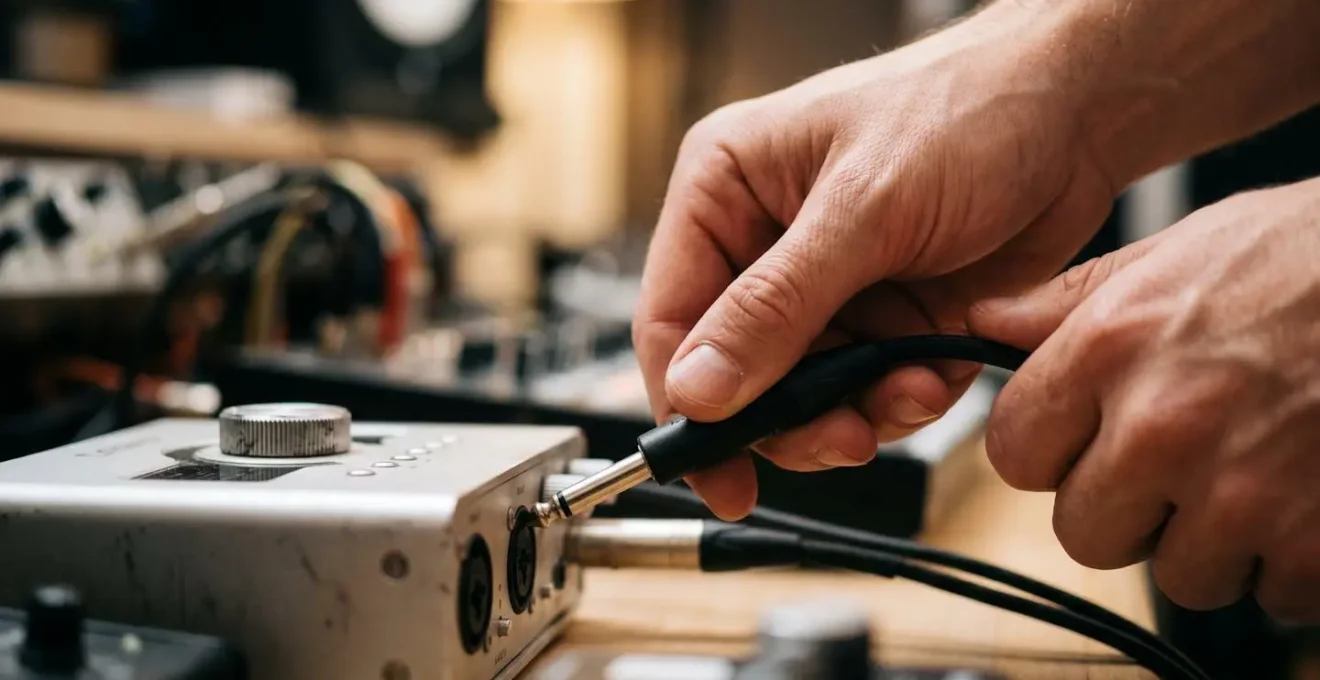
Electric guitar pickups are passive, high-impedance devices. They expect to be plugged into a high-impedance (Hi-Z) input, which is what you find on a guitar amplifier. Audio interfaces and preamps, however, often have both « Line » inputs (for keyboards, synths) and « Instrument » or « Hi-Z » inputs. A Line input has a low impedance. Plugging a guitar directly into a Line input creates an impedance mismatch that strangles your tone before it even gets recorded. It effectively acts as a filter that cuts the low-end and body from your signal, leaving only a thin, scratchy sound.
This is a classic sonic bottleneck that no amount of expensive gear can fix. The £800 preamp isn’t making your guitar sound worse; you are simply feeding it the wrong kind of signal. The solution is simple: always plug your electric guitar into an input labelled « Instrument » or « Hi-Z ». This ensures the electrical load is correct, allowing the full frequency spectrum from your pickups to pass through. As technical documentation confirms, plugging an electric guitar into a Line input instead of a Hi-Z/Instrument input creates an impedance mismatch causing a thin, brittle, and lifeless tone. This single mistake can make a £3,000 guitar sound like a cheap toy.
Before you blame your new gear, check your connections. Often, the most profound tonal improvements come not from spending more money, but from correcting a simple, fundamental error in the signal path.
Why Does a Handmade Guitar Sound Different From a Factory Instrument?
When we compare a mass-produced factory guitar with a handmade instrument from a luthier, we are comparing two fundamentally different philosophies of construction. This difference goes to the heart of why some instruments feel « alive » while others, even expensive ones, can feel sterile. It’s not about magic; it’s about the distinction between consistency and optimisation. A factory’s goal is to produce thousands of guitars that are consistently *good*. A luthier’s goal is to make one single guitar sound its absolute *best*.
A luthier works with the unique properties of each piece of wood. They engage in a process called « tap-tuning, » where they tap the wood to hear its resonant frequency and then carve or brace it to maximize its acoustic potential. They are not following a rigid template; they are having a conversation with the material. This holistic approach means every component is selected to work in synergy. As the consensus among luthiers suggests, the process is about individual optimisation:
A luthier’s goal is to make one guitar sound its absolute best, ‘tap-tuning’ the wood and adjusting bracing or carving to optimize the resonance of that unique piece.
– Luthier consensus, Guitar setup and construction analysis
This philosophy extends to the electronics. A factory uses the same mass-produced pickups across an entire product line for cost-efficiency. A luthier will often select or even hand-wind pickups specifically to complement the overtone profile of the specific instrument they are building.
Case Study: Hand-Wound vs. Mass-Produced Pickups
Tim Mills, founder of the renowned Bare Knuckle Pickups, explains that the difference lies in voicing. Factory pickups are designed for consistency and low cost, often using automated winding machines that produce a very uniform coil. Hand-wound pickups, by contrast, allow the winder to introduce slight, intentional inconsistencies in the coil’s tension and pattern. This « scatter winding » can reduce capacitance and increase resonant peak, resulting in a clearer, more dynamic, and more harmonically rich tone. A luthier can pair a guitar’s naturally bright-sounding body with a darker-voiced pickup (or vice-versa) to create a perfectly balanced final instrument.
An expensive factory guitar may have high-quality components, but a luthier-built instrument has system synergy, where the whole is truly greater than the sum of its parts.
Key Takeaways
- Your guitar’s final sound is a product of the entire ‘Tone Chain’, not just its price. A weak link, like poor setup or mismatched electronics, will cripple the sound of even the most expensive instrument.
- Investing in a professional setup (especially fretwork) and upgrading pickups provides a far greater return on investment for your tone than simply buying a more expensive guitar.
- Mastering one well-optimised instrument creates a deeper player-instrument bond and yields better results than collecting multiple guitars you barely know.
Why Are Traditional Instrument Makers Disappearing Faster Than the Skills Can Be Passed On?
The very existence of this debate—why a cheap guitar can sound better than an expensive one—is a symptom of a much larger, more troubling trend in the music industry. The skills of traditional luthiers, who practice the holistic craft described previously, are disappearing. This is happening because modern manufacturing has become incredibly good at one thing: producing high-quality « guitar platforms » at a very low cost.
The rise of CNC (Computer Numerical Control) machining has been a game-changer. A CNC router can cut a guitar body or neck with microscopic precision, over and over again. This has dramatically raised the baseline quality of budget-friendly instruments. As industry analysis points out, modern CNC manufacturing has raised the baseline quality so high that guitars in the £400 range can have a structural integrity and finish that rivals instruments that cost three times as much just a decade ago. This squeezes the market for the mid-range, traditionally-made instrument, pushing consumers towards either the cheap-but-good-enough CNC models or the very high-end boutique luthier market.
Simultaneously, the way these skills are passed on has fragmented. The old master-apprentice model, which ensured a deep, multi-year transfer of knowledge, is fading. In its place, we have a sea of democratized information—YouTube tutorials and online forums. While these resources are valuable, they often teach isolated tasks (like soldering a pickup) without imparting the holistic understanding of how all the parts work together. As one analysis of craft education puts it:
The traditional master-apprentice model, which ensured the deep, holistic transfer of skills over years, is being replaced by fragmented, democratized knowledge from online videos and forums.
– Craft education analysis, Traditional lutherie skills transfer research
This creates a generation of players and « techs » who can assemble parts but may not understand the art of voicing an instrument as a complete system. We are gaining knowledge of components but losing the wisdom of synergy. The very craft that creates truly exceptional-sounding instruments is being devalued because we’ve been taught to focus on the price tag and the spec sheet, not the soul of the instrument.
The next time you play a truly great-sounding guitar, regardless of its price, take a moment to appreciate it not as a commodity, but as a successful, synergistic system—a skill that is becoming rarer every day.