
Captivating stage presence comes not from adding more movement or flash, but from stripping away noise to reveal an authentic, embodied core that the audience can feel.
- Intentional stillness commands more attention than restless activity because it breaks patterns and creates anticipation.
- True connection is built when your body becomes a resonant chamber for the music’s emotion, not just a vehicle for technical skill.
Recommendation: Shift your practice from focusing only on what you do on stage to how you *are* on stage. Start by exploring the power of your breath and your connection to the ground.
You’ve played a technically flawless set. Every note was perfect, the arrangements were tight, and yet, the audience felt distant. You see them checking their phones, chatting at the bar, their attention drifting away. It’s a deeply frustrating experience for any performer: the disconnect between the quality of the music and the energy in the room. Why do some musicians walk on stage and command immediate, silent attention, while others, despite their immense skill, struggle to hold a room?
The conventional advice often feels hollow. « Move around more, » they say. « Make more eye contact. » « Wear a more interesting outfit. » These suggestions treat stage presence as an external layer to be added on, like a costume. They encourage you to perform ‘performance’ itself, often resulting in movement that feels inauthentic or a stage persona that creates a barrier between you and the audience. This approach misses the fundamental truth of stage magnetism.
But what if the secret isn’t in adding more, but in subtracting? What if the most powerful presence is cultivated not through frantic activity, but through profound, intentional stillness? True magnetism is an inside-out job. It’s about building an internal state of such clarity and focus that your very being becomes an instrument of connection. It’s about learning to use your body as a resonant chamber for the music’s emotion, allowing your audience to *feel* the story, not just hear it.
This guide moves beyond the superficial tips. We will explore the principles of embodiment and presence, breaking down why some performers are so compelling. We’ll examine how to use your body to transmit emotion, the nature of authentic stage personas, and the specific exercises you can practise to develop your own unique and commanding energetic signature.
This article provides a structured path to understanding and cultivating true stage magnetism. Below is a summary of the key areas we will explore to transform your relationship with the stage and your audience.
Summary: Unlocking Your Innate Stage Presence
- Why Does Standing Still Command More Attention Than Constant Activity?
- How to Use Your Body So Audiences Feel What You’re Playing?
- Born With Presence or Built Through Practice: Can Anyone Develop Stage Magnetism?
- The Stage Character Mistake That Makes Audiences Distrust Rather Than Connect
- Which Stage Presence Exercises Should You Practice First for Visible Improvement?
- How to Develop Commanding Stage Presence Without Natural Charisma?
- Why Does a Plain White Background Waste Your Chance to Tell Your Story?
- Why Does Your Live Show Fall Flat Despite Playing Every Note Correctly?
Why Does Standing Still Command More Attention Than Constant Activity?
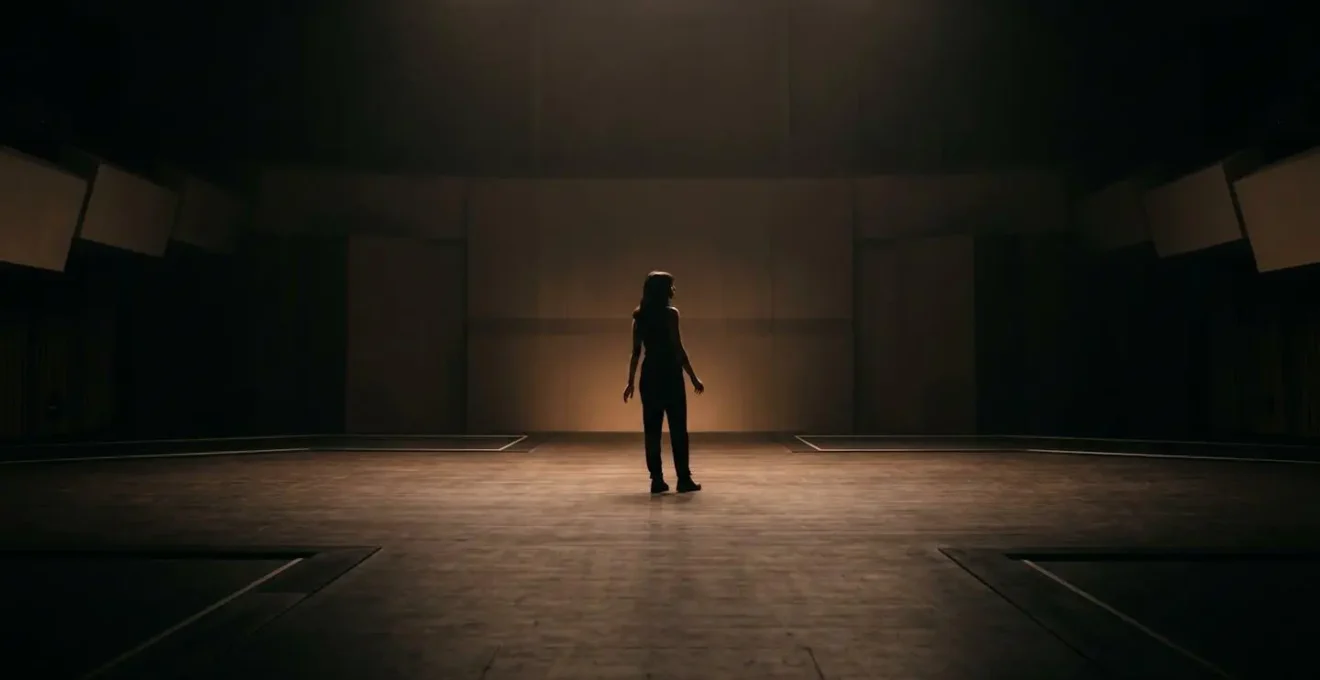
In a world saturated with noise and movement, stillness is a radical act. On stage, it’s a tool of immense power. Constant, nervous activity—pacing, shifting weight, fidgeting with gear—leaks energy. It signals to the audience’s subconscious that the performer is uncomfortable, which in turn makes the audience feel uneasy. This continuous, low-level motion becomes a form of white noise that the brain learns to ignore. Intentional stillness, however, does the opposite. It creates a sudden and compelling break in the visual pattern, forcing the brain to pay attention.
This isn’t just a psychological trick; it’s rooted in neuroscience. Our brains are wired to detect change and novelty. When a performer stops moving and holds the space with quiet confidence, they create a moment of tension and anticipation. The audience leans in, their focus sharpened, wondering what will happen next. This is supported by neuroscience research showing that even subtle low-frequency brain network fluctuations predict sustained attention states, highlighting the brain’s attunement to underlying patterns and breaks. Stillness is the ultimate pattern break on a busy stage.
This principle is central to what is often called the ‘attention economy’. As one study on the subject notes, the brain is fundamentally designed to seek out what’s new and different.
The brain is wired to seek novelty. When something new pops up, your dopamine system lights up. And dopamine isn’t just about pleasure; it’s about anticipation.
– Neuroscience Research, Attention Economy Study
By using stillness, you are not being passive; you are actively gathering the room’s energy and focusing it. You create a vacuum that only you can fill, making the first note you play, when it finally arrives, infinitely more impactful. It’s the difference between shouting in a loud room and speaking a quiet, deliberate word into a sudden silence. One is noise; the other is a statement.
How to Use Your Body So Audiences Feel What You’re Playing?
Your body is not just the vehicle that operates your instrument; it is an instrument in itself. Technical proficiency allows an audience to hear the music, but embodied resonance allows them to feel it. This is the process of letting the music’s emotional and physical energy move *through* you, making your physical presence a direct translation of the sound. It’s about shifting your focus from « What do my fingers need to do? » to « What does this chord feel like in my chest? » or « Where does this melody want to travel in my spine? »
This connection is made possible by our mirror neuron system. When an audience watches a performer who is physically expressing the joy, tension, or sorrow of a piece, their own brains fire in a similar way. They don’t just see the emotion; they experience a version of it themselves. Neuroimaging studies confirm that activity in the brain’s empathy-related regions correlates with observing emotional expressions. You are literally inviting the audience into your sensory experience of the music. When you allow yourself to physically manifest the music, you give the audience’s brains the data they need to feel it with you.

Look at the hands of a captivating performer. They aren’t just hitting notes; they are shaping the air, conveying tension in the grip, and release in the gesture. To begin cultivating this, practise somatic listening. Play a single note or chord and, instead of just listening with your ears, ask your body to listen. Feel the vibration in the floor, through your feet. Notice where the sound resonates in your body. Let that physical sensation inform a small, authentic movement—a slight lean, a breath, a change in your posture. This is the beginning of a performance that is felt, not just heard.
Born With Presence or Built Through Practice: Can Anyone Develop Stage Magnetism?
One of the most persistent myths in performance is that of the « natural. » We look at magnetic performers and assume they were simply born with an innate, un-teachable charisma. This belief is not only incorrect, but it’s also disempowering. The truth is that commanding stage presence is a skill. And like any skill, it can be learned, practised, and mastered. The key lies in understanding that your brain and body are not fixed entities.
The science of neuroplasticity provides the proof. For decades, it was believed the brain was largely fixed after childhood. However, recent neuroscience research confirms the brain remains malleable and capable of adapting throughout life. Every time you practise a new physical movement, a new mindset, or a new way of focusing your attention, you are physically re-wiring your brain. The shy, awkward feelings you might have on stage are simply well-worn neural pathways. Through deliberate, consistent practice, you can build new pathways for confidence, connection, and command.
This is not a theoretical concept; it’s a proven strategy used by some of the most iconic performers in history. One of the most powerful examples is the journey of David Bowie.
Case Study: David Bowie’s Transformation into Ziggy Stardust
Early in his career, David Bowie admitted to having ‘incredible shyness.’ He was not a natural-born rock god. His transformation into the magnetic Ziggy Stardust was a deliberate, systematic process of skill-building. He worked with mime artist Lindsay Kemp to master his physical expression and choreography. He meticulously designed costumes, hair, and makeup to create a fully realised character. Bowie himself stated he ‘packaged a totally credible plastic rock star,’ proving that stage magnetism could be constructed through intentional practice, character development, and a deep understanding of visual and physical storytelling. He didn’t find charisma; he built it.
Anyone can develop stage magnetism because anyone can practise. It requires shifting your definition of ‘practice’ to include not just your instrument, but also your body, your focus, and your intention. It is not about pretending to be someone you’re not, but about deliberately choosing and building the version of yourself you wish to be on stage.
The Stage Character Mistake That Makes Audiences Distrust Rather Than Connect
Developing a « stage character » is often suggested as a way to overcome shyness and build confidence. And while it can be a powerful tool—as seen with David Bowie—it hides a critical trap. The most common mistake performers make is creating a character that acts as a mask, a defensive wall between their true self and the audience. This inauthentic persona might look « cool » or « confident, » but audiences have a finely tuned sense for fakeness. They may not be able to articulate it, but they can feel the disconnect. Instead of fostering connection, this mask creates distrust.
The goal is not to invent a separate, fake person, but to practise authentic amplification. This means identifying a genuine part of your own personality—your humour, your intensity, your vulnerability, your quiet power—and turning up the volume on it for the stage. It’s still you, but it’s the version of you that is focused, energised, and ready to communicate with a room full of people. An amplified self is rooted in truth, whereas a fake persona is rooted in fear of not being enough.
As performance coach Teresa Wenhart explains, this authenticity is not an optional extra; it is the very core of a charismatic performance. The connection an audience craves is with a real human being.
Stage charisma is no accident—it is the result of inner clarity, emotional presence, and genuine connection. Emotional intelligence is not just an add-on technique but the core of your impact.
– Teresa Wenhart, Performing with Charisma: How to Radiate Authenticity on Stage
So, instead of asking, « What kind of cool character should I be? » ask yourself, « Which part of me does this music want to express? » Is it your rebellious side? Your romantic heart? Your quiet thoughtfulness? Find that authentic seed within you and give it the space, breath, and physicality it needs to fill the stage. That is the kind of ‘character’ an audience will not only believe, but connect with on a deep, emotional level.
Which Stage Presence Exercises Should You Practice First for Visible Improvement?
Developing stage presence requires a new kind of practice, one that focuses on your body and awareness as much as your instrument. To see tangible results quickly, it’s best to start with foundational exercises that build a strong base of intention and physical confidence. The goal is to move from hesitant, unconscious habits to deliberate, embodied choices. The most effective starting point is not complex choreography, but simple, focused awareness exercises.
Begin before you even pick up your instrument. The way you walk on stage sets the tone for the entire performance. Practise walking from the wings to the centre of the stage with a single, clear intention. For one walk, your intention might be « to greet an old friend. » For another, it might be « to share a secret. » Notice how this simple internal shift changes your posture, your pace, and the energy you project. This exercise teaches you to lead with your energetic signature, captivating the audience from your very first step. Another fundamental is practising bigger, more committed movements. Small, hesitant gestures read as insecurity; large, deliberate ones read as confidence.
Remember that building these new habits requires repetition. As neuroscience research on skill acquisition recommends, a new skill needs to be practiced frequently to forge the necessary neural pathways. Consistency is more important than intensity. A few minutes each day will yield more significant results than one long session per week. The following checklist provides a concrete starting routine to audit and improve your physical presence.
Your Action Plan: Auditing Your Stage Presence
- Record and Review: Film yourself performing a song. Watch it back without sound, focusing solely on your body language. Note any nervous habits or moments of disconnection.
- Study the Greats: Choose two or three performers whose stage presence you admire. Watch their live performances and analyse how their movements match the emotional arc of the music. Don’t copy them, but identify the principles they use.
- Movement with Intention: Choose a song and choreograph three key moments with deliberate physical gestures. Practise these bigger, bolder movements until they feel natural and integrated with the music.
- Embodied Song Mapping: Listen to one of your songs and map its emotional journey. Where is the tension? The release? The joy? Match a physical state to each section—e.g., grounded and heavy for a verse, expansive and light for a chorus.
- The Intentional Entrance: Before every practice session, practise your walk-on. Set a clear intention for the performance ahead and walk to your spot with that intention held firmly in your mind and body.
Starting with these exercises builds a strong foundation. They train you to be more aware, more intentional, and more physically confident on stage, leading to visible and rapid improvements in your overall presence.
How to Develop Commanding Stage Presence Without Natural Charisma?
The concept of « natural charisma » is a myth that holds many talented musicians back. What we perceive as charisma is rarely a magical, inborn quality. More often, it is a carefully honed set of skills centred around focus, intention, and authenticity. You do not need to be an extroverted, life-of-the-party person in your daily life to have a commanding presence on stage. In fact, some of the most magnetic performers are quiet and introverted off-stage.
The key is to differentiate between your ‘social self’ and your ‘performance self’. Your social self is conditioned to be polite, to fit in, and to not take up too much space. Your performance self has a different job. Its purpose is to communicate the emotional truth of the music, to hold the focus of a room, and to create a world for the audience to step into. This doesn’t mean being fake; it means accessing a different, more focused and amplified part of yourself. This is your authentic amplification in action.
For a shy or introverted performer, the path to presence isn’t about forcing yourself to become an entertainer. It’s about building a strong ‘container’ for your performance energy. This begins with grounding. Before you go on stage, stand with your feet flat on the floor and feel your connection to the earth. Focus on your breath, letting it drop deep into your belly. This simple act calms the nervous system and brings your awareness out of your anxious mind and into your physical body. From this grounded state, you can perform with intention rather than from a place of reaction or fear.
Your unique presence will not look like anyone else’s. An introverted performer might find their power in intense, focused stillness, drawing the audience into their internal world. An energetic performer might find it in explosive, joyful movement. The goal is not to copy a « charismatic » ideal, but to find what feels powerful and true for *you* and your music, and then practise amplifying that quality until it can fill the stage.
Why Does a Plain White Background Waste Your Chance to Tell Your Story?
Your performance doesn’t begin with the first note; it begins the moment the audience lays eyes on the stage. The visual environment—the lighting, the set, the arrangement of instruments—is your first opportunity to communicate. A generic, brightly lit stage with a plain white or black background says nothing. It is a blank canvas, but by leaving it blank, you are wasting a powerful tool of connection and storytelling. Your stage is an extension of your energetic signature.
Think of the stage setting as the first verse of your first song, sung without a single word. What story do you want to tell? A single, warm-toned spotlight in an otherwise dark space can create a feeling of intimacy and introspection. A minimalist setup with clean lines might suggest modernity and precision. A stage cluttered with vintage lamps and Persian rugs could evoke a sense of nostalgia and warmth. These are not just decorations; they are non-verbal cues that prime the audience, helping them enter the emotional world of your music before you’ve even played.
You don’t need a large budget to achieve this. The most impactful designs are often the simplest. Consider the power of colour. A wash of blue light can evoke melancholy or serenity, while a deep red can signal passion or anger. Consider a single, meaningful prop. A solitary, empty chair on stage can tell a whole story of loss or waiting. The placement of your gear matters too. Are you open and facing the audience, or are you shielded behind a fortress of keyboards and amplifiers?
Treat your stage design as part of your musical arrangement. Ask yourself: « What does my music look like? » and « How can the visual environment support the emotional journey of my set? » By consciously designing your space, you create a more immersive and cohesive experience. You show the audience that you have considered every element of their experience, and you invite them into a world that is uniquely yours, making them far more receptive to the music that is to follow.
Key Takeaways
- True stage presence is an internal skill, not an external performance. It’s built, not born.
- Intentional stillness and focused energy command more attention than constant, nervous movement.
- Your body is a resonant instrument; use it to translate the music’s emotion so the audience can feel it, not just hear it.
Why Does Your Live Show Fall Flat Despite Playing Every Note Correctly?
You’ve done the work. You’ve spent countless hours in the practice room, honing your craft until you can play your set in your sleep. Technically, you are flawless. Yet, the show feels flat. The applause is polite but not rapturous. The energy you’re putting out seems to vanish into a void. This is the painful gap between technical execution and true performance. Playing the right notes is simply the price of admission; it’s the baseline expectation. It is not, and has never been, the thing that creates a memorable, moving live experience.
A show falls flat because it lacks a human connection. It’s a broadcast, not a conversation. When a performer is entirely focused on technical perfection, their energy turns inward. Their focus is on their own fingers, their own voice, their own cues. The audience becomes an afterthought, observers of a highly skilled task rather than participants in a shared emotional experience. The performance may be impressive, but it fails to be compelling. It speaks to the head, but it completely bypasses the heart and the body.
The missing ingredient is embodied resonance. It’s the courage to let go of the obsession with perfection and instead commit to communicating the emotional core of the music. It’s allowing the joy of a chorus to lift your posture, the anger of a verse to create tension in your hands, the vulnerability of a bridge to soften your gaze. This is what an audience connects with. They don’t remember every perfect note, but they will never forget how a performance made them *feel*.
This is the ultimate reason why some musicians captivate before a single note is played. They walk on stage with a clear intention to connect, not just to execute. Their focused presence, their grounded body, and their open energy create an invitation. They establish a connection first, and then they pour the music into that established channel. Technical skill is the foundation, but presence is the bridge you build to your audience. Without that bridge, your music, no matter how brilliant, will remain on your side of the stage.
Begin today by applying these principles not as rules, but as invitations to explore your own unique energetic signature and transform your relationship with the stage.