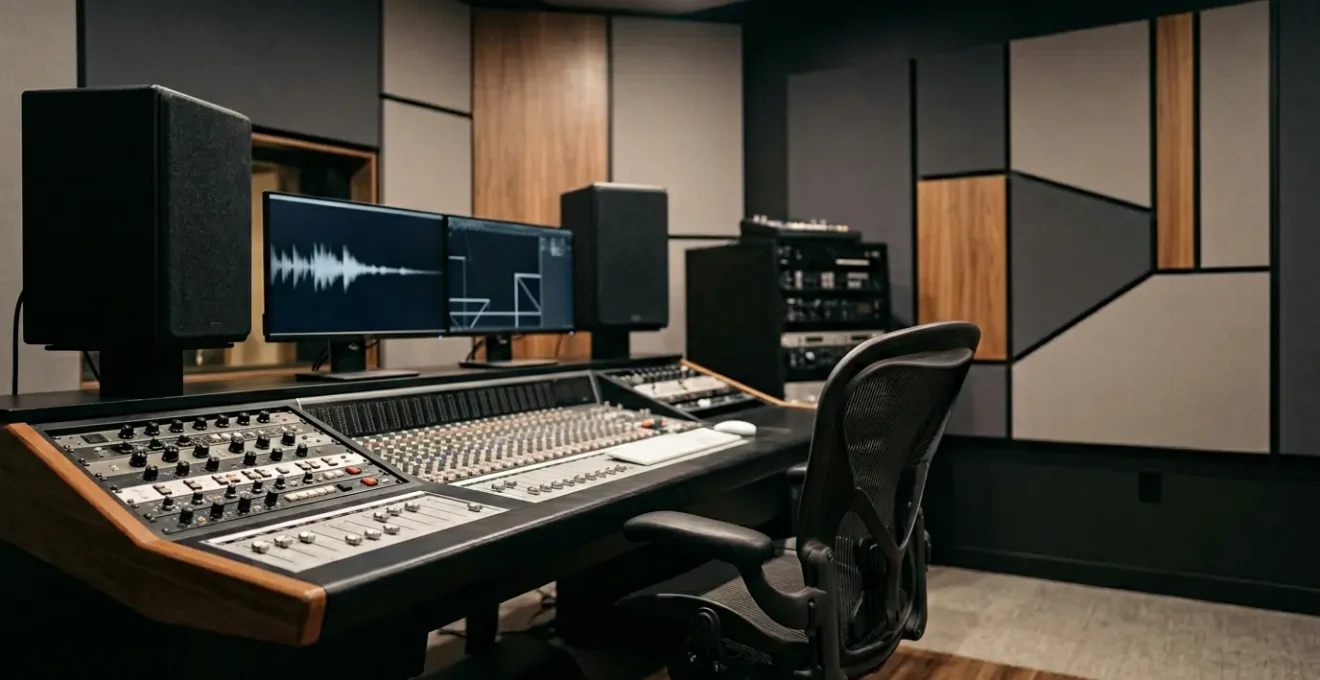
The professional’s edge isn’t a secret plugin; it’s a deliberate system that treats mixing as a cognitive task, not a gear collection contest.
- Your massive plugin library is the primary source of decision fatigue, actively making your mixes worse.
- A simple, three-stage plugin chain (Utility, Correction, Creation) built with stock tools outperforms a chaotic collection of premium plugins.
Recommendation: Stop chasing new plugins and commit to mastering a handful of essential tools using a structured, deliberate practice framework.
You have a hard drive bursting with hundreds, if not thousands, of pounds worth of plugins. You’ve watched countless tutorials, you own the same emulations as your heroes, yet your mixes still sound flat, cluttered, and fundamentally amateur. It’s a deeply frustrating experience shared by producers across the UK: the feeling that despite having all the right ingredients, the final dish is consistently underwhelming. The common advice is to buy the ‘next big thing’—a new compressor or a magic EQ that promises to fix everything.
The inconvenient truth, however, is that the problem isn’t your toolbox; it’s the sheer size of it. Professionals don’t get better results because their plugins are inherently superior. They get better results because they have cultivated a ruthless efficiency in both their technical workflow and, more importantly, their mental energy. They aren’t simply applying effects; they are executing a decision-making framework designed to achieve a specific goal with minimal friction.
But what if the key wasn’t about learning what 200 plugins do, but about unlearning the habits that make them ineffective? This guide breaks down the counter-intuitive strategies professionals use. We will explore the cognitive science behind plugin overload, build a bulletproof plugin chain that works 80% of the time, and reveal the practice habits that permanently separate the pros from the perpetual amateurs. It’s time to transform your existing tools from a source of overwhelming choice into a focused, powerful, and efficient system.
To navigate this shift in mindset, this article is structured to deconstruct the problem and provide a clear, actionable framework for change. The following sections will guide you through the core principles of professional plugin efficiency.
Summary: Mastering Your Tools for a Professional Sound
- Why Does Owning 200 Plugins Make Your Mixes Worse, Not Better?
- How to Create a Go-To Plugin Chain That Works on 80% of Your Mixes?
- Stock DAW Plugins or Premium Alternatives: Where Should Your Budget Go?
- The Plugin Upgrade Habit That Keeps You From Ever Learning Your Tools
- Which Plugin Categories Should You Master First for Immediate Mix Improvement?
- The Plugin Habit That Adds 40 Instances but Makes Your Mix Sound Worse
- The Template Mistake That Makes Your DAW Slow and Your Mind Overwhelmed
- Why Does Your DAW Workflow Take 10 Hours When Professionals Finish in 2?
Why Does Owning 200 Plugins Make Your Mixes Worse, Not Better?
The belief that a larger toolbox leads to better creations is a logical fallacy that plagues many producers. In reality, an overabundance of choice doesn’t liberate creativity; it paralyses it. This phenomenon, known as the « Paradox of Choice, » creates a significant mental burden. As author Barry Schwartz notes, « More choice means more options for people to consider, and a greater cognitive workload to do so, as all the different options are weighed up and evaluated. » When you face ten different 1176-style compressors for a single vocal track, you aren’t just choosing a tool; you’re spending precious mental energy comparing subtle differences, most of which will be imperceptible in the final mix.
This increased mental load has a direct, measurable impact on creative output. Your brain has a finite amount of high-quality decision-making capacity, often referred to as cognitive energy. Every trivial choice—which EQ, which saturator, which of the 50 reverb presets—depletes this reserve. Consequently, by the time you reach critical mix decisions like vocal balance or overall dynamics, you’re operating with a diminished capacity, leading to poor judgment and endless, unfocused tweaking.
The impact of this is not just theoretical. Extensive research on musical performance reveals that pieces performed under an additional cognitive load suffer a significant decrease in expressiveness. In a mixing context, this translates to sterile, lifeless tracks. Instead of making bold, musical decisions, you’re stuck in an analytical loop, auditioning plugins instead of mixing the song. A professional with five mastered plugins will always produce a better mix than an amateur with 200 plugins they barely understand, precisely because the professional has eliminated decision fatigue from their workflow.
How to Create a Go-To Plugin Chain That Works on 80% of Your Mixes?
The antidote to plugin paralysis is not finding the « perfect » plugin, but creating a reliable, repeatable system. Professionals don’t reinvent the wheel for every track; they rely on a standardised signal chain that handles the vast majority of mixing tasks. This « Go-To » chain isn’t a rigid preset but a flexible framework built on a logical progression of processing. By committing to a consistent order of operations, you replace chaotic guesswork with an efficient, goal-oriented workflow. This allows you to focus on the sound, not the tool.
The most effective framework is a three-stage process: Utility, Correction, and Creation. This sequence ensures you build your mix on a solid technical foundation before making any creative or « colourful » decisions. You first solve technical problems, then you enhance the sound. This structured approach prevents common mistakes, such as trying to boost a frequency with a character EQ when the real issue is a clashing element that needs to be cut, or adding compression to a signal that is poorly gain-staged.
Adopting this system forces you to be intentional with every plugin you insert. Each tool has a specific job within a specific stage of the process. This clarity not only speeds up your workflow but also dramatically improves your results, as each processing step supports the next in a logical and cumulative way. Here is a professional framework to build your own go-to chain:
- Stage 1 – Utility: Begin with the technical essentials. This includes gain staging to ensure optimal level into your processors, checking and correcting phase rotation, and applying a high-pass filter to remove unnecessary low-frequency mud. This stage is about cleaning up the signal before any creative work begins.
- Stage 2 – Correction: Address technical problems in the source audio. Use a surgical, transparent EQ to remove harsh resonances, apply a de-esser to control sibilance, and use corrective dynamic processing (like multi-band compression for problem frequencies) to tame unruly peaks without adding character.
- Stage 3 – Creation: Now, you can enhance the sound. This is where you add tonal EQ for character and shape, apply compression for musical dynamics and groove, introduce saturation for pleasing harmonic content, and use spatial effects like reverb and delay to create depth and dimension.
Stock DAW Plugins or Premium Alternatives: Where Should Your Budget Go?
One of the most persistent myths in music production is that expensive, third-party plugins are a prerequisite for professional-sounding mixes. This belief fuels a multi-million-pound industry and keeps countless producers trapped in a cycle of buying gear instead of building skills. The reality is that modern Digital Audio Workstations (DAWs) come equipped with incredibly powerful and transparent stock plugins that are more than capable of producing commercial-quality records. As one professional engineer bluntly stated in a forum, « You can still pump out great, commercial mixes with stock plugins. They are not incapable. The engineer is incapable. »
The perceived gap in quality often has more to do with user interface and marketing than with sonic capability. Premium plugins often feature visually appealing, skeuomorphic designs that emulate vintage hardware, which can inspire confidence and trick our brains into perceiving a « warmer » or « punchier » sound. However, when subjected to objective listening, the differences often vanish. A recent audio blind test demonstrated that even seasoned professionals struggled to consistently tell the difference between mixes made with expensive plugins and those using their stock counterparts.
This proves the fundamental point: your budget and time are finite resources. Investing them in learning the core principles of EQ, compression, and spatial effects with your existing stock plugins will yield a far greater return than purchasing another emulation you don’t fully understand. The focus should shift from gear acquisition to knowledge acquisition.

As the image above suggests, true progress comes from focused learning, not from accumulating more tools. Master the stock compressor in your DAW—learn its attack, release, and ratio curves inside and out—and you will be better equipped than someone who owns ten premium compressors but only ever uses presets. Your budget’s best investment is in education that teaches you how to hear and what to listen for, not in another piece of software.
The Plugin Upgrade Habit That Keeps You From Ever Learning Your Tools
The constant desire for new gear is a well-documented phenomenon in creative fields, formally known as Gear Acquisition Syndrome (GAS). Researchers Jan-Peter Herbst and Jonas Menze define it as « the musicians’ unrelenting urge to buy and own instruments and equipment as an anticipated catalyst of creative energy. » This habit is particularly destructive in the digital realm, where « Black Friday » sales and influencer marketing create a perpetual cycle of desire and disappointment. You buy a new plugin expecting it to be a silver bullet, only to find your mixes sound the same, leading you to seek the next purchase.
This cycle prevents the single most important factor in developing professional skill: deep, deliberate practice. Professionals get great results from their tools because they have spent hundreds, if not thousands, of hours pushing them to their limits. They know exactly how a specific compressor will react to a percussive vs. a sustained sound, or how to create space with subtractive EQ alone. They have moved beyond the « what » (what the plugin does) to the « how » and « why » (how it does it, and why it’s the right choice for a specific problem).
To break the GAS cycle, you must replace the habit of buying with the habit of structured learning. This means treating your existing plugins like instruments to be mastered. Instead of trying a new plugin, commit to exploring the one you already own. The goal is to move from a superficial user to a power user who can leverage the « last 10% » of a tool’s capability—the part that most amateurs never even discover.
Your Action Plan for Curing Gear Acquisition Syndrome
- Adopt the 100-Hour Rule: Commit to logging 100 hours of active use on your primary plugin for each category (EQ, compressor, etc.) before even considering a new purchase. This gamifies deep learning and fights upgrade impulses.
- Master Compressor Controls: Take a single drum loop and use only one compressor. Create 10 distinct grooves by only manipulating the attack and release controls. This builds muscle memory for how timing shapes dynamics.
- Map EQ Frequencies: Process the same vocal track in five different ways using only subtractive EQ. Focus on a different critical frequency range each time (e.g., mud, boxiness, harshness, presence, air) to train your ears.
- Explore Compressor Ratios: Use one compressor to create three distinct « personalities » on a bass guitar: a low ratio with slow attack for punch, a medium ratio with fast attack for consistent levelling, and a high ratio for aggressive saturation.
- Take the 5-Plugin Challenge: Mix an entire song using a maximum of five plugins. This forces you to be creative and discover the hidden capabilities of your core tools.
Which Plugin Categories Should You Master First for Immediate Mix Improvement?
With a universe of plugins available, knowing where to focus your learning is critical. The fastest path to better mixes isn’t through complex, « magic » processors, but through the uncompromising mastery of fundamental tools. Amateurs are often drawn to exciting effects like lush reverbs or complex multi-band saturators, but professionals know that a mix stands or falls on its foundational structure. Get the basics right, and the creative effects will enhance your mix. Get them wrong, and no amount of expensive reverb will save it.
Therefore, your priority should be the « unsexy » but essential trio of tools that control the core elements of a mix: level, frequency, and dynamics. These are the pillars upon which every great-sounding record is built. By focusing your deliberate practice here, you address the root causes of most mix problems—uncontrolled dynamics, frequency masking, and poor gain structure—leading to immediate and dramatic improvements in clarity, punch, and balance.
The key is to learn these tools not just as processors, but as creative, problem-solving instruments. A high-pass filter isn’t just for « removing rumble »; it’s your primary tool for creating depth and separation. A simple compressor isn’t just for « controlling peaks »; it’s an instrument for shaping groove and attitude.

As the image suggests, mastery lies in the precise and intentional use of a few core controls. Forget the dazzling GUIs and focus on what matters. Here is the priority sequence for plugin mastery:
- Master First: The Foundational Trio. Before anything else, become an expert with a gain utility plugin, a high-pass filter, and a reliable metering plugin. Perfect gain staging and cleaning up low-end mud across every single track will provide a bigger improvement to your mix clarity than any fancy processor.
- Master Second: Subtractive EQ. Reframe your approach to EQ. It is not a tool for « boosting » good sounds, but for « sculpting space » by removing conflicting frequencies. Make every element fit by only carving out space before you even think about reaching for a boost.
- Master Third: One Compressor, Three Personalities. Learn to make your single stock compressor behave like three distinct units. Use a slow attack for enhancing punch, a fast attack for transparent control, and a very high ratio with a fast attack to create harmonic saturation and attitude.
The Plugin Habit That Adds 40 Instances but Makes Your Mix Sound Worse
A common amateur mixing habit is « death by a thousand cuts. » It involves inserting a plugin on nearly every track to make small, individual tweaks—a little EQ here, a touch of compression there. While it feels productive, this approach often leads to a mix that sounds worse than when you started. A session with 40, 60, or even 100+ plugin instances suffers from both technical and musical degradation. The problem is that every plugin, no matter how subtle, introduces a tiny amount of latency, potential phase shift, and aliasing. Individually, these artefacts are inaudible. Cumulatively, they sum up on the mix bus to create a sound that is hazy, narrow, and lacks punch.
Furthermore, this track-by-track processing approach is incredibly inefficient and often counterproductive. It encourages you to mix in solo, perfecting the sound of one instrument in isolation, only to find it clashes horribly when placed back in the context of the full arrangement. Professionals work differently. Instead of treating each track as an island, they group related instruments (e.g., all drum tracks, all backing vocals) and process them together on a bus or group track. This is bus processing.
This approach has two huge advantages. First, it is far more efficient, both for your workflow and your computer’s CPU. As professional mixing engineer analysis points out, stock plugins are often more CPU-efficient, and in large mixes, this becomes critical. Using one EQ and one compressor on a drum bus instead of on ten individual drum tracks saves immense processing power. Second, it creates a more cohesive, « glued-together » sound. Processing the group as a whole helps the individual elements feel like they are part of a single, unified performance.
To break the habit of excessive plugin use, you must shift your strategy from individual track processing to group-based bus processing. Here’s how:
- Embrace Bus-Based Shaping: Instead of using 40 individual track EQs, route your tracks into 8 logical groups (e.g., Drums, Bass, Guitars, Vocals, Keys, FX). Apply your broad tonal shaping and « glue » compression on these buses for a more cohesive sound.
- Enforce the « No Solo » Rule: Make it a strict discipline to add and adjust plugins while listening to the entire mix. A plugin should only be added if it improves the sound in context, not in solo.
- Audit for Phase Coherence: Be aware that the cumulative phase shift from dozens of plugins can weaken your mix. Regularly check your mix in mono to reveal phase issues caused by plugin overuse.
- Conduct an 80/20 Audit: At the end of a mix, identify the 20% of your plugins that are doing 80% of the sonic work. Be ruthless in removing or deactivating the other 80% that provide only minimal, often imperceptible, contributions.
The Template Mistake That Makes Your DAW Slow and Your Mind Overwhelmed
A well-designed template can be a producer’s greatest asset, saving hours of setup time. However, a poorly designed one becomes a significant liability. The most common mistake is creating a « mega-template »—a single, monolithic session file pre-loaded with hundreds of tracks for every conceivable instrument, complete with pre-inserted EQs, compressors, and reverbs on every channel. The intention is good: to be ready for anything. The reality is a DAW that takes minutes to load, feels sluggish, and presents you with a visually overwhelming sea of tracks that clutters your mind before you’ve even recorded a single note.
This approach front-loads decisions you haven’t even encountered yet, violating a key principle of professional workflow: make decisions only when you have to. A pre-loaded reverb on a vocal track you haven’t recorded is not a time-saver; it’s a mental distraction. It encourages a « paint-by-numbers » approach to mixing rather than a responsive, musical one. Professionals have moved away from this cumbersome method towards a more agile system.
Case Study: The Modular Template System
An analysis of modern engineering workflows reveals a shift from single mega-templates to modular, purpose-driven template systems. Instead of one giant session, professionals create smaller, dedicated templates for specific tasks (e.g., ‘Vocal Recording’, ‘Drum Programming’, ‘Basic Mixdown’). These lean templates can be imported into a master session as needed. This approach keeps DAW performance fast and the screen uncluttered. The crucial insight is that these templates provide routing infrastructure (buses, sends) and gain-staging frameworks, but with most or all plugins deactivated by default. A plugin is only activated when a specific need arises, turning the template into a ‘decision framework, not a preset’. This philosophy allows engineers to focus their cognitive energy on creative choices rather than fighting technical overhead.
To optimise your workflow, you must transform your template from a pre-filled colouring book into a clean, organised canvas. Your template should set up your routing, labelling, and grouping, but leave the creative choices to the mixing stage. Deactivate all but the most essential utility plugins (like a meter on your mix bus). This ensures your session loads instantly and you start with a clean slate, both on your screen and in your mind. This allows you to react to the music itself, making intentional choices rather than defaulting to a pre-determined chain that may not be appropriate for the song.
Key takeaways
- The paradox of choice is a real cognitive burden; a large plugin library actively hinders your ability to make good mixing decisions.
- Mastering your DAW’s stock plugins offers a far greater return on investment than purchasing new, premium alternatives you don’t fully understand.
- Professional workflow is about managing finite cognitive energy, not just time. A systematic approach to tools, templates, and tasks is essential.
Why Does Your DAW Workflow Take 10 Hours When Professionals Finish in 2?
The vast difference in speed between an amateur and a professional mix engineer is rarely about « faster clicking. » It’s about a fundamental difference in approach to energy, decisions, and commitment. While an amateur can spend an entire day endlessly tweaking a kick drum sound, a professional is bound by deadlines and, more importantly, a deep understanding of cognitive limits. They know that their ability to make good, objective decisions degrades over time.
As one expert from Berklee College of Music notes, « Professionals don’t just work faster; they manage their cognitive energy. They tackle the most critical tasks first and use systematic breaks to reset their ears and avoid decision fatigue. » This is the crux of it. A professional’s workflow is optimised to preserve their most valuable asset: their fresh perspective. They spend their first hour, when their energy and objectivity are highest, on the « big picture » moves that will define 80% of the mix—overall balance, vocal level, and the core kick/bass relationship. Amateurs often do the opposite, wasting their best hours on minute details that no one will ever hear.
Furthermore, professionals operate with a « decision budget. » They know they have a finite number of good choices they can make in a day. Therefore, they systematise or automate everything that doesn’t require creative thought. Repetitive tasks like naming tracks, colour-coding, creating sends, and routing are done via shortcuts, macros, and lean templates. This saves their precious decision-making capacity for what truly matters: the music. While industry data on professional mixing workflows shows that mixing a song typically takes a minimum of 4 hours, experienced engineers know exactly when to stop, committing to a « compelling » mix rather than chasing an unattainable, sterile « perfection. »
To drastically reduce your mix time, you must adopt these professional time and energy management principles:
- Prioritise by Impact: Always tackle the most critical mix decisions first, when your cognitive energy is at its peak. Get the vocal level, kick/bass relationship, and lead instrument presence right before touching anything else.
- Set a « Good Enough » Threshold: Operate as if you are under a deadline. The goal is a compelling and emotional mix, not a technically flawless one. Learn to commit to decisions and move on. Endless tweaking often sterilises a performance.
- Implement a Break Protocol: Your ears are not objective after 60 minutes of continuous listening. Take a 10-15 minute break every hour, listening to nothing or to completely different music, to reset your auditory perspective.
- Systematise All Repetition: Create keyboard shortcuts, macros, and presets for every repetitive task. Every second saved on administrative work is a second of cognitive energy preserved for creative choices.
Stop chasing the next plugin and start building your system. Apply these principles today to reclaim your creative focus, make better decisions, and finally transform your workflow to achieve professional, compelling mixes with the tools you already own.