
The solution to rushed, anxious-sounding fast tracks isn’t to practice more with a metronome, but to fundamentally shift your perspective. True energy comes from controlling space and tension within the beat, not from sheer speed. This guide dismantles the « faster is better » myth, revealing how mastering groove architecture, arrangement, and relaxed technique allows you to create powerful, exciting music that feels effortless and breathes with life.
There’s a specific kind of panic a musician feels. It’s when that killer up-tempo track, the one that should ignite a room, starts to feel like it’s running away from you. The drummer speeds up, the bassist tenses, and what was meant to be exhilarating punk rock or driving drum ‘n’ bass suddenly sounds flustered and anxious. Every musician in the UK has felt this, whether in a Camden rehearsal room or a home studio in Manchester. The common advice is predictable: « practice with a click, » « subdivide the beat, » « just feel it more. » While well-intentioned, this advice often misses the core of the problem.
The issue isn’t a lack of speed or a faulty internal clock. The frantic energy stems from a fundamental misunderstanding of what creates power in fast music. We are taught to chase the beat, leading to physical tension and a cluttered sonic picture. This forces the listener into a state of anxiety rather than excitement. The secret lies not in playing faster, but in understanding how to manipulate the space within the tempo. But what if the key wasn’t hitting every note perfectly on the grid, but in knowing precisely when and how to deviate from it?
This guide offers a different approach, a philosophy centered on control, not chaos. We will explore the paradox of how the fastest players achieve speed through relaxation, not force. We’ll deconstruct the architecture of a groove to understand how it can be accelerated without collapsing. By examining the roles of arrangement, recording choices, and subtle rhythmic manipulation, you will learn to calibrate tension and release. This isn’t about simply playing fast; it’s about making fast music feel incredible.
Contents: Why Energetic Songs Feel Rushed and How to Fix It
- Why Do the Best Fast Players Look Like They’re Playing Slowly?
- How to Speed Up a Song Without the Groove Falling Apart?
- Programmed or Live Recording: Which Approach Creates Better Energy in Fast Tracks?
- The Arrangement Mistake That Makes Fast Songs Sound Cluttered Instead of Exciting
- Where Should Up-Tempo Tracks Appear for Maximum Album or Set Impact?
- Why Does Moving Notes Off the Grid Make Your Beat Sound Better?
- How to Make Your Chorus Explode After a Sparse Verse Without Just Adding Volume?
- Why Do Your Programmed Grooves Sound Like a Robot Despite Using Real Drum Samples?
Why Do the Best Fast Players Look Like They’re Playing Slowly?
The greatest paradox in high-tempo performance is a visual one: the most technically dazzling and rapid players often appear calm, controlled, and almost unnervingly relaxed. This isn’t an illusion; it’s the physical manifestation of economic movement. A rushed sound is the audible result of physical tension. When a musician tenses up to play faster, they engage antagonistic muscles, creating friction that actively slows them down and requires more effort for each note. This extra effort translates into a frantic, pushed feel that suffocates the groove.
True speed comes from relaxation. By eliminating unnecessary tension, a player can execute movements with maximum efficiency, allowing for precision and endurance at high velocities. This state of controlled relaxation is both a mental and physical discipline. As one professional musician describes the process of tackling intense passages, the focus is not on trying harder, but on consciously relaxing into the speed. Professional musician Karen notes in a discussion on warming up for Musician Health Resource:
This only increases tension and slows me down. Because I’ve already warmed up and focused my ears and mind, I’m better able to increase the breath and focus on relaxing while performing intense muscle movement and speed work.
This mental shift from « forcing speed » to « allowing speed » is crucial. It’s a technique that has benefits beyond just technique, as studies indicate that relaxation techniques can reduce performance anxiety in up to 75% of musicians. The calm demeanour of a virtuoso isn’t a sign of indifference; it’s the primary tool they use to unlock effortless and genuinely energetic performance.
How to Speed Up a Song Without the Groove Falling Apart?
Speeding up a song often feels like a house of cards—one slight push and the whole structure collapses. This happens because the groove’s integrity doesn’t rely on the primary pulse (the quarter note click) but on its internal groove architecture. This refers to the intricate web of rhythmic subdivisions (8ths, 16ths, 32nds) and the precise dynamic relationships between them. A stable groove is a well-defined hierarchy of these layers. When you only focus on playing the main beats faster, these crucial underlying subdivisions become smeared and undefined, causing the feel to disintegrate.
The key is to practice and internalise the song at its target tempo, focusing on the clarity of the fastest-moving rhythmic element, typically the 16th notes on a hi-hat or shaker. This element is the scaffolding that holds the entire groove together. By ensuring this subdivision remains consistent and clear, the slower elements (like the backbeat snare and the bass drum pattern) have a solid grid to lock into. Using a click track is essential here, not as a rigid cage, but as an objective reference for this foundational subdivision.
Furthermore, groove isn’t just about timing; it’s about feel. A fascinating study on rhythm perception published in Nature found that the feeling of « groove » is highest for rhythms of moderate complexity, but specifically within a 4/4 time signature. This suggests our brains are wired to desire a certain level of syncopation and structural complexity to feel the urge to move, but only within a familiar framework. Rushing destroys this delicate complexity, reducing the rhythm to a simple, un-engaging pulse. To speed up a song effectively, you must preserve its intricate architectural details, ensuring the complexity that makes it groove isn’t lost in the acceleration.
Programmed or Live Recording: Which Approach Creates Better Energy in Fast Tracks?
The choice between programmed and live drums for an up-tempo track is not a question of which is « better, » but what kind of energy you want to create. Each approach offers a distinct form of propulsive power, and understanding their characteristics is key to serving the song. Programmed drums, locked perfectly to the grid, provide a relentless, machine-like drive. This is the source of the unstoppable momentum in many electronic, pop, and industrial tracks. The energy is one of perfect consistency and hypnotic power, where every single hit lands with mathematical precision.
Live drumming, conversely, offers an interactive, breathable energy. A human drummer, even when playing to a click, introduces infinitesimal micro-timing variations—a snare that pushes the beat by milliseconds, a hi-hat that sits slightly behind. This is not a flaw; it is the essence of human feel. This rhythmic elasticity creates a responsive tension and release that interacts with the other instruments, generating an organic excitement that is the hallmark of rock, jazz, and funk. The energy is one of collaboration and dynamic conversation.
The decision depends entirely on the emotional goal of the track. Is the energy meant to be a powerful, unyielding force, or a dynamic, living pulse? The following comparison, based on insights from music production experts, clarifies the trade-offs.
| Characteristic | Programmed Drums | Live Drums |
|---|---|---|
| Timing Precision | Perfect grid alignment, every hit exactly on beat | Human micro-timing variations, natural push/pull |
| Energy Type | Relentless, machine-like drive (EDM, electronic) | Breathable, interactive excitement (rock, punk) |
| Dynamics Range | Velocity-controlled, consistent hit-to-hit | Natural dynamic expression, nuanced variations |
| Cymbal Behavior | Sampled loops, limited sustain control | Real-time manipulation, organic decay and choke |
| Production Time | Faster workflow, instant editing capability | Requires studio time, setup, skilled drummer |
| Best For | Pop, trap, house, tempo-matched consistency | Jazz, rock, blues, genres requiring human feel |
Ultimately, as a producer noted in Sound on Sound, the « solidity that you get from a drum machine » provides an undeniable foundation for certain genres. However, for music that needs to swell, breathe, and react, the nuanced imperfections of a live performance are often where the true magic lies.
The Arrangement Mistake That Makes Fast Songs Sound Cluttered Instead of Exciting
When the tempo increases, the time between musical events shrinks. This compression of time is the primary reason why arrangements that work perfectly at 100 BPM can turn into an incoherent mess at 160 BPM. The single biggest mistake is frequency masking, where multiple instruments with similar timbres and note choices compete for the same narrow slice of the sonic spectrum. A chugging rhythm guitar, a driving synth bass, and the low end of a piano can all occupy the same 200-500Hz range. At a slow tempo, the brain can distinguish them; at a fast tempo, they blur into an indistinct roar, robbing the track of power and clarity.
Creating excitement in a fast arrangement isn’t about adding more layers; it’s about creating spectral space. This means making deliberate choices about which instrument « owns » which frequency band at any given moment. If the guitars are providing the mid-range energy, the keyboards should either occupy a higher frequency (with a brighter patch) or a lower one, or simply not play at all during that section. A powerful fast mix sounds big because every element has its own defined space to exist in, contributing to the whole without fighting its neighbours.
This requires thinking like an orchestrator, even in a four-piece rock band. The goal is to create a sonic jigsaw puzzle where each piece fits perfectly, rather than just piling instruments on top of each other. An audit of your arrangement’s frequency real estate is the most effective way to turn clutter into punchy, defined energy.
Your Audit Plan for a Clutter-Free Mix
- Points of Contact: Listen critically and list all the frequency ranges where two or more instruments are competing for attention (e.g., low-mids between bass and rhythm guitar, presence range between vocals and lead synth).
- Collect Elements: Solo the competing instruments and identify the core sonic elements. Is the guitar’s value its percussive « chug » or its harmonic content? Is the synth’s role to provide a pad or a sharp melody?
- Establish Coherence: Define the hierarchical role of each instrument. Which one is the primary energy source in that frequency band? The other becomes the supporting element and must be sculpted to fit around the primary one.
- Assess Impact & Clarity: A/B test the mix with and without the supporting elements. Does removing an instrument create more clarity and power, or does it leave a noticeable hole? This determines whether an element needs to be carved out with EQ or removed entirely.
- Execute the Plan: Apply strategic techniques. Use high-pass filters to remove unneeded lows, pan conflicting parts to opposite sides, and use subtractive EQ on the supporting element to carve out a pocket for the primary one.
Where Should Up-Tempo Tracks Appear for Maximum Album or Set Impact?
The placement of a high-energy track within an album or live set is a critical act of tension calibration. An up-tempo song is an emotional peak, and its impact is defined almost entirely by what comes before and after it. Throwing your fastest, most powerful song at the very beginning can be effective as a statement of intent, but it can also leave you with nowhere to go. The audience’s energy peaks too soon, and the rest of the set can feel like a slow decline. Conversely, saving it exclusively for the end can make the journey there feel lethargic.
A more dynamic approach treats tempo as a narrative tool. A classic and highly effective structure is the « wave » or « arc. » This involves starting with something mid-tempo to establish a groove, building to a high-energy peak (your first up-tempo track) around a third of the way through the set, and then strategically pulling back the intensity. This creates a moment of release and gives the audience a chance to breathe. This valley makes the next peak—perhaps your most explosive track reserved for the final act—feel even more impactful. The contrast is what generates the emotion.
This concept of tempo as a storytelling device is central to masterful sequencing. It’s not just about alternating fast and slow songs. It’s about guiding the listener’s emotional and physiological state. As Mystic Alankar Music Production eloquently puts it when discussing the producer’s role:
Tempo can act as a storytelling device, emphasizing emotional moments and guiding listeners through dynamic shifts.
– Mystic Alankar Music Production, Selecting the Right Tempo: The Heartbeat of Your Music
Think of your album or setlist as a story with a beginning, middle, and end. Your up-tempo tracks are the exhilarating plot twists and climactic moments. Their power comes not just from their intrinsic energy, but from their perfect placement within the narrative you are building for the listener.
Why Does Moving Notes Off the Grid Make Your Beat Sound Better?
A beat that is perfectly quantized, with every hit landing on the mathematical centre of the grid, has precision but lacks a crucial human element: ‘swing’ or ‘shuffle’. This quality, which makes a beat feel like it’s bouncing and grooving, comes from a deliberate and consistent manipulation of time. Moving notes off the grid isn’t about random sloppiness; it’s about introducing a specific pattern of micro-timing deviations that create rhythmic elasticity. This is what separates a mechanical pulse from a living, breathing groove.
The most common form of this is swing, which is often misunderstood. In its simplest form, it involves playing consecutive 8th or 16th notes unevenly. Instead of a 50/50 split in duration, the on-beat note is held slightly longer, and the off-beat note is consequently shorter and delayed. This « loping » feel is the heart of blues, jazz, and much of hip-hop. By nudging the off-beat notes slightly later in your DAW (Digital Audio Workstation), you are emulating this classic human feel. The key is consistency; applying the same millisecond delay to all the off-beat 16th notes in a hi-hat pattern, for example, creates a coherent shuffle feel.

This is not just an artistic theory; it’s a measurable cognitive phenomenon. A groundbreaking 2025 study on swing rhythm published in PLOS ONE explored this « groove hypothesis. » Researchers found that professional musicians achieve synchronization within a tiny ±5ms error margin, using the swing ratio to maintain a human feel while staying perfectly locked in. This elasticity is what allows music to groove. By moving notes off the grid, you are not introducing errors; you are injecting the very DNA of human rhythmic perception, transforming a sterile sequence into something that makes people want to move.
How to Make Your Chorus Explode After a Sparse Verse Without Just Adding Volume?
The amateur’s instinct for making a chorus « hit » is to simply push the faders up. While volume plays a role, a truly explosive chorus is built on the principle of contrast and expansion. The impact isn’t just about being louder; it’s about being wider, deeper, and denser than the verse that preceded it. A sparse verse creates a sense of anticipation and focus. The chorus then delivers the payoff by dramatically expanding the sonic landscape in multiple dimensions at once, creating a feeling of release and exhilaration that volume alone cannot achieve.
This expansion can happen across several domains. If the verse is sonically narrow (e.g., vocals, bass, and kick drum mostly in the centre of the stereo field), the chorus can explode outwards by introducing wide-panned double-tracked guitars, stereo synth pads, and spacious reverb. If the verse is rhythmically simple (driven by quarter or 8th notes), the chorus can accelerate the perceived energy by introducing dense 16th-note patterns on hi-hats or a tambourine. This increase in rhythmic density creates excitement without necessarily changing the tempo.
The most powerful technique is frequency expansion. A great chorus often introduces sonic information in frequency ranges that were completely vacant in the verse. By saving the deep sub-bass (below 80Hz) and the sparkling high-end « air » (cymbals, shakers, high synth pads above 8kHz) for the chorus, you create a physical impact that feels like the song is suddenly blooming in all directions. Here are five powerful techniques that leverage contrast over pure volume:
- Expand frequency range dramatically: Add new sub-bass frequencies below 80Hz AND high-frequency air (shakers, cymbals, bright synth pads) above 8kHz that were completely absent in the verse.
- Shift from mono/center to wide stereo: Keep verse elements relatively centered or mono, then have chorus doubles, harmonies, and effects dramatically widen the stereo image to envelop the listener.
- Increase rhythmic subdivision density: If the verse is driven by 8th notes (bass or guitar), transition to 16th note-driven elements in the chorus to create an immediate sense of acceleration and excitement.
- Layer with contrasting textures: Instead of adding more notes, add layers with different sonic textures—e.g., a sustained distorted synth pad under a staccato guitar riff creates size and power.
- Apply frequency bloom technique: Use dynamic EQ or multiband expansion to make the chorus « bloom » in specific frequency bands (especially the 2-5kHz presence range) triggered by the section change.
Key Takeaways
- Energy is Control, Not Force: The fastest, most energetic performances come from relaxed, economic movement, not muscular tension.
- Groove Has an Architecture: A stable groove relies on the clarity of its underlying subdivisions. To speed up a track, you must maintain this internal structure.
- Arrangement is About Space: A cluttered fast track is usually caused by frequency masking. Carving out dedicated spectral space for each instrument creates power and clarity.
Why Do Your Programmed Grooves Sound Like a Robot Despite Using Real Drum Samples?
One of the most common frustrations in modern production is painstakingly programming a beat with high-quality, multi-sampled live drum sounds, only for it to sound sterile and lifeless. The problem isn’t the quality of the samples themselves, but the absence of the subtle, interconnected imperfections that define a human performance. Using real drum samples is only the first step; the final 10% of work involves re-introducing the « ghost in the machine » by emulating the three core elements of a live drummer: dynamic variation, micro-timing, and spatial context.
A real drummer never hits a drum or cymbal with the exact same velocity twice in a row. Programming a hi-hat pattern where every hit is at a velocity of 100 is the number one cause of « machine gun » effect. Humanizing this involves creating patterns, not just randomization. For instance, in a 16th-note pattern, the 8th notes played by the stronger hand would be consistently louder (e.g., velocity 90-100) while the in-between 16ths played by the weaker hand would be softer (e.g., 50-65). Adding ultra-quiet « ghost notes » on the snare drum that are felt more than heard further deepens the groove’s complexity.
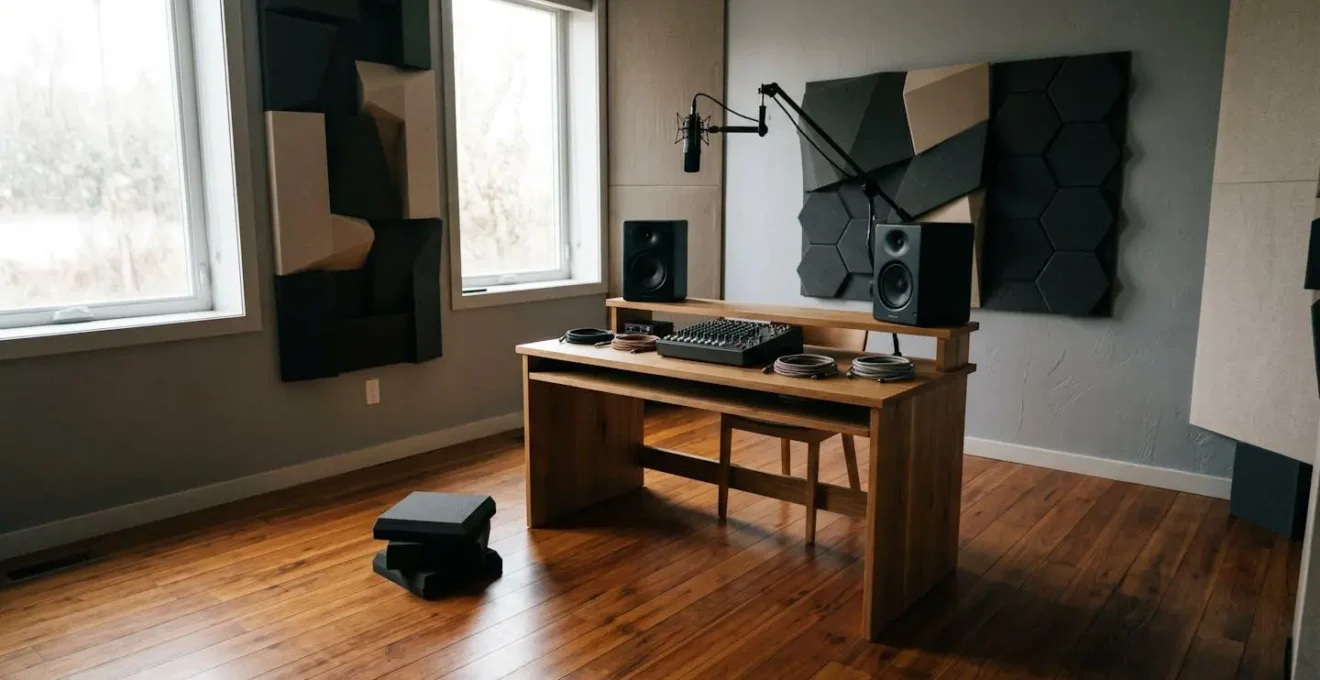
Finally, real drums are played together in a single room. The sound of the snare bleeds into the hi-hat microphone; the crash of a cymbal resonates through the whole kit. To make samples sound cohesive, they need a shared spatial context. This is achieved by sending all the individual drum tracks to a common reverb or room simulation bus. This « glue » makes the disparate samples sound like a unified instrument played in a real space. Without these layers of humanization, even the best samples are just a collection of isolated, robotic sounds.
- Program ghost notes extensively: Add countless quiet in-between notes (especially on snare and hi-hats at velocities 20-40) that aren’t consciously heard but are essential to authentic groove.
- Apply patterned velocity variations: Stop randomizing—instead mimic a real drummer’s strong hand/weak hand pattern (e.g., 16th-note hi-hats: 8th notes at velocity 90-100, off-beat 16ths at 50-65).
- Modulate samples systematically: Use subtle pitch (+/- 5 cents), filter cutoff, or sample start time modulation on each hit to avoid the machine-gun effect of identical repeated samples.
- Add bleed and shared room ambience: Layer subtle cymbal bleed into the snare mic track and apply a shared room reverb to the entire kit to make individual samples sound like they’re played together in a real space.
Now that you understand the principles of groove architecture and tension calibration, the next step is to apply them. Open your latest project, identify one source of rhythmic tension or arrangement clutter, and use these techniques to transform it into a source of energy and power.