Learn & create
Every musician remembers the moment they transitioned from a passive listener to an active creator. Whether it is the first time you sat in front of a piano, picked up a saxophone, or opened a Digital Audio Workstation (DAW), the urge to create is universal. However, the path from a musical idea to a finished, professional-sounding track is rarely a straight line. It is often cluttered with technical hurdles, theoretical confusion, and creative blocks.
This resource is designed to bridge the gap between your creative instincts and the technical skills required to execute them. By deconstructing complex topics into actionable strategies, we aim to help you move beyond basic tutorials and develop a deep, intuitive understanding of how music works. Whether you are struggling with muddy mixes, robotic midi performances, or songwriting structures that feel stagnant, the following sections provide the roadmap to elevate your craft.
Transcending Basic Music Theory: How to Create Emotion
Many songwriters feel trapped by the very rules meant to help them. You might know your scales and diatonic chords, yet your progressions sound like a textbook exercise rather than a compelling song. The secret lies not in discarding theory, but in understanding which rules to break and when.
Moving Beyond Default Progressions
To escape the cycle of generic songwriting, one must explore harmonic concepts that add color and tension. While standard major and minor chords form the foundation, professional composers often utilize specific techniques to evoke deeper emotions:
- Modal Interchange: Borrowing chords from parallel modes (like using a minor iv in a major key) to create unexpected emotional shifts.
- Extended Harmony: Incorporating 9ths, 11ths, and 13ths to add sophistication, provided they are voiced correctly to avoid « mud » in the frequency spectrum.
- Voice Leading: Ensuring that individual notes flow smoothly from one chord to the next, which distinguishes a polished composition from a blocky, amateur progression.
Optimizing the Production Workflow
In the modern era, the producer is often the composer, engineer, and mixer combined. This freedom comes with the paralysis of choice. With thousands of plugins and infinite editing possibilities, it is easy to spend ten hours on a task that professionals finish in two. Developing a streamlined workflow is arguably as important as having a good ear.
Speed and Intentionality in the DAW
A common pitfall for digital producers is the « templatetrap » or the habit of hoarding plugins. A sterile digital production often stems from over-processing rather than poor tools. To stay in a creative flow state for an eight-hour session, consider these workflow adjustments:
- Master Your Shortcuts: Learning just 20 core keyboard shortcuts in your DAW (whether Logic, Ableton, or Pro Tools) can halve your production time.
- Commit to Audio: Resist the urge to keep every MIDI channel editable. Committing to audio forces you to make decisions and move forward.
- The « LessisMore » Plugin Philosophy: Owning 200 plugins often leads to worse mixes than mastering a core suite of ten. Focus on understanding the parameters of subtractive synthesis and dynamic control before upgrading your library.
Breathing Life into Performance and Programming
Why does a perfectly quantized beat feel boring, while a slightly messy live drum take makes you move? The human ear craves imperfection and dynamic variance. Whether you are recording live instruments or programming midi, the goal is to replicate the nuance of human interaction.
Dynamics and Groove
Two major factors separate amateur recordings from canonical masterpieces: dynamic control and « swing » or groove. A mechanical performance—where every note is the same volume and perfectly on the grid—fails to engage the listener emotionally.
For instrumentalists, such as pianists or wind players, this means mastering the subtle art of dynamic shading—knowing when to build intensity for a climax and how to maintain clarity in quiet passages. For electronic producers, this involves moving notes off the grid, adjusting velocity values manually, and understanding how different elements (like bass and drums) interact to create a « pocket. » Deep funk or authentic swing isn’t about mathematical precision; it’s about the microscopic push and pull of time.
Songwriting Structure and Arrangement
You may have a great hook and a catchy beat, but if the song’s structure is flawed, the listener will tune out before the end. A common issue is the four-minute song that feels like it drags on for ten. This is usually a failure of arrangement and structural evolution.
Keeping the Listener Hooked
Arrangement is the art of managing the listener’s attention span. To ensure your track retains its energy from start to finish, you must carefully manage the entry and exit of musical textures:
- Contrast is Key: Verses and choruses must sound distinct, not just in volume but in density and instrumentation.
- The Explosion Effect: Making a chorus « explode » isn’t just about making it louder; it’s about stripping back the pre-chorus to create a vacuum that the chorus then fills.
- Strategic transitions: Drum patterns and fills should signal section changes, guiding the listener subconsciously through the song’s narrative.
Overcoming Creative Blocks and Finishing Tracks
The most difficult skill to master is often the ability to declare a piece of work « finished. » The fear that a track isn’t good enough leads to endless revisions, often destroying the magic of the original demo. It is worth noting that professional songwriters often write dozens of songs for every single one that gets released.
To grow, you must shift your mindset from perfectionism to iteration. Whether you are trying to decode an orchestral score, build a trumpet embouchure, or mix a pop song, the principles remain the same: consistent practice, deliberate study of the masters, and the courage to call a project done and move on to the next. By mastering the fundamentals of theory, production, and performance outlined here, you equip yourself with the tools to turn your creative vision into reality.

Why Do Your Major Key Songs Sound Cheesy, Not Joyful?
Contrary to common belief, the key to writing emotionally rich major key songs isn’t avoiding happiness, but mastering harmonic nuance. The « cheesy » sound comes from predictable, friction-free progressions. By intentionally introducing and controlling dissonance through techniques like voice leading, borrowed…
Lire la suite
Why Do Your Up-Tempo Songs Sound Rushed Instead of Energetic?
The solution to rushed, anxious-sounding fast tracks isn’t to practice more with a metronome, but to fundamentally shift your perspective. True energy comes from controlling space and tension within the beat, not from sheer speed. This guide dismantles the « faster…
Lire la suite
Why Do Your Fast Solos Sound Like Exercises While Slower Players Sound Musical?
The frustrating gap between your technical skill and your musical expression doesn’t come from a lack of knowledge, but from practising the wrong things in the wrong order. Musicality is not built by accumulating scales and patterns, but by internalising…
Lire la suite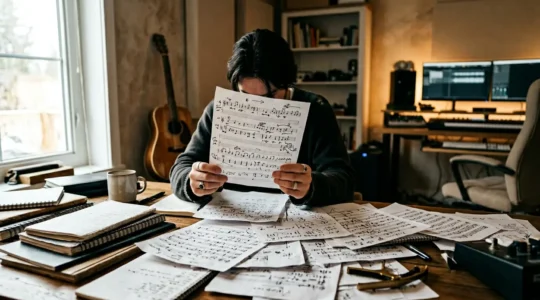
Why Do Hit Songwriters Reject 90% of Their Own Ideas?
The biggest myth holding you back is that every song idea is precious; the professional reality is that songwriting is a manufacturing process where over 90% of the raw material is discarded to engineer a commercially viable product. Success requires…
Lire la suite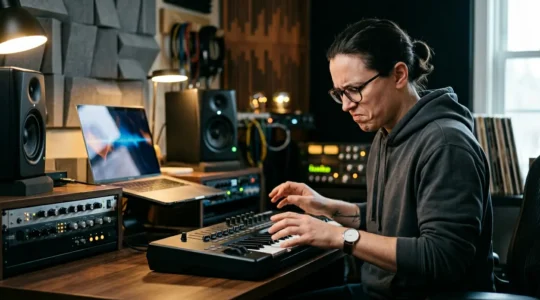
Why Your Music Sounds Amateur Despite Following Every Tutorial
Your production doesn’t sound amateur because of a technical flaw, but because of a missing creative vision that fails to unify your skills. Professionals prioritise ‘macro’ skills like songwriting and emotional arc before ‘micro’ skills like EQ and compression. Finishing…
Lire la suite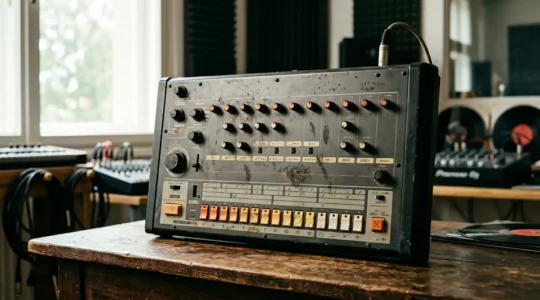
Why Do Your Programmed Grooves Sound Like a Robot Despite Using Real Drum Samples?
Contrary to common belief, the key to a human-sounding groove isn’t just using « real » drum samples or randomly shifting notes. The stiffness comes from a misunderstanding of ‘feel’. This article reveals that groove is not chaos but a deliberate language…
Lire la suite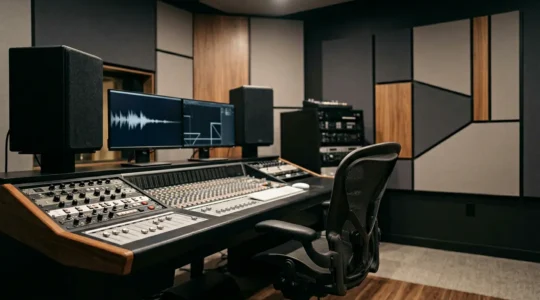
Why Do Professionals Get Better Results From the Same Plugins You Own?
The professional’s edge isn’t a secret plugin; it’s a deliberate system that treats mixing as a cognitive task, not a gear collection contest. Your massive plugin library is the primary source of decision fatigue, actively making your mixes worse. A…
Lire la suite
Why Does Your DAW Workflow Take 10 Hours When Professionals Finish in 2?
Spending 10 hours on a track professionals finish in 2 isn’t about your talent or your DAW—it’s about a broken production system that creates friction and decision fatigue. True speed comes from building efficient systems (lean templates, task-specific workflows) that…
Lire la suite
Why Does Playing a Sonata Feel So Much Harder Than It Should?
You can play difficult standalone pieces, yet a sonata of similar technical level feels impossibly hard. That’s because the challenge isn’t just the notes. A sonata demands you become a musical architect, building a single, unified dramatic narrative over a…
Lire la suite
Why Can’t You Follow an Orchestral Score Even Though You Read Piano Music?
The pianist’s struggle with orchestral scores isn’t a failure of reading ability, but a crisis of information management. The key is to stop trying to process every note. Reading a full score demands a shift from linear note-tracking (piano) to…
Lire la suite