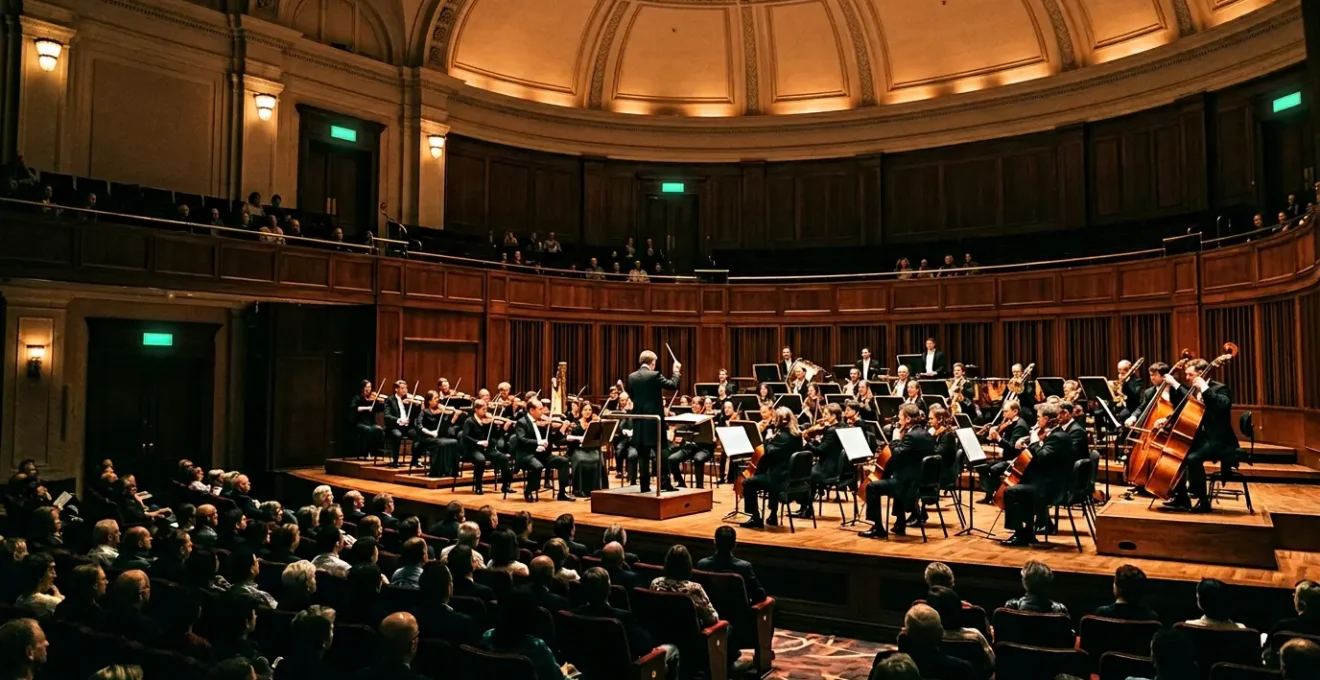
Contrary to popular belief, the magic of a live concert isn’t just about ‘better acoustics’—it’s a complex cognitive event where your brain actively builds the experience.
- The physical space of a hall creates ‘sound envelopment’, a 3D audio immersion that stereo recordings cannot mimic.
- Watching musicians provides crucial visual cues that your brain synchronises with sound to decode emotional intent and narrative.
- Active listening is a trainable skill that involves parsing instrument layers, a process fundamentally different from passively hearing a pre-mixed recording.
Recommendation: The next time you attend a concert, shift your focus from passive listening to actively observing how sound, sight, and the room itself combine. You’ll unlock a profoundly deeper level of appreciation.
There’s a universally understood, yet difficult to describe, chasm between hearing a symphony in a concert hall and playing the same piece on a high-end sound system. We often reach for simple explanations: the « energy of the crowd » or the « acoustics of the room. » While true, these are just surface-level observations. They don’t explain the fundamental shift in perception, the feeling that the music is not just being heard, but *experienced*—a living, breathing entity unfolding in time and space. The common wisdom suggests a better recording or superior speakers could bridge this gap, but this misses the point entirely.
The real difference lies not in the sound waves alone, but in how our brain processes them. A live performance is a multi-sensory data stream. It’s a torrent of auditory information from every direction, visual cues from a hundred musicians, and even the subtle social feedback of a rapt audience. A recording, no matter how pristine, is an interpretation; it’s a two-dimensional photograph of a three-dimensional event, pre-mixed and flattened. It hands you a finished product.
But what if the true magic isn’t in receiving a perfect product, but in the cognitive act of creation itself? This article proposes a different perspective: the profound feeling of live music comes from the fact that the listener’s brain is working as an active partner in the performance. It is a process of cognitive reconstruction, where you are not just a passive recipient, but the final, crucial interpreter of a rich, complex, and unrepeatable event.
This guide will deconstruct that live experience, moving from the physics of the concert hall to the neuroscience of your brain. By exploring how your position in the hall changes what you hear, how orchestras build their unique sonic identities, and how you can train yourself to listen more actively, we will uncover the hidden alchemy that makes a live concert an irreplaceable human experience.
Summary: Unlocking the Live Concert Experience
- Why Does the Same Symphony Sound Completely Different From Stalls Versus Gallery?
- How to Listen to Orchestral Music So Time Flies Instead of Drags?
- Why Does the London Symphony Sound Different From the Berlin Philharmonic Playing the Same Work?
- The Concert Etiquette Worry That Prevents You Enjoying Live Classical Music
- Which Orchestral Concerts Should Classical Newcomers Attend First?
- Live Concert or Reference Recording: Which Teaches You More About Symphonies?
- Why Do Audiences Lose Interest During Your Performance Even When You Play Well?
- Why Do All Symphonies Seem to Sound the Same Until You Learn What to Listen For?
Why Does the Same Symphony Sound Completely Different From Stalls Versus Gallery?
The most immediate difference between a live concert and a recording is the physical reality of the sound. At home, music comes from two or more fixed points. In a concert hall, you are submerged in it. The idea that every seat offers a unique auditory perspective isn’t just a turn of phrase; it’s a physical fact. Your location dictates the balance of direct versus reflected sound, fundamentally altering your perception of the music. A seat in the front stalls delivers crisp, direct sound from the instruments, emphasising clarity and detail. A seat in the upper gallery, however, receives a richer blend of sound that has travelled, reflected off multiple surfaces, and arrived at your ears from all directions. This creates what acousticians call sound envelopment—the feeling of being completely surrounded by the music.
This isn’t a subtle effect. Depending on the hall’s design, there can be an audible variation of 3 to 10 dB in sound strength across different seating areas. This means some seats are literally twice as loud as others. But it’s the quality, not just the quantity, of sound that matters. The best seats aren’t always the closest or most expensive; they are the ones that provide the optimal blend of direct sound (for clarity) and lateral reflections (for envelopment and a sense of space). The sound waves travel, bend, and reflect in a complex dance before they reach you.
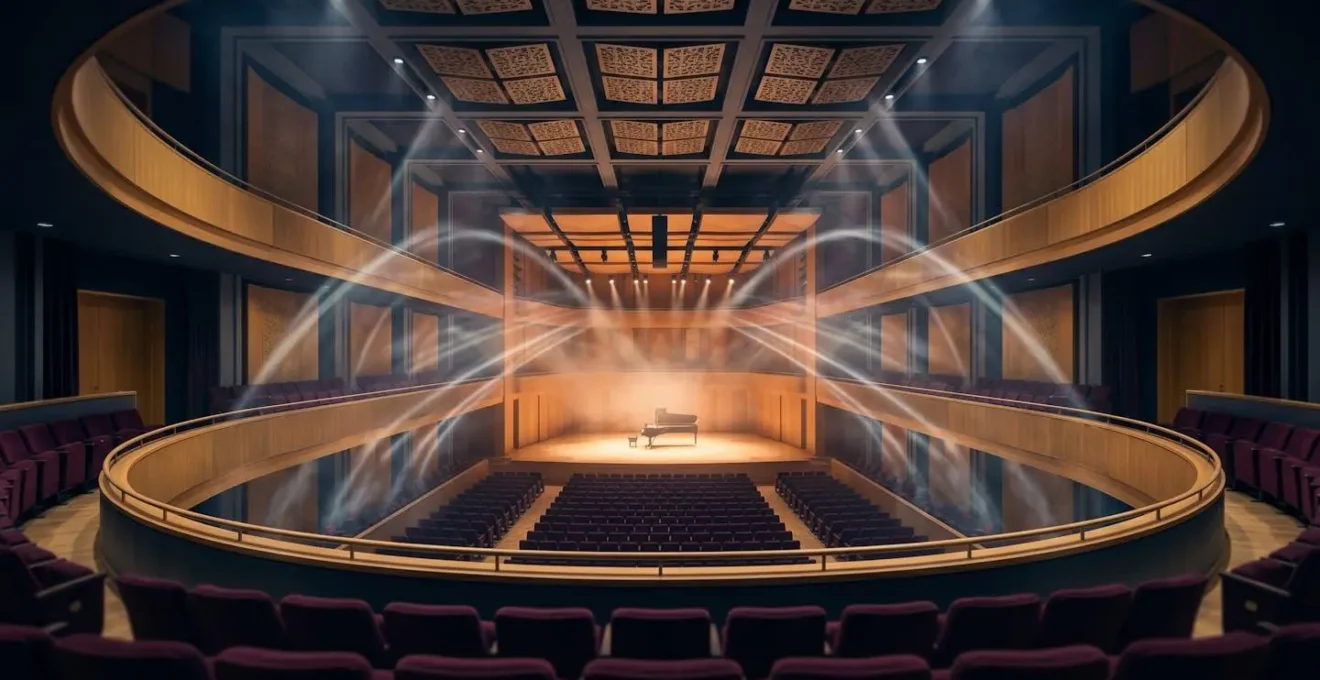
As the image above illustrates, sound in an architectural space is not a linear beam but a three-dimensional field. As physicist Manfred R. Schroeder noted, achieving this feeling of immersion is a primary goal of concert hall design. It’s about more than just reverberation; it’s about being wrapped in sound. This multi-directional auditory input is something a standard stereo recording, which projects sound from the front, simply cannot replicate. This physical immersion is the first layer of the live experience, transforming passive listening into a full-body sensory event.
How to Listen to Orchestral Music So Time Flies Instead of Drags?
If the hall provides the physical soundscape, your brain provides the map to navigate it. The feeling of time dragging during a concert is often a sign of passive listening, where the complex orchestral texture washes over you as a single, undifferentiated wall of sound. The key to engagement—and making an hour-long symphony feel like minutes—is to shift from hearing to active listening. This is not about ‘concentrating harder’; it’s about giving your brain a specific job to do. It’s the skill of performing what cognitive scientists call Auditory Scene Analysis: the brain’s remarkable ability to untangle a complex mix of sounds and identify individual sources.
When you listen to a recording, this work is largely done for you by a sound engineer who has decided the « correct » balance. In a concert hall, you are the engineer. You have the raw data, and you can choose where to focus your attention. You can follow the melancholic line of the solo oboe, track the conversational interplay between the first and second violins, or feel the foundational pulse of the double basses. This active participation transforms the experience. Neuroscience research demonstrates that the brains of professional musicians show distinct patterns of activity when listening, suggesting that trained listening is a different neurological event altogether.
Engaging with music this way is a skill that can be developed. By consciously directing your focus, you begin to perceive the intricate architecture of the piece rather than just its surface. This mental engagement is what makes time seem to disappear, as you become absorbed in the process of discovery.
Action Plan: Techniques for Active Concert Listening
- Practice Auditory Scene Analysis: Train your brain to parse individual instruments. Try to focus on a single instrument, like the principal cello or a French horn, and follow its line through an entire passage.
- Engage Visual-Auditory Synchronisation: Watch the musicians. Notice the conductor’s preparatory breath before a big entry, the shared glance between section leaders, or the physical effort of a brass player in a loud passage. This links what you see to what you hear, adding a rich narrative layer.
- Identify Grouping: Notice how composers use the orchestra. Listen for moments when different instrument families blend to create a new, unified colour (concurrent grouping) and moments when a melody is passed from one section to another, weaving through the orchestra (sequential grouping).
- Learn Timbral Fingerprints: Focus on distinguishing the unique ‘colour’ or timbre of each instrument family. Learn the difference between the mellow warmth of a horn, the bright cut of a trumpet, the reedy edge of an oboe, and the lushness of the string section.
Why Does the London Symphony Sound Different From the Berlin Philharmonic Playing the Same Work?
Even when listening to a recording, seasoned listeners can often identify an orchestra by its signature sound. The London Symphony Orchestra might be known for its brilliant, flexible brass, while the Berlin Philharmonic is famed for its rich, blended string sound. This sonic identity is a product of many factors: the conductor’s philosophy, the players’ training, and even the specific makes of their instruments. But in a live setting, another character enters the performance: the concert hall itself. The hall is not a neutral container; it is an orchestra’s most important instrument, shaping and colouring every note it produces.
The architecture of a hall imparts a distinct acoustic fingerprint. This is why the same orchestra can sound dramatically different on tour than in its home venue. Research has consistently shown that certain architectural designs are more successful than others at creating a rich, immersive sound.
Case Study: The « Shoebox » Signature
Many of the world’s most acoustically revered concert halls—such as Vienna’s Musikverein and Boston’s Symphony Hall—share a classic rectangular or « shoebox » design. A study comparing listener preferences across various hall shapes found that this traditional design excels at providing a uniform, enveloping sound. The parallel walls and high ceilings create a rich tapestry of lateral reflections that surround the listener. In contrast, more modern « vineyard » or « fan-shaped » halls, while offering better sightlines, can sometimes create a less cohesive and more variable acoustic experience across the seating areas.
The hall’s character interacts with the orchestra’s playing to create a unique, unrepeatable event. A hall with a long reverberation time (like a cathedral) will flatter the lush, blended sound of a Romantic symphony but may obscure the crisp details of a Bach cantata. A « dryer » hall with less reverb might offer stunning clarity but lack warmth. As one of the 20th century’s leading acousticians, Leo L. Beranek, observed, this interaction is key to a hall’s identity:
The warmth of Vienna’s Musikverein vs. the clarity of Berlin’s Philharmonie creates distinct sonic fingerprints. High-ranking halls are predominately shoebox in shape—there are no fan-shaped halls among the top-rated venues.
– Leo L. Beranek, Journal of the Acoustical Society of America
The Concert Etiquette Worry That Prevents You Enjoying Live Classical Music
For many newcomers, the biggest barrier to enjoying a classical concert isn’t the music itself, but the perceived minefield of social rules. The fear of clapping « in the wrong place, » coughing at the wrong moment, or wearing the wrong thing can create an anxiety that gets in the way of the music. This « etiquette worry » stems from a modern convention of reverent silence, a practice that is, historically speaking, a very recent invention. For much of classical music history, audiences were far more boisterous and interactive.
In fact, modern silence-between-movements etiquette emerged only in the mid-19th century, driven by composers and conductors who wanted the music to be treated as a quasi-religious art form. Before that, composers like Mozart and Beethoven fully expected audiences to applaud spontaneously after a particularly exciting passage or bravura solo. The concert hall was a social space as much as an artistic one.

Knowing this history helps to reframe the experience. The point is not to follow a rigid set of rules, but to participate in a shared, communal focus. The silence in a modern concert hall is not an empty, restrictive void; it is a collective holding of breath, a shared tension that makes the eventual release of the music (and the applause) all the more powerful. It’s a sign of a group of people agreeing to focus their attention on one thing together. Music historian Philip Gossett put it best:
The modern etiquette of sitting on your hands would have horrified Mozart, Beethoven, Donizetti: they all expected their music to be applauded after climactic movements, arias, choruses.
– Philip Gossett, Classical California
Which Orchestral Concerts Should Classical Newcomers Attend First?
Diving into the world of orchestral music can feel daunting. With centuries of music and dozens of composers, where does one even begin? The key is to match the concert experience to your existing tastes and personality, rather than trying to tackle a heavyweight 90-minute symphony on your first outing. Choosing the right « entry point » can be the difference between a captivating evening and a confusing one.
Think of your first few concerts as a tasting menu. A program with a variety of shorter pieces—an overture, a concerto, and a symphony, for example—is often more accessible than one dedicated to a single, monumental work. This variety reduces the risk of attention fatigue and exposes you to a wider range of styles and moods in one evening. Beyond the programming, consider the type of concert experience you’re looking for:
- Start with the Familiar: If you love film scores, look for a « live-to-picture » concert or a program dedicated to composers like John Williams or Hans Zimmer. If you enjoy familiar melodies, a « Pops » concert featuring orchestral arrangements of popular or show tunes is a fantastic and relaxed introduction.
- Match to Your Personality: The orchestral repertoire is vast enough to suit any temperament. If you appreciate logic, structure, and intricate patterns, the music of Bach and the Baroque era might be a perfect fit. If you are drawn to grand emotions, drama, and passion, the Romantic composers like Tchaikovsky, Mahler, or Dvořák will deliver. For adventurous listeners who enjoy rhythmic drive and bold colours, exploring 20th-century masters like Stravinsky or Bartók can be thrilling.
- Consider the Scale: A full symphony orchestra is a powerful force, but sometimes a smaller ensemble is more approachable. A concert by a chamber orchestra offers a more intimate and detailed listening experience, where you can more easily follow individual instruments and their interplay.
Ultimately, the goal is to find a performance that resonates with you on a personal level. As researchers Tapio Lokki and Jukka Pätynen found, the acoustic experience itself can be transformative; « When an orchestra plays louder, in some halls the size of the orchestra seems to increase and the hall ‘wakes up’ in fortissimo. » Finding a concert that delivers that « waking up » moment for you is the perfect start to a lifelong journey.
Live Concert or Reference Recording: Which Teaches You More About Symphonies?
A reference recording is an invaluable tool for learning a symphony. It allows you to repeat passages, follow along with a score, and familiarise yourself with the music’s structure in a controlled environment. However, it presents a single, polished, and ultimately artificial version of the work. A live concert, in contrast, offers a richer, multi-layered learning experience that engages more of your brain precisely because it is more complex and less « perfect. »
The key difference lies in the information available to you. A recording presents an auditory « scene » that has already been analysed and assembled by an engineer. The live experience gives you the raw data. This allows for a deeper form of learning through visual-auditory synchronisation. Watching a violinist’s bow dig into the string at the start of a powerful phrase, or seeing the entire string section breathe and move as one, connects physical gesture to musical sound. This visual information provides a narrative and emotional context that a recording strips away. You’re not just hearing the music; you’re seeing how it’s made, moment by moment.
This multi-sensory encoding makes the memory of the music stronger. As Dr. Andrew Budson of Harvard Medical School explains, the live context creates a more profound impression: « In a performance venue, there’s an incredible complex sound signature all around you. Music ends up being encoded as a rich experience because lots of different things are going on simultaneously. » While studies show a correlation between our ability to parse speech in a noisy room and music in a complex orchestra, the live concert adds layers of visual and spatial information that supercharge the learning process. The recording teaches you the « what » of a symphony; the live concert begins to teach you the « how » and « why. »
Why Do Audiences Lose Interest During Your Performance Even When You Play Well?
From the performer’s perspective, one of the most perplexing challenges is seeing an audience disengage, even during a technically flawless performance. From the listener’s perspective, this explains why some perfectly played recordings can feel sterile or boring. The answer lies in a neurological concept known as predictive processing. Our brains are constantly trying to predict what will happen next, and music is a masterclass in playing with these expectations through patterns of tension and resolution.
A metronomically rigid, note-perfect performance, while impressive, can become too predictable. Once the brain figures out the pattern, it can « check out » because there are no surprises. It’s the subtle, human variations in timing, dynamics, and articulation—the micro-deviations from the predictable—that keep our brains hooked. These small surprises trigger a neurological response. In fact, listening to classical music for just 20 minutes has been shown to enhance the activity of genes involved in dopamine secretion, the neurotransmitter associated with pleasure and reward. It’s the artful manipulation of our predictions that generates this chemical and emotional payoff.
This is why live performance is so compelling. No two live performances are ever identical. The conductor may stretch a phrase slightly differently, a soloist may take a risk, or the collective energy of the orchestra may shift from one night to the next. These are not mistakes; they are the essence of a living interpretation. As researchers at Harvard noted, this element of human variability is essential for emotional connection:
A technically perfect but metronomically rigid performance becomes predictable, allowing the listener’s brain to disengage. One key way that music generates emotions is through patterns of tension and resolution.
– Harvard Medicine researchers, Harvard Medicine Magazine
Key Takeaways
- The live concert experience is a multi-sensory cognitive event, not just an auditory one. Your brain actively constructs the experience from sound, sight, and space.
- The physical shape of a concert hall creates « sound envelopment, » a 3D audio immersion that is fundamentally different from stereo reproduction.
- Active listening is a trainable skill of « Auditory Scene Analysis, » where you learn to deconstruct the orchestral texture instead of hearing it as a single mass.
- The subtle, human variations in a live performance play with your brain’s predictive patterns, creating the tension and release that generates emotional engagement.
Why Do All Symphonies Seem to Sound the Same Until You Learn What to Listen For?
For an untrained ear, the dense texture of a symphony orchestra can sound like an overwhelming, homogenous mass. Differentiating between Brahms and Beethoven, let alone telling one symphony from another, can seem impossible. This is a common experience, and it highlights the fact that appreciative listening is a learned skill. It’s not about having « good ears »; it’s about training your brain what to listen for. Without a framework, our brains default to perceiving the orchestra as a single sound source rather than a collection of dozens of individual voices.
The journey from hearing noise to hearing music involves developing a capacity for auditory grouping. As orchestration expert Dr. Stephen McAdams explains, our brains are evolved to identify sound sources. We learn to group instruments by timbre (all violins playing together), by pitch (a high flute melody floating above the orchestra), or by rhythm (a percussive pattern). Composers are masters of manipulating these grouping principles, using orchestration to create clarity, blend colours, and direct the listener’s attention. Learning to recognise these techniques is like learning the grammar of orchestral music.
Interestingly, this learning process can actually rewire how your brain processes music. In a striking discovery, neuroscientific research at UCF revealed that professional musicians often use their occipital (visual) cortex when listening to music, while non-musicians primarily use the temporal (auditory) lobe. This suggests that trained musicians may be « visualising » the musical score or the physical actions of playing as they listen, adding another layer of data to their cognitive processing. This shows that expert listening is a fundamentally different brain activity. The symphonies don’t all sound the same; rather, we need to learn the language they are speaking to tell them apart.
The difference between a live concert and a recording is the difference between participating in a conversation and reading a transcript. One is a living, breathing, multi-sensory event that demands your active cognitive engagement, while the other is a fixed, polished artifact. By attending a concert with this new awareness—ready to analyse the soundscape, watch the visual narrative, and embrace the human element—you transform yourself from a passive audience member into an active collaborator in the creation of musical meaning. The next step is to put this knowledge into practice. Find a local concert, choose a seat, and listen with new ears.