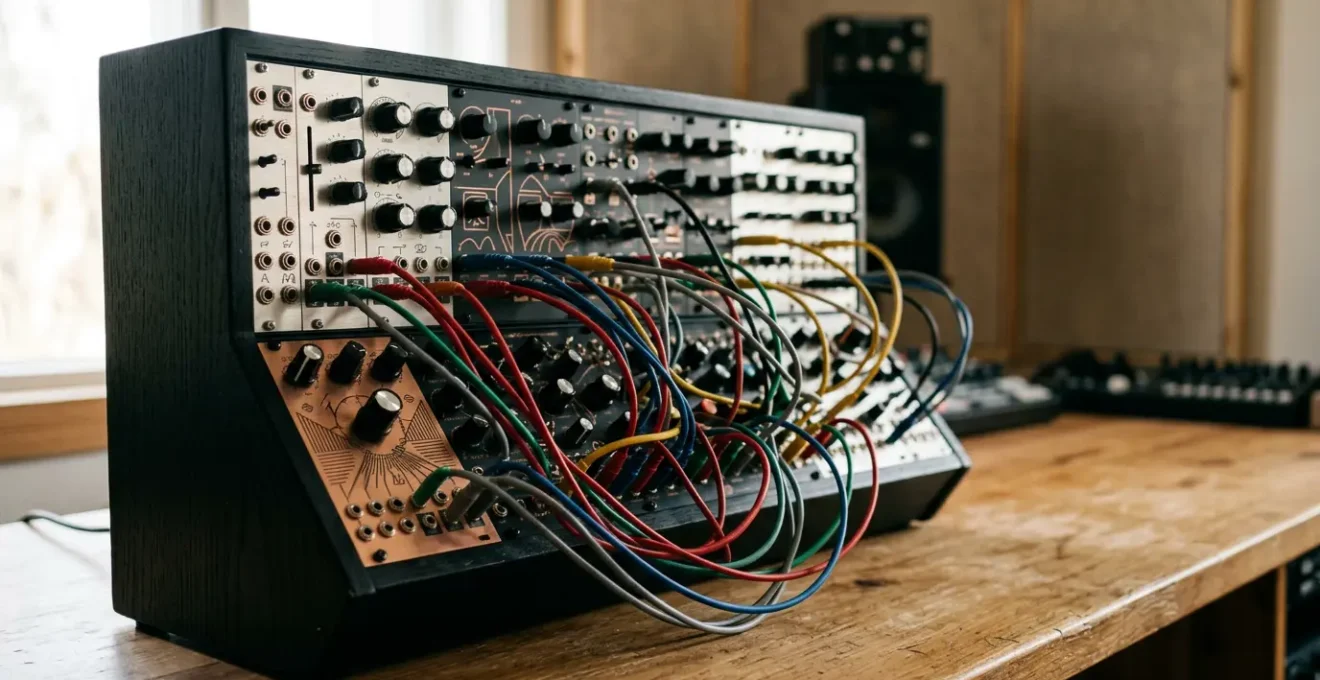
The exorbitant price of modular synthesis isn’t justified by its sonic output alone, but by its function as a tool for creative rewiring and intentional practice.
- Unlike software, the physical, tactile process of patching fosters a deeper, more deliberate engagement with sound design, leading to unique creative insights.
- The apparent limitations and « inefficiencies » of modular are its greatest strengths, forcing you out of familiar workflows and into a state of discovery.
Recommendation: Before investing heavily, explore this philosophy firsthand with software like VCV Rack or a semi-modular synth to see if the process, not just the product, resonates with you.
Let’s be honest. You see the mesmerising walls of blinking lights and tangled patch cables, you hear the otherworldly bleeps and bloops, and then you see the price tag. A single module can cost more than a powerful software synthesiser, and a full case can run into thousands of pounds. The logical part of your brain screams: « Why? I can create complex, evolving sounds with a handful of plugins for a fraction of the cost. » This skepticism is not just valid; it’s the most rational starting point for any musician evaluating modular synthesis today.
The standard arguments you’ll hear—about analogue warmth, small-batch manufacturing, or having a « unique sound »—often fall flat. While there’s truth to them, they don’t fully address the core discrepancy in value. We live in an age where digital tools are astonishingly capable, and the line between analogue and digital sound is blurrier than ever. Many producers work entirely « in the box » and create world-class, professional music. So, the justification for modular can’t simply be about the end result.
But what if the entire debate is framed incorrectly? What if modular’s true value isn’t as a sound-making machine that competes with plugins, but as a practice, a physical interface for thinking, and a creative playground built on intentional friction? The proposition is that the ‘why’ of modular has less to do with the sounds it produces and everything to do with what it does to the person using it. It’s not about acquiring a better tool; it’s about becoming a different kind of artist.
This article will deconstruct that value proposition. We will explore why the « journey » is the real product, how to begin without financial regret, and why the limitations of a focused system can make you a better songwriter. We will unpack the philosophies that divide modular formats and reveal why even with the same gear, amateur and professional patches sound worlds apart. Prepare to look past the price tag and into the process.
To navigate this complex world, this guide breaks down the core questions and philosophies behind modular synthesis. Below is a summary of the journey we are about to embark on, from understanding the mindset to mastering the techniques.
Summary: Unpacking the True Value Proposition of Modular Synthesis
- Why Do Modular Users Say the Journey Matters More Than the Destination?
- How to Start Modular Without Wasting £2,000 on Modules You’ll Never Use?
- Eurorack or Buchla Format: Which Modular Philosophy Matches Your Creativity?
- The Modular Mistake of Buying Cool Modules That Don’t Work Together
- In What Order Should You Add Modules for Maximum Musical Growth?
- Why Do Songwriters With Fewer Tools Often Write Better Songs?
- How to Create Patches That Sound Like You Instead of Preset Modifications?
- Why Do Your Synth Patches Sound Amateur Despite Using the Same Synths as Professionals?
Why Do Modular Users Say the Journey Matters More Than the Destination?
The phrase « it’s about the journey » can sound like a defensive cliché, an excuse for an expensive hobby that produces few finished tracks. Yet, in the context of modular synthesis, it points to a profound psychological shift. Unlike a plugin where parameters are presented on a neat grid, a modular synth is a blank slate of inputs and outputs. There are no presets, no « right » way to connect things. This forces a sonic dialogue; you propose an idea with a patch cable, the machine responds with a sound, and you react. This slow, deliberate interaction is a form of active problem-solving that engages the brain differently than clicking a mouse.
This hands-on process is incredibly effective at inducing a « flow state »—a state of deep immersion and energised focus. The tactile feedback of plugging in a cable, turning a physical knob, and hearing an immediate sonic consequence creates a closed loop between thought, action, and result. This isn’t just a feeling; it’s a recognised phenomenon, with recent market analysis showing a 19% growth in beginners’ adoption of modular synthesizers, many of whom are seeking this very experience. The destination—a finished sound or song—becomes secondary to the rewarding process of discovery itself.
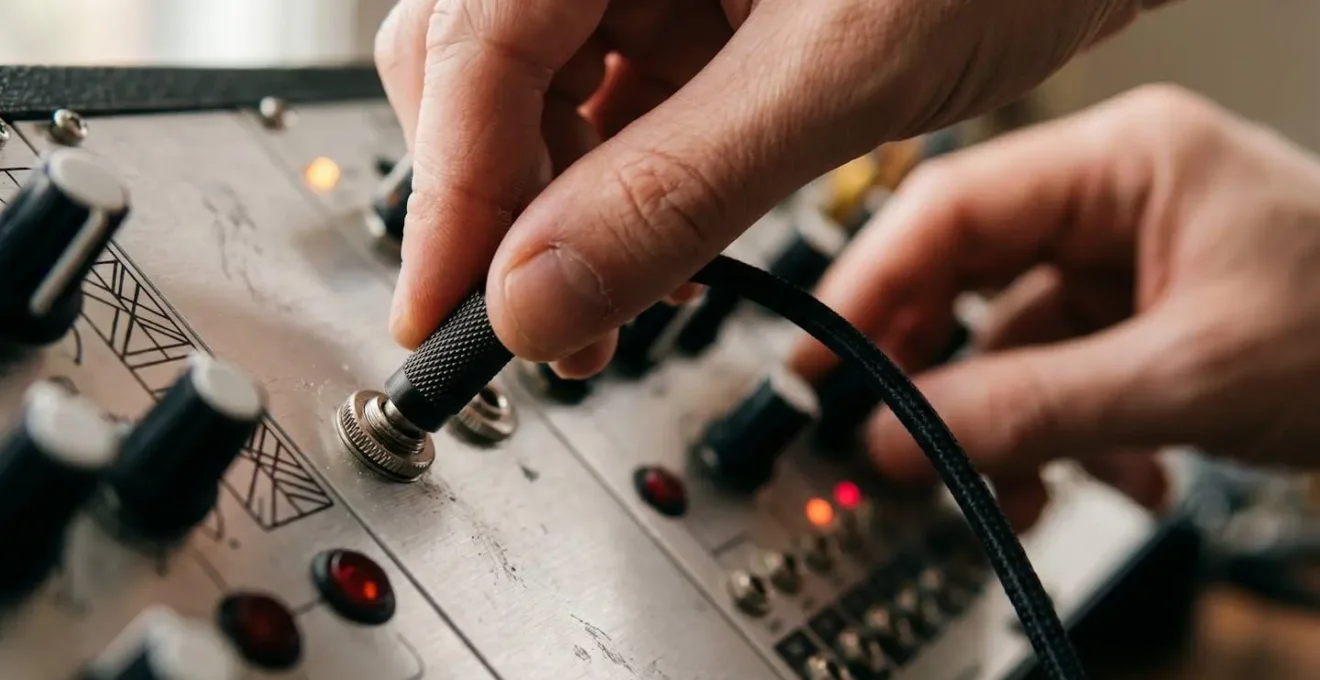
As you can see, the focus is on the physical interaction. This deep engagement is what experts refer to when discussing peak creativity. It’s about building an intuition through physical repetition until the actions become second nature. As explained by Dr. John Kounios of Drexel University in a study on the neuroscience of creativity:
Productive flow states can be attained by practice to build up expertise in a particular creative outlet coupled with training to withdraw conscious control when enough expertise has been achieved.
– Dr. John Kounios, Drexel University Creativity Research Lab
Ultimately, the « journey » is the gradual rewiring of your musical brain. You stop thinking about sound in terms of presets and start thinking in terms of fundamental building blocks: control voltage, signal flow, and modulation. The product isn’t the patch; the process-as-product is the new, deeper understanding of synthesis you gain along the way. This is the value that no plugin can replicate.
How to Start Modular Without Wasting £2,000 on Modules You’ll Never Use?
The fear of making a costly mistake is the single biggest barrier to entry in modular synthesis. With the knowledge that 60% of independent musicians now record in home studios, budget-conscious decisions are more critical than ever. The internet is littered with photos of expensive systems being sold at a loss because the owner bought modules based on hype rather than need. Avoiding this fate requires a strategic, patient approach that prioritises self-knowledge over gear acquisition.
The most common error is buying « exciting » modules first—complex oscillators, granular processors, or flashy effects—without the necessary support system. A powerful voice module is useless without the « boring » utilities: mixers to combine signals, attenuators to control modulation depth, and logic gates to create complex rhythms. Starting with these foundational blocks, or by exploring synthesis concepts in a risk-free environment, is the key to building a system that you will actually use and grow with.
Instead of diving headfirst into Eurorack, consider a phased entry that allows you to discover your personal workflow. Think of the second-hand market not as a place to find cheap gear, but as a low-risk « rental system. » A popular, well-regarded module can often be bought and resold months later for a minimal loss, effectively letting you test-drive its function. This iterative process is far more valuable than weeks of online research. The goal isn’t to build your « dream system » on day one, but to discover what that dream system even is, one module at a time.
Action Plan: A Strategic Path to Enter Modular Synthesis
- Start with Software or Semi-Modular: Use VCV Rack (free software) or a hardware synth like a Moog Mother-32 to identify your workflow preferences before buying standalone modules.
- Leverage the Second-Hand Market: Treat the used market as a « rental system. » Buy popular modules, learn them deeply, and resell for a minimal loss to discover your true needs.
- Prioritise « Boring » Utilities First: Acquire attenuators, mixers, and logic gates before exciting sound sources. Utilities maximise the potential of any voice you add later.
- Define a Single Sonic Goal: Aim for one specific outcome (e.g., « evolving ambient textures ») and buy only the minimum modules required to achieve it.
- Document Your Patches: Use diagrams and recordings to understand which modules become essential to your workflow and which remain underutilised.
Eurorack or Buchla Format: Which Modular Philosophy Matches Your Creativity?
Not all modular systems are created equal. Beyond the size of the panels or the type of patch cables, there lie two fundamentally different philosophies of sound and music creation, broadly categorised as « East Coast » and « West Coast » synthesis. Understanding which philosophy aligns with your creative goals is vital before you invest a single pound. Your choice here will influence every sound you make.
East Coast synthesis, pioneered by Bob Moog and forming the foundation of most Eurorack systems, is primarily subtractive. You start with a harmonically rich waveform (like a sawtooth or square wave from a Voltage-Controlled Oscillator, or VCO) and carve away frequencies using a Voltage-Controlled Filter (VCF). This approach is precise, melodic, and rooted in traditional keyboard-based music. It excels at creating powerful basslines, sharp leads, and structured compositions, making it a natural fit for techno, pop, and other rhythmically driven genres.
West Coast synthesis, championed by Don Buchla, takes a radically different approach. It is often additive, starting with a simple waveform (like a sine wave) and adding harmonic complexity through techniques like wavefolding and frequency modulation (FM). Instead of a filter as the primary sound shaper, it often uses Low-Pass Gates (LPGs) that control both timbre and volume simultaneously, creating organic, percussive sounds. The focus is less on precise melodies and more on generative processes, textural soundscapes, and exploring timbre. As one historical analysis notes, Buchla’s intent was not to replicate existing instruments, but to create entirely new sonic worlds.
This table breaks down the core differences, helping you identify which path resonates more with your musical intuition. As this comparative analysis shows, the choice is about workflow as much as sound.
| Characteristic | East Coast (Eurorack/Moog) | West Coast (Buchla) |
|---|---|---|
| Synthesis Method | Subtractive: Start with harmonically rich waveforms (saw, square) and filter/sculpt away | Additive/Complex: Start with simple waveforms (sine) and add complexity via wavefolding, FM, AM |
| Control Voltage Standard | ±5V to ±10V bipolar (affects modulation behavior and depth) | 0-10V unipolar in 200 series (creates different modulation ‘feel’) |
| Musical Approach | Precise sequencing, melodic/harmonic structures, rhythmic precision | Generative processes, random sources, organic/textural soundscapes |
| Typical Genre Fit | Techno, pop, bass music, structured composition | Ambient, experimental, algorithmic/generative music |
| Core Module Philosophy | VCO → VCF (filter as primary shaper) → VCA with ADSR envelopes | Complex oscillators → Low-pass gates (LPGs) → Function generators (AD/AR) |
| Performance Interface | Traditional keyboard, precise pitch tracking (1V/octave) | Touch plates, pressure sensors, unconventional controllers |
The Modular Mistake of Buying Cool Modules That Don’t Work Together
The allure of a unique, powerful module is strong. You might see a mesmerising demo of a granular processor or a chaotic random source and think, « I need that sound! » This impulse purchase is the most common and costly mistake in modular. A synthesiser is a system, an ecosystem where every part must communicate effectively. Without a shared understanding of function and, crucially, voltage, a collection of « cool » modules can result in a frustrating and musically incoherent mess.
The most insidious compatibility issue isn’t function, but voltage standards. Different formats and even different manufacturers within Eurorack use varying voltage ranges for audio and control signals (CV). This isn’t just a technical detail; it’s the reason why your patch might sound « broken. » Mixing modules without understanding their expected voltage levels can lead to harsh digital clipping, weak modulation, or envelopes that don’t trigger correctly. It’s the invisible framework that determines whether your system feels cohesive or like a box of broken toys.
This issue is a classic example of how a lack of foundational knowledge can undermine expensive hardware purchases. The problem isn’t that the modules are bad; it’s that they are speaking different languages. A module designed for a ±10V bipolar LFO signal will behave erratically when fed a 0-5V unipolar signal from another module. Before buying any module, the first questions should be: « What are its input/output voltage ranges? » and « How does that compare to the rest of my system? »
Case Study: The Voltage Range Compatibility Trap
A comprehensive analysis by Chris Meyer of Learning Modular highlights a critical, often-overlooked difference between modular formats. Classic Moog systems used low-level audio signals with high-voltage power rails, providing about 18 dB of headroom. This meant you could mix several oscillators without distortion. In contrast, modern Eurorack uses high-level audio signals (±5V) with clipping limits close to the power rails (±10V), leaving only about 6 dB of headroom. This technical difference, as detailed in Meyer’s research, explains why mixing three VCOs at full volume in Eurorack often causes harsh clipping, while older systems maintained clarity. Musicians buying modules based on features alone, without understanding these headroom constraints, often end up fighting technical incompatibility instead of making music.
The solution is to think like a systems engineer, not a collector. Plan your rack around a core philosophy and ensure that the foundational utility modules—mixers, attenuators, and VCAs—are in place to properly tame and scale the signals between your more « exciting » modules.
In What Order Should You Add Modules for Maximum Musical Growth?
Once you’ve committed to starting a modular system, the question of « what’s next? » becomes a constant source of anxiety and temptation. A haphazard approach, buying whatever seems interesting this week, leads to a disjointed instrument and stagnant creativity. The most effective method for expansion is to let your music tell you what it needs. This means embracing a period of limitation to diagnose your true creative bottleneck.
The process is simple but requires discipline. Start with a complete, but minimal, synthesiser voice: a sound source (VCO), a sound shaper (VCF), a volume controller (VCA), and a modulator (envelope generator). Spend significant time—at least 20 hours—exploring only this simple configuration. Push it to its absolute limits. Sooner or later, you will hit a wall. You’ll think, « I wish this sound wasn’t so static, » or « I can’t create the rhythmic patterns I want. » That specific frustration is the signal. That is your creative bottleneck.
Your next module purchase should be a direct, targeted solution to that single problem. If your sounds are static, you need a more complex modulation source like a versatile LFO or a random voltage generator. If your rhythms are boring, you need a clock divider or logic module. By adding only one module that solves a diagnosed problem, you ensure that every addition has an immediate and profound impact on your music. This « Creative Bottleneck Method » transforms gear acquisition from a consumerist habit into a deliberate step in your artistic development.
Action Plan: Your 5-Point Module Synergy Audit
- Function Inventory: List the core function of every module you own or plan to buy (e.g., Sound Source, Modifier, Modulator, Utility). Are any categories critically empty or overstuffed?
- Signal Path Mapping: Sketch out three ideal patches. Identify which modules are used in all three (your core) and which are used in none (your potential waste).
- Modulation Matrix Check: For each sound source and modifier, list its CV inputs. Now list your modulation sources (LFOs, envelopes). Is there a healthy balance, or a severe surplus of destinations with no sources?
- The ‘Boring’ Utility Ratio: Count your mixers, multiples, and attenuators. Is the ratio of ‘exciting’ sound modules to these ‘boring’ utilities greater than 2:1? If so, you likely lack the essential glue for a cohesive system.
- Single-Goal Stress Test: Define one specific sonic goal (e.g., « generative acid bassline »). Can you achieve this with your planned setup? If not, what is the single, cheapest module that unlocks it?
Why Do Songwriters With Fewer Tools Often Write Better Songs?
There’s a persistent paradox in music creation: giving an artist a room full of infinite options often results in less finished, less impactful work. Conversely, imposing strict limitations can lead to a surge of creativity. This isn’t just anecdotal; it’s a well-documented psychological principle known as creative constraint. In the world of synthesis, a massive modular system or a DAW loaded with hundreds of plugins can be a creative trap, overwhelming the artist with choice and inducing a state of paralysis.
The core issue is cognitive load. Every tool, every option, every parameter consumes a portion of your finite mental bandwidth. When you are faced with a near-infinite number of choices, a significant part of your brainpower is diverted to simply managing those choices, leaving less available for the actual creative act of composition. As research on musical tasks has found, musicians under high cognitive load demonstrate significantly less creative insight. A simple, limited system—like a single semi-modular synth—removes this burden. It forces you to master the tools you have, pushing you to discover novel uses for them instead of searching for a new tool for every problem.

This minimalist setup, as depicted here, isn’t a sign of a beginner but often the mark of a focused artist. By intentionally limiting the toolkit, the songwriter shifts their mental energy from « what could I use? » to « what can I do with this? ». This constraint fosters deep knowledge and mastery. You learn every nuance of your VCF, every sweet spot of your envelope generator. This deep familiarity allows for faster, more intuitive creation, where the tools become a seamless extension of your musical ideas rather than an obstacle course of options.
The power of a limited toolset lies in its ability to force creative problem-solving. When you can’t just add another voice or a different effect, you’re compelled to find more imaginative solutions with what you have: How can I use an LFO as a sub-harmonic oscillator? How can I create a percussive sound with only a filter? These questions, born of limitation, are the very essence of innovative sound design and songwriting.
How to Create Patches That Sound Like You Instead of Preset Modifications?
Developing a unique sonic signature is the ultimate goal for any synthesist. In a world saturated with presets and common techniques, this means moving beyond the obvious and learning to imbue your patches with personal character. This isn’t about finding a « secret » module, but about mastering advanced patching techniques that create complexity, movement, and a sense of unpredictability that is uniquely yours. It’s about making the synth speak your language.
The first step is to think of modulation not as a simple A-to-B connection, but as an interconnected web. Amateurs modulate parameters; professionals modulate the modulators themselves. For example, instead of just using an envelope to control a filter’s cutoff, use that same envelope to subtly control the speed of the LFO that is modulating the oscillator’s pitch. This creates compound movements that are far more organic and interesting than simple, linear changes. Cross-modulation and feedback loops are central to this philosophy. Route the output of a VCA back into the FM input of its own oscillator. Use a filter’s output to trigger an envelope. These techniques can lead to chaotic, untameable results, but within that chaos lies a universe of unique timbres.
Another key is to embrace extreme modulation depths. Many beginners are too timid, applying only 20-30% modulation. Push your knobs to 80-100%. This is where the true character of a module is often revealed, in the harmonically rich, sometimes dissonant territories at the edge of its capabilities. You can always scale it back, but you’ll never discover those sounds if you don’t push the limits. True signature sound design is a process of exploration, documentation, and deconstruction—a daily practice of building, breaking, and rebuilding.
Your Path to a Signature Sound: Advanced Patching Techniques
- Modulation Signature: Create unique modulation pairings. Route a filter envelope’s output to modulate an LFO’s speed, or use an audio-rate oscillator to modulate a filter’s cutoff.
- Embrace Cross-Modulation: Establish feedback loops where everything can modulate everything else. Route a VCA’s output back to a VCO’s FM input for controlled chaos.
- Daily Deconstruction Practice: Choose a professional track, identify one sound, and spend 30-60 minutes trying to recreate it from scratch. Document what you learn about modulation, waveform choice, and timing.
- Push Modulation to the Extremes: Explore modulation depths of 80-100% to discover harmonically rich timbres, then scale back to taste. Don’t be afraid of the ‘unmusical’ zones.
- Document Everything: Make patch diagrams and record every interesting sound you create. Attempt to recreate your own patches after a week to build intuition and muscle memory.
Key Takeaways
- The true value of modular synthesis lies in the creative process and the hands-on journey of discovery, not just the final sound.
- Strategic entry is key: start with software or semi-modular synths and prioritise « boring » utility modules to avoid costly mistakes.
- Creative constraints are a feature, not a bug. Limiting your tools can significantly boost creativity by reducing cognitive load and forcing deeper mastery.
Why Do Your Synth Patches Sound Amateur Despite Using the Same Synths as Professionals?
It’s one of the most frustrating experiences for an aspiring synthesist. You buy the same highly-regarded oscillator or filter used by your favourite artists, you follow similar patching principles, but your final sound lacks the depth, life, and « expensive » quality of theirs. The patch feels static, thin, and fundamentally « amateur. » The reason for this disparity often has little to do with the primary sound-shaping modules themselves. The secret lies in the subtle, almost invisible art of micro-dynamics and articulation.
Professional patches « breathe. » They are imbued with constant, subtle variations that prevent them from sounding robotic. Amateurs typically focus on the main architecture: oscillator into filter into VCA. Professionals spend most of their time orchestrating a complex ballet of slow, subtle modulations that animate that core structure. This means using multiple LFOs and envelopes, often layered, to control the VCA and filter. A static drone becomes a living sound when its volume gently swells with a 30-second LFO cycle while its timbre is animated by a faster, more random voltage.
This mastery is not a conscious checklist but an automated expertise built over thousands of hours of practice. This is where the « journey » pays its dividends. The brain develops domain-specific neural pathways for this micro-control, allowing for an intuitive, flow-like state of creation. This is what you are hearing in a professional’s patch: not a better oscillator, but a brain that has been physically rewired by the process of patching.
The Secret of VCA Dynamics in Professional Synthesis
Neuroscience research into creative flow states reveals that the difference between amateur and expert musicianship isn’t about gear, but about optimized neural processing. High-experience musicians exhibit reduced frontal lobe activity during creative flow, indicating that their expertise has become automated. When creating a synth patch, this translates to an intuitive control over micro-dynamics. As detailed in neuroimaging studies on creativity, professional patches often use multiple, layered modulators on the VCA to create an organic ‘breathing’ effect rather than a flat, static tone. This subtle, constant movement is what gives a patch professional depth and is a direct result of thousands of hours of hands-on practice, not a specific module choice.
The path to a professional sound, therefore, isn’t about buying more gear. It’s about a dedicated practice of adding depth and complexity through subtle, layered modulation. Start by giving every parameter—filter cutoff, oscillator pitch, VCA level—its own slow, subtle, and independent source of movement.
Ultimately, the question of whether modular is « worth it » is a personal one, but it should be based on the right criteria. If your goal is to quickly and efficiently produce sounds that are comparable to plugins, the answer is likely no. But if you are seeking a deeper relationship with sound, a method for breaking out of creative ruts, and a practice that rewires your musical thinking, then the investment is not in the gear itself, but in the transformative journey it facilitates. Begin that journey today, not with a shopping cart, but with a curious mind and a simple set of tools.