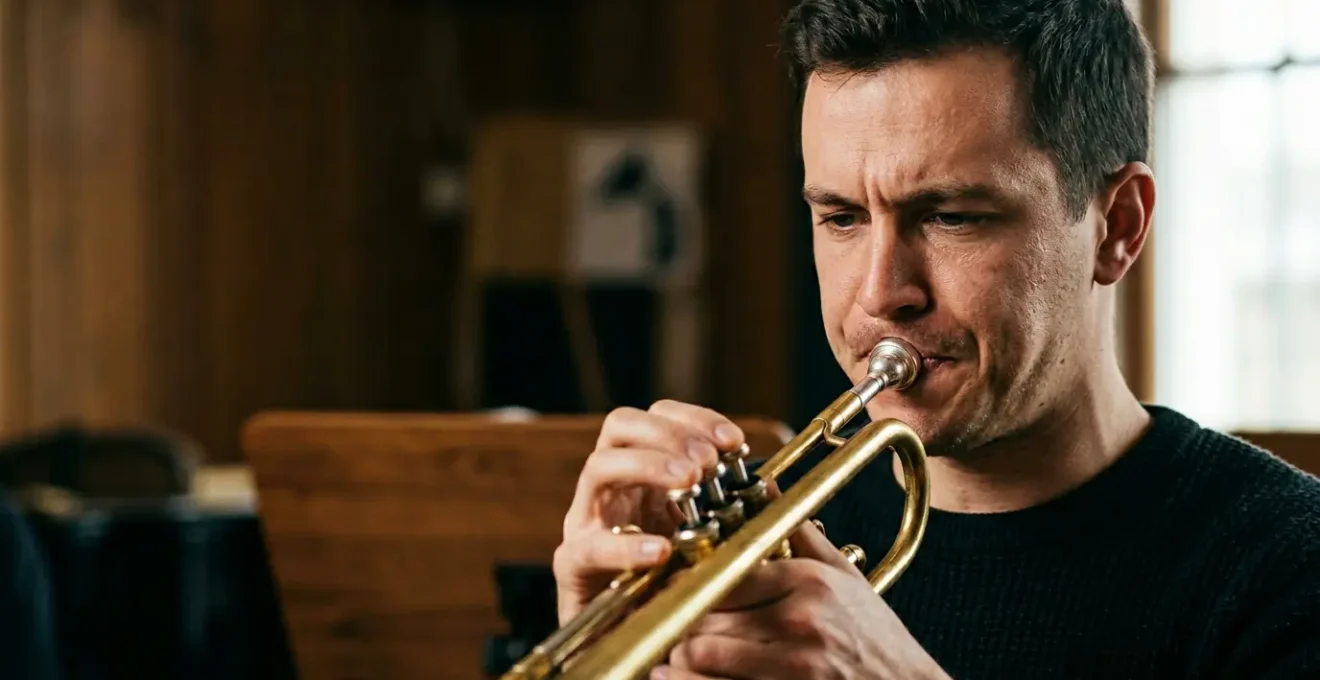
If your trumpet playing is cut short by pain and fatigue, the problem isn’t a lack of strength; it’s a crisis of efficiency. The pain is a direct signal of wasted energy, excessive muscle tension, and poor resonance. This guide reframes endurance not as a matter of ‘toughing it out’, but as a skill of physiological efficiency, showing you how to harness the physics of your instrument to get maximum sound with minimum physical effort, just like the pros.
For many aspiring trumpet players, the 30-minute mark is a wall of pain. The lips start to swell, the tone becomes airy, and the high notes feel a world away. The common advice is predictable: « practise more, » « build your chops, » or « don’t use so much pressure. » While well-intentioned, this advice often misses the fundamental point. It treats the player’s face like a brute-force muscle group that just needs to get stronger, ignoring the delicate biomechanics at play. This approach can lead to frustration, plateaus, and even injury.
The conversation around trumpet endurance is often confined to exercises like long tones and lip slurs, without explaining the underlying principles. We’re told what to do, but not why it works. The real key to unlocking hours of pain-free playing, however, lies not in building more muscle, but in achieving a state of profound physiological efficiency. It’s about understanding that the trumpet is an amplifier, designed to take a small, precise vibration and turn it into a powerful sound. The pain you feel is a diagnostic tool, telling you that you’re fighting the instrument instead of working with it.
But what if the secret wasn’t in your lips at all, but in your mind, your maintenance routine, and your understanding of physics? This article abandons the « more is more » mentality. Instead, we will deconstruct the common barriers to endurance by exploring the science of efficient playing. We will explore why correct technique feels easier, not harder, how a clean instrument is a prerequisite for good habits, and when your equipment is genuinely holding you back.
This guide will provide a clear roadmap to transforming your endurance. We will analyse the physical principles of sound production, the crucial role of maintenance, the psychology of equipment upgrades, and the critical importance of injury prevention and recovery. Prepare to change the way you think about your relationship with the instrument.
Summary: A Trumpet Player’s Guide to Unlocking Effortless Endurance
- Why Does Correct Trumpet Technique Feel Like Less Work, Not More?
- How to Clean Your Trumpet So Valves Never Stick During Performances?
- Student or Pro Trumpet: When Does Upgrading Actually Improve Your Playing?
- The Trumpet Playing Habit That Causes Career-Ending Injuries
- How Long Should Trumpet Embouchure Development Take and What Are the Stages?
- How to Protect Your Embouchure Through 30 Consecutive Show Nights?
- Why Does Central Heating Destroy Pianos Faster Than Cold Storage?
- Why Does Touring Destroy Musicians’ Health Even When the Shows Go Well?
Why Does Correct Trumpet Technique Feel Like Less Work, Not More?
The core misunderstanding that leads to pain is the belief that playing trumpet is an act of force. We push air harder, press the mouthpiece tighter, and tense our facial muscles, believing this is the path to a bigger, higher sound. The reality is the precise opposite. Professional-level endurance comes from achieving maximum resonance amplification with minimum physical input. Your job isn’t to create the volume; your job is to create a perfectly efficient vibration that the instrument can amplify for you. When you feel like you’re working hard, it’s a sign that your energy is being wasted as heat and muscle tension instead of being converted into sound waves.
This principle of efficiency is about finesse, not force. Imagine skipping a stone across a lake. A forceful, clumsy throw makes a big splash and the stone sinks. A precise, relaxed flick with the right angle and spin sends it gliding effortlessly across the surface. Your embouchure works the same way. Too much tension creates a « splash »—a forced, strained sound and swollen lips. A relaxed, focused aperture allows the air column to vibrate freely, creating a clear « buzz » that the trumpet can amplify into a rich, resonant tone. As one foundational guide, Blackwell’s Trumpet Basics, puts it, true mastery is about achieving peak performance with minimal effort.

This image perfectly illustrates the concept: the gentle, ordered ripples represent efficient resonance, while the turbulent splashing signifies wasted, forceful effort. Correct technique aligns your body to produce those efficient ripples. This involves a relaxed posture, an open throat, and a focused but not tight embouchure. The feeling is one of release and amplification, not of struggle. The moment it starts to feel like less work, you know you are on the right track.
How to Clean Your Trumpet So Valves Never Stick During Performances?
While we focus on the player’s body, we often forget that the instrument itself is half of the biomechanical system. A poorly maintained trumpet directly sabotages your efforts towards efficiency. A sticky or slow valve is more than an annoyance; it’s a trigger for bad habits. When a valve fails to respond instantly, the player instinctively compensates with finger tension, altered hand position, and even increased mouthpiece pressure, disrupting the smooth flow of air and undoing hours of careful practice. This mechanical friction creates physiological tension, turning a simple maintenance issue into an endurance problem.
The primary culprits for sticky valves are dirt, old oil residue, and microscopic corrosion. Regular cleaning isn’t just about hygiene; it’s about ensuring the machine you’re operating is in perfect working order, allowing your neuromuscular patterns to execute cleanly without fighting the instrument. Oiling your valves is a critical part of this. While frequency can vary, professional maintenance guidelines suggest oiling valves at least once a week, and daily for new instruments during their break-in period. This simple act ensures that the pistons, which have tolerances measured in thousandths of an inch, can move without resistance.
A pre-performance check is non-negotiable for any serious player. It removes any doubt about the instrument’s reliability, allowing you to focus entirely on your musical and physical technique. Going on stage with clean, fast valves is a prerequisite for an efficient, relaxed performance.
Your Pre-Performance Valve Check Sequence
- Inspection: Remove each valve cap and pull the valve partially out to inspect the piston surface for any debris, gunk, or signs of discoloration.
- Cleaning: Gently wipe down the entire piston with a clean, lint-free cloth. Check for any scratches or nicks that could cause future sticking.
- Oiling: Apply 2-3 drops of high-quality valve oil along the length of the piston, ensuring it coats the surface as you rotate it slightly.
- Alignment: Carefully reinsert the valve, rotating it gently until you feel it « click » or lock into its proper alignment with the valve casing guide.
- Testing: Test the valve’s action by pressing it rapidly 10-15 times. It should feel smooth, fast, and quiet. Repeat for all three valves, ensuring they are not mixed up.
Student or Pro Trumpet: When Does Upgrading Actually Improve Your Playing?
It’s a tempting thought for any player hitting a wall: « Maybe it’s not me, it’s the instrument. » The allure of a professional-grade trumpet, with its promise of better response, richer tone, and superior intonation, can be powerful. However, upgrading your horn is one of the most misunderstood aspects of development. While a high-quality instrument absolutely makes a difference at a certain level, it is not a magic bullet. A professional trumpet will not fix a flawed technique; in fact, its unforgiving nature will often make fundamental problems even more obvious.
A professional horn is designed for maximum efficiency. It’s built with more precise tolerances, higher-quality materials, and advanced acoustic designs to reward a player who already has a solid foundation. It amplifies what it is given. If you give it an efficient, resonant buzz, it will sing. If you give it a tense, airy, and pressure-heavy buzz, it will amplify that just as faithfully. The belief that a better horn will fix endurance issues is a dangerous myth. Endurance is built in the player, not the trumpet. Spending thousands on a new instrument before mastering fundamental air support and embouchure control is like buying a Formula 1 car to learn how to drive.
Case Study: The Limits of a Great Instrument
A pedagogical review from an experienced band director highlights this exact issue. In an article on BandDirector.com, the director notes that students with ingrained bad embouchure habits—excessive pressure, a « smiling » embouchure, or a bunched chin—showed the same poor tone, weak range, and lack of endurance whether they played on a student model or a professional horn. The study concludes that upgrading equipment before establishing proper fundamentals becomes a « crutch, » masking problems instead of solving them. A great instrument cannot overcome a poor foundation, as sufficient air and a good horn cannot fix a bad embouchure.
So, when should you upgrade? The time is right when you can consistently produce a good, resonant tone across the practical range of your current horn, your endurance is reliable, and you feel that the instrument’s response or intonation is the primary factor limiting your musical expression. When you are no longer fighting your body, but you begin to feel you are fighting the horn, an upgrade becomes a genuine tool for improvement, not a desperate fix.
The Trumpet Playing Habit That Causes Career-Ending Injuries
The pursuit of endurance through brute force and excessive pressure isn’t just inefficient; it’s dangerous. The most insidious habit a trumpet player can develop is relying on mouthpiece pressure against the lips to compensate for poor air support or an underdeveloped embouchure. This single habit is the root cause of most playing-related pain and, in extreme cases, can lead to career-ending injuries. When you press the mouthpiece hard, you restrict blood flow to the delicate lip tissue, causing swelling, bruising, and a rapid decline in performance. This is the micro-trauma that makes your face hurt after 30 minutes.
Over time, this chronic tension can lead to more severe conditions. The constant strain on the facial muscles can affect the temporomandibular joint (TMJ), leading to jaw pain, clicking, and headaches. The most feared condition, however, is embouchure or focal dystonia. This is a neurological disorder where the brain’s control over specific muscles becomes haywired. For a brass player, this can manifest as an uncontrollable tremor, tensing, or curling of the lips when they attempt to play. It’s a devastating condition that research indicates affects approximately 1% of all professional musicians. It is often the tragic endpoint of years of practising with excessive tension.

This image reveals the hidden battlefield of trumpet playing: the subtle but powerful muscles of the jaw and face. The goal is to perform with these muscles engaged but not clenched. The habit of using pressure is a shortcut that bypasses the real work of developing proper air support and embouchure control. Breaking this habit is the single most important step towards long-term, pain-free playing. It requires conscious effort to transfer the work from the small, weak muscles of the face to the large, powerful muscles of your core breathing apparatus.
How Long Should Trumpet Embouchure Development Take and What Are the Stages?
One of the biggest sources of frustration for developing players is the perceived lack of progress. You practise daily, but the endurance gains feel slow and inconsistent. This often leads to the question: « How long should this take? » The answer requires a shift in perspective. Building a trumpet embouchure is not like lifting weights to build bicep muscles; it’s more like a gymnast learning a complex routine. It is less about raw strength and more about developing highly refined neuromuscular patterning. You are training your brain to send incredibly precise signals to the tiny muscles of your lips.
This process has distinct stages and a realistic timeline. While every player is different, experienced players and teachers often cite similar figures. You can expect it to take about three months of consistent, correct practice to develop a workable and reliable embouchure that can get you through basic playing. However, perfecting that embouchure—to the point where it can handle the demands of professional playing, resist fatigue, and recover quickly—is a much longer journey. The general consensus is that it takes around three years of dedicated work to build a truly solid, world-class embouchure. This isn’t meant to be discouraging, but to set realistic expectations. This is a marathon, not a sprint.
The stages of development typically follow a pattern:
- Stage 1: Foundation (0-6 months): The focus is on producing a clear, steady buzz with minimal pressure. The main goal is consistency of tone in the middle register. Long tones are king here.
- Stage 2: Expansion (6 months – 1.5 years): Once the foundation is stable, you begin to expand your range (both high and low) and flexibility. Lip slurs and interval studies become crucial for training the muscles to shift smoothly between notes.
- Stage 3: Refinement & Stamina (1.5 – 3+ years): In this stage, you work on solidifying your range and building serious endurance. This involves playing more demanding etudes and repertoire, focusing on maintaining tone quality and precision even when fatigued. This is where the neuromuscular patterns become truly automatic.
Understanding this timeline helps you to be patient with the process. A bad day or a week of slow progress is just a blip on a multi-year journey. The key is consistent, mindful practice that reinforces good habits, not just logging hours.
How to Protect Your Embouchure Through 30 Consecutive Show Nights?
For a touring musician or anyone facing a period of intense playing, performance is only half the battle. The other half is recovery. Approaching your embouchure with the mindset of a professional athlete is essential. An athlete doesn’t just train; they have a structured regimen for warming up, cooling down, nutrition, and rest. Your embouchure, a complex system of delicate tissue, deserves the same respect, especially under the relentless demand of consecutive performances. The ability to play night after night is not a measure of toughness, but a testament to a smart and disciplined recovery strategy.
The most overlooked yet critical part of this strategy is the « warm-down. » After a long and demanding performance, the lip tissue is swollen and filled with lactic acid. Just as a runner cools down with a slow jog and stretching, a trumpeter needs to help their embouchure return to a resting state. This involves very gentle, low-register playing, soft lip flapping (motorboating), and free-buzzing without the mouthpiece. This light activity helps to flush out metabolic waste products and reduce swelling, dramatically speeding up recovery for the next day. Going from the final high note of the show straight to the case is a recipe for cumulative damage.
Other crucial recovery tactics are borrowed directly from the world of vocal health. Systemic hydration is non-negotiable; dehydrated tissue is brittle and more prone to injury. Avoiding irritants like excessive alcohol or spicy foods before playing can also preserve tissue sensitivity. In rehearsals, pros use a technique called « marking »—playing demanding passages softly or down an octave to save the embouchure for the show. Using a practice mute can also reduce the physical load during long practice sessions. This entire approach is about managing your « systemic load » and ensuring you never spend more physical capital in one day than you can recover by the next.
Why Does Central Heating Destroy Pianos Faster Than Cold Storage?
A player’s endurance can be affected by factors far beyond their own body. The instrument itself is highly susceptible to environmental conditions, particularly temperature and humidity. While the title refers to pianos, the principle is just as critical for a brass instrument. A trumpet is a precisely engineered piece of metal, and sudden or extreme temperature changes can affect its performance, intonation, and even its structural integrity, forcing the player to compensate in ways that waste energy and cause fatigue.
The most common issue players face is what is known as « Cold Horn Syndrome. » Bringing a cold trumpet from outside into a warm room and immediately starting to play is a significant shock to the system. The cold metal causes the warm, moist air from your lungs to condense rapidly inside the instrument. This excess water can cause gurgling sounds, affect valve action, and, over the long term, accelerate corrosion and the dreaded « Red Rot » (a process of dezincification that eats away at the brass). More immediately, a cold horn plays out of tune, forcing you to use your embouchure and mouthpiece pressure to « lip » notes into pitch—a direct path to inefficiency and fatigue.
Case Study: Managing the Micro-Climate of Your Instrument
Expert advice on brass instrument care often emphasizes treating the instrument case as a « micro-climate controller. » When you come in from a cold environment, the best practice is to leave the trumpet in its closed case for at least 30 minutes. This allows the instrument to acclimatise to the new room temperature gradually. This simple act prevents the thermal shock that stresses solder joints and affects the metal’s acoustic properties. It also minimises the extreme condensation that causes performance issues and long-term damage, a phenomenon well-documented by experienced players and technicians.
Just as central heating’s dry air can damage a piano’s wood, the constant fluctuation between different environments puts stress on a trumpet. A smart player understands that managing their instrument’s environment is part of managing their own performance. A stable, well-maintained instrument requires less physical compensation, directly contributing to greater endurance.
Key Takeaways
- Endurance is a skill of physiological efficiency, not brute strength. Pain is a sign you are fighting the instrument.
- Consistent, meticulous maintenance is non-negotiable. A faulty instrument forces physical compensations that drain stamina.
- Mastering technique on your current instrument must come before upgrading. A professional horn amplifies habits, good or bad.
Why Does Touring Destroy Musicians’ Health Even When the Shows Go Well?
The problem of pain after 30 minutes is a microcosm of a much larger issue that plagues many musicians: the disconnect between performance and health. The « show must go on » mentality often prioritises the immediate musical product over the long-term well-being of the player. For a touring musician, this is magnified tenfold. The combination of travel, inconsistent schedules, lack of proper rest, and the nightly demand of a high-energy performance creates a perfect storm for physical breakdown. Even when the shows are artistically successful, the cumulative systemic load can be devastating.
The issue extends far beyond just « tired chops. » Trumpet playing is a full-body activity. Poor posture from sitting on a tour bus, lack of sleep affecting motor control, and the physical stress of hauling gear all contribute to a decline in playing efficiency. This leads to a vicious cycle: as your overall physical condition deteriorates, you rely more on inefficient habits like mouthpiece pressure to get through a performance, which in turn causes more localised damage and fatigue. It’s no surprise that a study found that as many as 61% of brass instrument players experience musculoskeletal injuries related to their playing.
The ultimate path to professional-level endurance—the kind that withstands the rigours of touring—is a holistic one. It requires treating yourself as a performance athlete. This means prioritising sleep, managing stress, maintaining good posture, and, most importantly, understanding that recovery is as crucial as practice. It’s about recognising that your health and your playing are not separate; they are two parts of the same system.
Most injuries are going to be a combination of several things. Probably some tightness in the breathing or chops, or excessive pressure in addition to playing too much. It is rare for these things to come out of the blue, and under-recovery is just as important a concept to understand as overtraining.
– Professional Trumpeter, A Trumpet Player on Chops, Injury Prevention, and Recovery
This insight is the final piece of the puzzle. The pain you feel is not an isolated event. It is the result of a system out of balance. By focusing on efficiency, embracing disciplined recovery, and caring for your overall health, you can move beyond the 30-minute wall and build a lifetime of healthy, powerful playing.
The next logical step is to systematically diagnose your own playing. Begin by recording yourself, paying close attention not to how it sounds, but to how it feels. Identify moments of tension and apply the principles of efficiency to build a more sustainable practice routine.