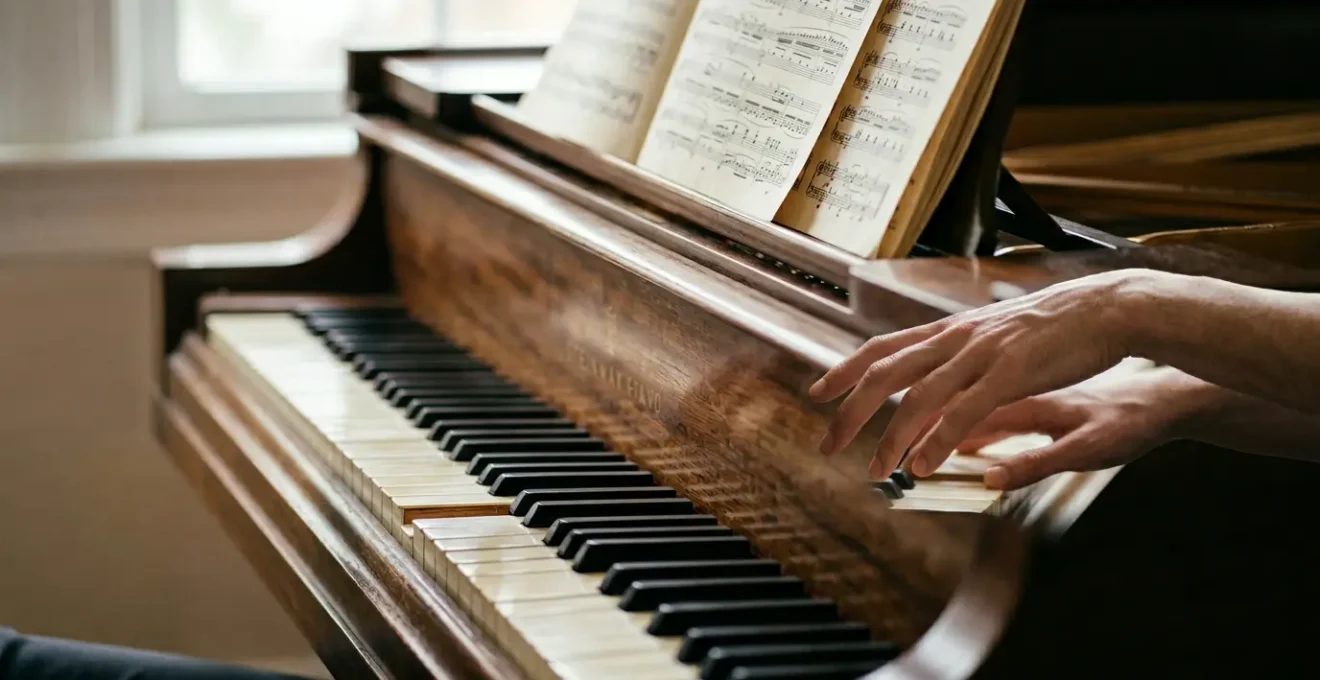
You can play difficult standalone pieces, yet a sonata of similar technical level feels impossibly hard. That’s because the challenge isn’t just the notes. A sonata demands you become a musical architect, building a single, unified dramatic narrative over a long-form structure. It’s a test of psychological stamina and structural intelligence that goes far beyond mastering separate sections, requiring a completely different mindset to perform convincingly.
For many ambitious pianists in the UK and beyond, there comes a moment of reckoning. You’ve diligently worked through your studies, conquered challenging etudes, and can deliver a Chopin Nocturne or a Debussy Prélude with confidence. Then, you tackle your first substantial sonata—perhaps a Mozart or an early Beethoven—and hit a wall. The notes themselves may not be harder than what you’ve played before, but the entire experience feels exponentially more demanding, fragmented, and strangely elusive. Why?
The common advice is to « practice more » or « focus on the difficult passages. » But this only addresses the symptoms. The truth is that playing a sonata is a fundamentally different task from playing a collection of individual pieces. It’s the difference between building a single, structurally sound cathedral and crafting a series of beautiful, but separate, stained-glass windows. The challenge is not just technical; it’s architectural, psychological, and emotional.
If you’ve felt this frustration, you are not alone. The key is to shift your perspective from that of a musician who plays notes to that of a musical architect who builds a cohesive world of sound. This is not about raw finger dexterity; it is about developing structural intelligence and psychological endurance. This guide will deconstruct the unique demands of the sonata, moving beyond the obvious to explore the underlying reasons for its difficulty.
We will examine the mental stamina required, the right pathway to approach this repertoire, and the common practice mistakes that sabotage success. We’ll even look at how your instrument and environment play a role in this high-stakes performance, providing a holistic understanding of what it truly takes to master the sonata.
Summary: Deconstructing the Sonata Challenge
- Why Must You Understand Structure to Play a Sonata Convincingly?
- How to Maintain Focus Through a 30-Minute Sonata Performance?
- Which Composer’s Sonatas Should You Learn First and Why?
- The Practice Mistake of Learning Movements Separately Without Ever Connecting Them
- At What Stage of Development Should Pianists Begin Serious Sonata Study?
- How to Learn Score Reading Starting From Nothing in 8 Weeks?
- How Often Should Your Grand Piano Be Tuned and Serviced for Best Results?
- Why Does Your Grand Piano Sound Different Every Time the Weather Changes?
Why Must You Understand Structure to Play a Sonata Convincingly?
The first hurdle in moving from individual pieces to a sonata is a mental one. You are no longer just presenting a single mood or idea; you are guiding a listener through a dramatic argument. A typical sonata-form movement (often the first) is a three-act play: the Exposition, where the main characters (themes) are introduced; the Development, where they conflict and transform; and the Recapitulation, where they return, changed by their journey. To play this convincingly, you must be the narrator, understanding how each part relates to the whole.
Many students learn the definition of sonata form but fail to grasp its dramatic purpose. As Wikipedia contributors note, for performers today, « sonata form is currently viewed as a model for musical analysis, rather than compositional practice. » For the pianist, this means your job is to reverse-engineer the composer’s drama. You must identify the primary and secondary themes, feel the tension of the development, and deliver the release of the recapitulation with intention. Without this structural awareness, you are simply playing a string of technically correct but emotionally disconnected events.
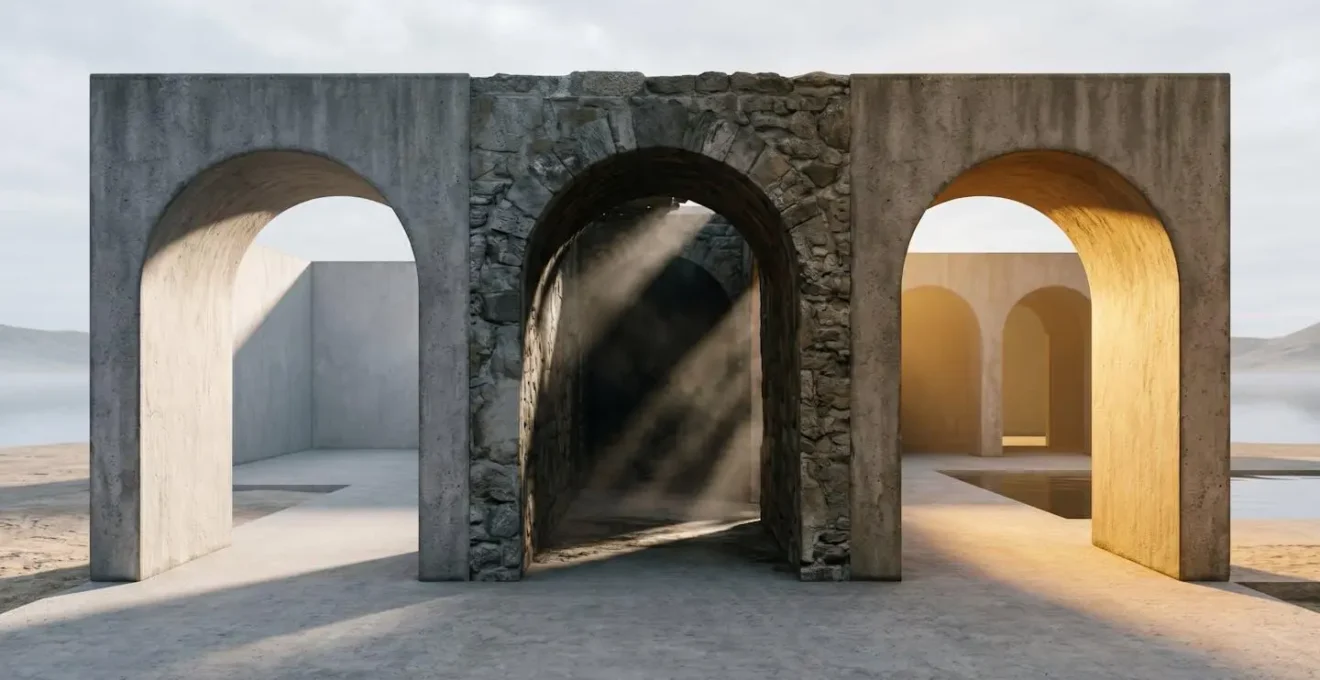
This visual metaphor of a journey through different landscapes—from a calm beginning, through a turbulent center, to a resolved conclusion—is precisely the experience you must create. A performance without structural understanding is like a story told with all the right words but in the wrong order. The architectural cohesion is lost, and the listener—and often the player—is left feeling unsatisfied, without knowing exactly why.
Ultimately, understanding the form isn’t an academic exercise; it’s your roadmap to telling a compelling story.
How to Maintain Focus Through a 30-Minute Sonata Performance?
A 25- or 30-minute sonata presents a challenge that is rarely encountered in shorter works: psychological stamina. The sheer length pushes the boundaries of human concentration. It’s not just about remembering all the notes; it’s about staying actively engaged in the musical narrative, moment to moment, without your mind wandering. This is a skill that must be trained separately from technique.
The difficulty is rooted in our cognitive limits. As some research shows that the human brain maintains high concentration for about 20-30 minutes, a full sonata performance is, by definition, a mental marathon. During a performance, adrenaline can help, but in the practice room, you must build the capacity for sustained focus. Simply « trying harder » is ineffective. Instead, you need concrete strategies to train your attention span as rigorously as you train your fingers.
Incorporating mindfulness and structured practice can dramatically improve your ability to stay « in the zone »:
- Set micro-goals: Before each practice run, define a specific focus, such as « maintain a consistent tempo in the coda » or « shape the crescendo in the development. » This gives your brain a clear target.
- Practice in focused intervals: Use a technique like the Pomodoro method (e.g., 25 minutes of intense focus followed by a 5-minute break) to simulate the demands of a long movement and train your brain to stay on task.
- Eliminate distractions: The practice space must be sacred. Put your phone in another room and ensure you won’t be interrupted. Every small distraction erodes your limited pool of focus.
- Practice mindfulness: Even five minutes of meditation before playing can train your brain to notice when your mind has wandered and gently bring it back to the task at hand—the music.
By treating focus as a trainable aspect of your musicianship, the prospect of a 30-minute performance becomes a manageable challenge rather than a daunting impossibility.
Which Composer’s Sonatas Should You Learn First and Why?
Jumping directly into a late Beethoven or a complex Schubert sonata is a common but disastrous mistake. The path to mastering sonatas is progressive, building your structural and stylistic understanding piece by piece. Choosing the right entry point is crucial for building confidence and avoiding the frustration that leads many pianists to give up on this repertoire entirely.
The ideal journey begins before the sonata proper, with its miniature cousin: the sonatina. This is where you first learn the language of sonata form in a contained and manageable context. A recommended pathway looks like this:
- Sonatinas by Clementi and Kuhlau: These are the foundational texts. They present the core concepts of exposition, development, and recapitulation in a clear, concise, and technically accessible way. Mastering these is non-negotiable.
- Mozart’s « Sonata Facile » (K. 545): As the name implies, Mozart himself considered this an « easy » sonata. It is the perfect first « real » sonata, offering elegant melodies and a crystal-clear structure.
- Haydn Sonatas: Often overlooked, Haydn’s sonatas are a treasure trove for the developing pianist. As expert Joshua Ross notes, « Many of Haydn’s sonatas have a reputation for being more approachable for beginners than those of Beethoven or Mozart. » They are witty, surprising, and excellent for developing a crisp and articulate technique.
- Beethoven’s « Easy » Sonatas (Op. 49, No. 1 & 2): Before tackling the « Pathétique » or « Moonlight, » these two shorter sonatas offer the first taste of Beethoven’s dramatic language in a more manageable form, usually under ten minutes each.
This progression is not about « dumbing down » the repertoire. It is a strategic approach to acquiring the specific set of skills—technical, analytical, and emotional—required to perform sonatas. Each step builds upon the last, ensuring that by the time you approach a more substantial work, you have the tools to understand its architecture and tell its story.
By respecting this pedagogical ladder, you transform the daunting mountain of sonata repertoire into a series of achievable, rewarding climbs.
The Practice Mistake of Learning Movements Separately Without Ever Connecting Them
Perhaps the most common and damaging practice habit is treating a sonata’s movements as three or four unrelated pieces. A pianist might perfect the first movement, then the second, then the third, but only attempt to play them in sequence a week before a performance. This approach completely misses the point and is a primary source of the feeling of fragmentation and difficulty. A sonata is a single entity, and the thematic threads and emotional transitions between movements are as important as the movements themselves.
Composers often link movements through shared motifs, harmonic relationships, or a continuous dramatic arc. The silence between movements is not an empty void; it is a charged, meaningful pause—a breath before the next chapter. Your job is to manage the energy and narrative across these breaks. Does the fiery ending of the first movement set up the serene contemplation of the second? Does the playful scherzo release tension before the monumental finale? These are performance decisions that cannot be made if you only practice movements in isolation.
Case Study: The Structural Importance of Connection in Chopin’s Sonata No. 2
In his B minor Sonata, Chopin provides a masterclass in movement connection. As an analysis in Pianist Magazine points out, the very end of the first movement’s exposition is written in two slightly different ways. The first time, it leads musically back to the beginning for the repeat. The second time, it’s adjusted to lead seamlessly into the development section. Ignoring this intentional « musical junction » by skipping the repeat, a common practice, can upset the entire temporal balance and equilibrium of the piece, working directly against the composer’s clear architectural intentions.
This illustrates a crucial point: the seams between sections are often where the deepest artistry lies. Learning to navigate these transitions is a core part of learning the sonata.
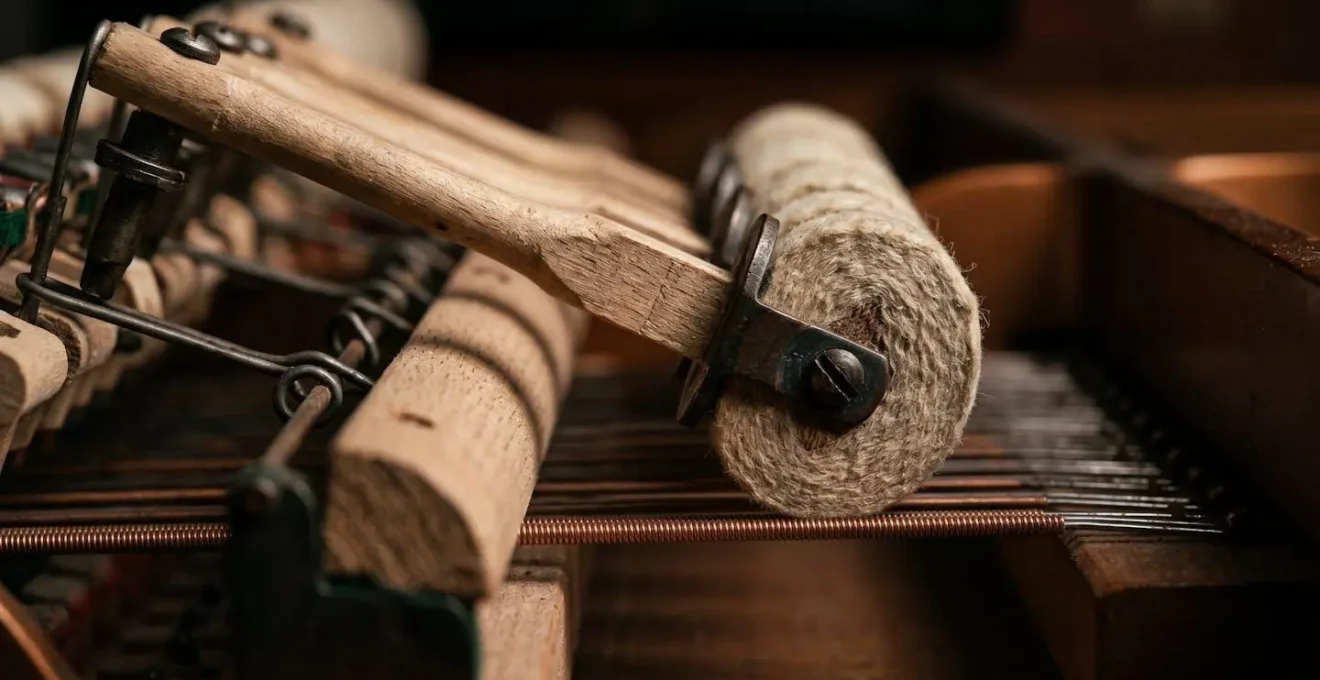
This image of the suspended hammer captures the essence of that critical moment of silence. It is not an absence of music, but a moment of potent transition. Begin practicing full run-throughs of your sonata much earlier in the learning process. Record yourself playing the entire work, and listen back specifically to the transitions. You will quickly discover that connecting the movements is a separate skill, and one that is central to transforming a collection of pieces into a unified sonata.
Therefore, you must practice the whole story, not just the individual chapters, to truly master the narrative form.
At What Stage of Development Should Pianists Begin Serious Sonata Study?
The question of « when » to start sonatas is often mistakenly answered with a grade level (e.g., « after Grade 5 »). This is a flawed metric. The true prerequisite for sonata study isn’t a certificate, but the possession of a specific set of analytical and physical skills. Without them, even a technically proficient player will struggle to make musical sense of the form. Attempting sonatas prematurely can lead to immense frustration and ingrained bad habits.
Before tackling a major sonata, a pianist should have shifted their curiosity from « what notes to play » to « why did the composer write these notes? » This marks the transition from a purely technical to an analytical and aesthetic approach. As the Arioso7 Piano Blog puts it, « once a student has a well rounded exposure to theory, harmony, and understands the physical demands of playing with a focus on relaxation, using a full arm, supple wrist follow-through motion, then he is best equipped to tackle some of the more challenging passages. »
This readiness is less about a specific age or grade and more about a holistic musical maturity. It’s about having the tools not just to play the notes, but to understand and interpret the musical architecture. Instead of waiting for a teacher to tell you you’re ready, you can perform a self-audit to gauge your preparedness.
Your Sonata Readiness Audit: 5 Points to Check
- Theoretical Foundation: Can you identify keys, chords (and their inversions), and basic modulations in a piece of music away from the piano?
- Technical Inventory: Have you mastered all major and minor scales and arpeggios, and can you execute them without undue tension?
- Musical Voicing: Can you consistently make a melody sing out over a quieter accompaniment, demonstrating hand independence?
- Analytical Mindset: Do you have experience with other multi-page, contrapuntal works (like Bach’s Inventions) where you had to trace a musical idea through the piece?
- Dynamic Control: Can you produce a wide range of dynamics, from pianissimo to fortissimo, with a consistently beautiful and controlled tone?
If you can confidently answer « yes » to these questions, you are not just ready to play a sonata; you are ready to understand it. If not, focusing on these areas is the most direct path to preparing yourself for the challenge.
How to Learn Score Reading Starting From Nothing in 8 Weeks?
The ability to look at a complex score—especially an orchestral one—and hear it in your head is a superpower for a musician. For the sonata performer, advanced reading skills unlock a deeper understanding of musical architecture. However, the title’s premise, « starting from nothing in 8 weeks, » reflects a common but dangerous misconception about skill acquisition in music. True score reading fluency is not a quick fix; it’s a long-term commitment.
While you can certainly build a solid foundation in eight weeks, it is crucial to have realistic expectations. As pianist and pedagogue Peter J. Folliard states regarding his graduated method, « it will take maybe 12-18 months of doing these exercises (45-60 minutes daily) until you’re feeling somewhat proficient. » Embracing this timeline is the first step to success. The « 8-week plan » should therefore be seen as the launch sequence for a much longer journey, not the entire trip.
Here is a realistic plan to build your foundational score-reading habits over eight weeks:
- Weeks 1-2: Two-Part Fluency. Focus exclusively on Bach’s Two-Part Inventions. Practice hands separately, then together, with a metronome, aiming for flawless reading of two independent lines.
- Weeks 3-4: Clef Basics. Begin working with a preparatory score-reading book. The goal is not speed, but accuracy in navigating the essential clefs (treble, bass, and introducing alto).
- Weeks 5-6: Structural Mapping. Take a simple sonata movement you already know. Away from the piano, use a pencil to map its structure directly on the score. Bracket themes, circle key modulations, and draw arrows showing thematic development. This is training your analytical eye.
- Weeks 7-8: Simple Reductions. Find a simple string quartet score (like an early Haydn). Try to play the two violin parts together, then the viola and cello parts. You are learning to « reduce » a score to its harmonic and melodic essence.
This approach builds the core skills methodically, setting you up for the long-term journey toward true proficiency rather than leading to the frustration of an unrealistic short-term goal.
How Often Should Your Grand Piano Be Tuned and Serviced for Best Results?
In the quest to conquer a sonata, it’s easy to focus solely on your own skills and forget a critical partner in the performance: the piano itself. A grand piano is not a static piece of furniture; it is a complex machine with over 12,000 parts, under immense tension, that is highly sensitive to its environment. Playing a demanding work on an out-of-tune or poorly regulated instrument is like trying to run a marathon in ill-fitting shoes. It adds an unnecessary layer of cognitive and physical friction.
An out-of-tune piano forces your ear to constantly fight against dissonant harmonics, draining mental energy that should be spent on musical interpretation. A poorly regulated action—where the touch is uneven—forces your fingers to work harder and inconsistently, undermining your technical security. To give yourself the best possible chance of success, you must ensure your instrument is a help, not a hindrance.
The standard professional recommendation for a grand piano in a home environment is to have it tuned at least twice a year. This baseline service accounts for the major seasonal shifts in temperature and humidity. However, for a serious pianist preparing demanding repertoire, this is often not enough. A more rigorous schedule is advisable:
- Standard Tuning: A full tuning every 6 months to address seasonal pitch changes.
- Concert/Recording Prep: An additional tuning a day or two before any important performance, recording session, or audition.
- Regulation and Voicing: A full service of the action (regulation) and hammers (voicing) should be considered every 2-5 years, depending on usage. This ensures the touch and tone remain even and responsive.
Think of this not as a cost, but as an investment in your own practice. A well-maintained piano removes variables, allowing you to focus 100% of your attention on the music. It gives you a consistent, reliable partner, which is essential when tackling the architectural complexity of a sonata.
By controlling this crucial element of your performance ecosystem, you eliminate a significant source of frustration and free up mental bandwidth for the real challenge: the music itself.
Key takeaways
- Sonatas are a test of architectural intelligence; you must build a unified dramatic story, not just play notes.
- Psychological stamina across a 20-30 minute arc is a specific skill that must be trained separately from technique.
- The connections and transitions *between* movements are a critical part of the composition and must be practiced as such.
Why Does Your Grand Piano Sound Different Every Time the Weather Changes?
The final, and perhaps most humbling, piece of the sonata puzzle lies in accepting that you are in partnership with an instrument that is alive and constantly changing. If you’ve ever noticed your piano sounds bright and sharp on a dry winter day, and dull or « mushy » during a humid summer spell, you are not imagining it. This phenomenon is a core part of the performance ecosystem a pianist must learn to manage.
The primary culprit is the soundboard. This large, thin sheet of wood (usually spruce) is the heart of the piano’s resonance. Wood is hygroscopic, meaning it absorbs moisture from the air. When humidity is high, the soundboard swells, increasing its crown (its slight upward curve). This pushes the bridges up, increasing tension on the strings and making the piano go sharp, often with a « bigger » but sometimes less clear tone. Conversely, when the air is dry, the soundboard shrinks, the crown flattens, tension decreases, and the pitch drops, which can make the tone seem thin or brittle.
What does this have to do with playing a sonata? Everything. It means the instrument you are practicing on is a moving target. The subtle shifts in touch and tone require constant micro-adjustments from the performer. The delicate voicing you perfected in a dry room may sound harsh in a humid one. This is why a performance in a new, unfamiliar hall is so challenging; you are not just adapting to a new acoustic space, but to a new micro-climate that is affecting the piano’s very soul.
Embracing the sonata challenge, therefore, is about more than just mastering a piece of music. It is about becoming a holistic musician: an architect of sound, an athlete of the mind, and a sensitive partner to a living, breathing instrument. The path is demanding, but the reward is a level of musical understanding and expression that is unparalleled.