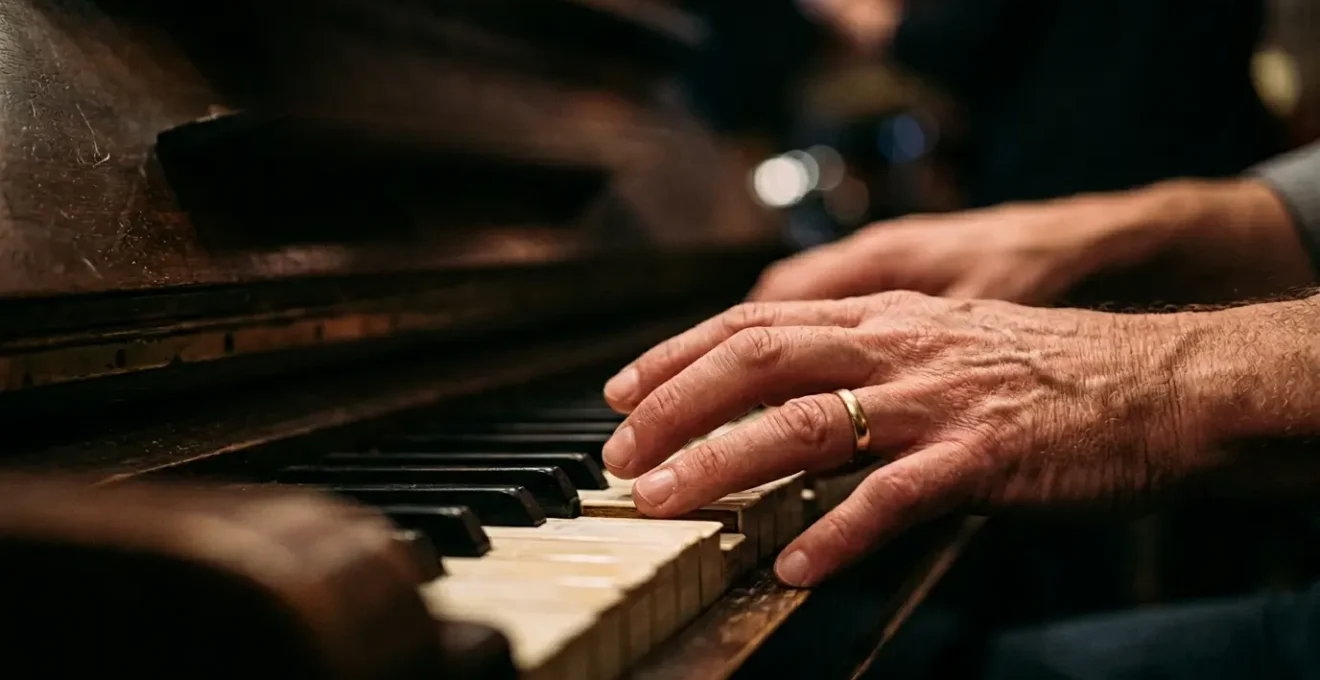
The key to authentic swing is realizing it’s a physical language, not a mathematical formula; your stiff playing comes from obeying the written note instead of internalizing the rhythmic conversation.
- Written music is a simplification; true swing lives in the un-notatable micro-timing and articulations between the beats.
- Developing « feel » requires shifting focus from *what* you play to *how* it’s placed, weighted, and articulated in relation to the band’s pulse.
Recommendation: Stop trying to ‘calculate’ swing. Start by physically mimicking the rhythmic feel of a single master, like Count Basie or Art Blakey, until their groove becomes your own muscle memory.
You’ve spent countless hours in the practice room. You’ve transcribed the solos, you’ve learned the scales, and you can play those eighth-note lines exactly as they’re written on the page. You set the metronome, play the « correct » long-short triplet-based rhythm, and yet, when you listen back, something is fundamentally wrong. It sounds rigid, mechanical, and frankly, a bit lifeless. It doesn’t have the effortless momentum, the buoyant groove, the very *lifeblood* of the recordings you love. This frustration is a rite of passage for nearly every developing jazz musician, a sign that you’re ready to move beyond the page and into the heart of the music.
The common advice— »just listen more » or « feel it as a triplet »—is well-intentioned but often misses the mark. It treats swing as a simple rhythmic instruction to be applied, like a software plugin. But what if the entire premise is flawed? What if the stiffness isn’t because you’re playing the rhythm incorrectly, but because you’re trying to play a « rhythm » at all? The truth is that authentic swing isn’t a pattern; it’s a physical response. It’s a dynamic, breathing entity that lives in the spaces between the notes, in the weight of an accent, and in the fluid relationship to the beat. This guide will dismantle the myth of the « correct » swing ratio and give you a practical framework for internalizing the genuine, conversational feel that makes jazz move.
In this article, we will deconstruct the very nature of swing feel. We’ll explore why written notation is an inadequate guide, provide a concrete plan to develop an authentic groove, and examine how that feel changes across different jazz eras. Prepare to stop counting and start feeling.
Summary: Unlocking Your Natural Swing Groove
- Why Does Playing Exactly What’s Written Sound Nothing Like the Recording?
- How to Develop Authentic Swing Feel in Your Playing Within 3 Months?
- New Orleans, Kansas City or Bebop: How Does Swing Feel Change Across Eras?
- The Swing Mistake That Makes Your Jazz Sound Like Show Band Parody
- When Should You Stop Thinking About Swing and Trust Your Instincts?
- Why Does Moving Notes Off the Grid Make Your Beat Sound Better?
- Why Does « Thinking Less » Often Produce Better Solos Than « Thinking More »?
- Why Do Your Programmed Grooves Sound Like a Robot Despite Using Real Drum Samples?
Why Does Playing Exactly What’s Written Sound Nothing Like the Recording?
The core of the problem lies in a fundamental misunderstanding of musical notation. Written music is not a perfect blueprint; it’s a heavily simplified map. It excels at communicating pitch and basic duration, but it’s notoriously poor at capturing the subtle, human elements of rhythmic feel. When a composer or arranger writes a line of swung eighth notes, they are using a convenient shorthand for an idea that is far too complex and fluid to be accurately transcribed. Trying to play it literally is like trying to understand a joke by analyzing its grammar. You miss the point entirely.
This limitation is at the heart of the jazz tradition. As jazz educator Bret Pimentel notes, swing is an oral and aural tradition passed down through listening and imitation, not reading. This is why a computer playing a perfectly transcribed Charlie Parker solo sounds sterile, while the original recording is a torrent of energy. The magic isn’t in the notes themselves, but in the rhythmic placement and articulation—the ghost notes, the accents, the way a note is attacked and released. Research in jazz pedagogy has identified at least 5 basic articulation types that are essential to the language, none of which are adequately represented by a standard notehead.
The image above perfectly captures this disconnect: the rigid, printed world of notation versus the organic, textured reality of musical sound. The sheet music tells you the ‘what,’ but the groove—the life of the music—is in the ‘how.’ To sound authentic, you must graduate from being a reader of maps to an explorer of the terrain. This means using your ears as your primary guide and viewing the written page as a mere starting suggestion, not a set of rigid instructions.
How to Develop Authentic Swing Feel in Your Playing Within 3 Months?
Developing an authentic swing feel isn’t about finding a magic metronome setting; it’s about deep, focused listening and physical internalisation. It’s a process of training your body to respond to a rhythmic concept until it becomes second nature. While mastery takes a lifetime, you can make a transformative leap in just three months by abandoning the quest for a mathematical formula and adopting a listening-first methodology. This process is about building a direct link between what you hear and what your muscles do, bypassing the over-analytical part of your brain.
Your first month should be dedicated entirely to absorption. Choose one single artist—a horn player like Lester Young or a pianist like Red Garland—and immerse yourself in their music. Listen to their phrasing not for the notes, but for the rhythm. Use an app to slow down a short, two-bar phrase. Sing it. Tap it on your lap. Don’t touch your instrument yet. The goal is to get the shape and lilt of their time-feel into your body. Your focus is on the *feel*, not the theory.
In the second month, move to imitation. Now, take those short phrases you’ve internalized and learn them on your instrument, by ear. Record yourself and compare it directly to the original, not for note accuracy, but for rhythmic feel. Are you pushing the beat like the recording? Are you laying back? Is your accent on the « and » of two as strong and clear? This is where you begin building the muscle memory. You are training your brain and fingers to, as neuroscientists put it, « anticipate the auditory consequences » of your movements. You’re learning what it *feels like* to produce an authentic sound.
The third month is for integration. Start taking the rhythmic vocabulary you’ve learned from your chosen artist and apply it to simple tunes you already know, like a blues or a standard. Improvise using only the rhythmic shapes you’ve been practicing, even if it’s just on one or two notes. The goal is to take the feel you’ve borrowed and make it your own, using it as a foundation for your own ideas. By focusing intensely on one source and breaking the process down into absorption, imitation, and integration, you build an authentic foundation that no amount of theory or « correct » counting can replicate.
New Orleans, Kansas City or Bebop: How Does Swing Feel Change Across Eras?
A common mistake is to think of « swing » as a single, monolithic rhythm. In reality, the feel of swing has evolved dramatically throughout jazz history, adapting to the music’s function, tempo, and instrumentation. Understanding these distinct « dialects » of swing is crucial for authentic interpretation. Playing a 1920s New Orleans tune with a 1940s bebop feel is as out of place as speaking modern English at a Shakespearean festival. Each era has its own unique rhythmic center of gravity and emotional weight.
Early New Orleans jazz, for instance, was primarily dance and parade music. Its feel is a buoyant, two-beat pulse, often with a collective, polyphonic texture where multiple instruments improvise simultaneously. The swing is more « bouncy » and closer to a straight-eighth feel, reflecting its ragtime roots. Contrast this with the rise of the big bands and Kansas City swing in the 1930s. Here, the music was for ballroom dancing, demanding a smooth, powerful, and consistent four-four pulse. The rhythm section became a well-oiled machine designed to make people move, creating a more relaxed, « laid-back » groove built on infectious riffs.
Case Study: Count Basie’s Minimalist Piano and Rhythmic Space
Count Basie’s piano style is a masterclass in the Kansas City feel. He was renowned for his spareness, often reducing solos to a few perfectly placed notes. This wasn’t laziness; it was a deliberate strategy. By using silence and minimalism, Basie forced the « All-American Rhythm Section »—Freddie Green, Walter Page, and Jo Jones—to carry the time. This created an incredible sense of space and forced the groove to be felt in the pulse of the guitar and bass, establishing the signature laid-back ‘pocket’ that defined an era.
With the advent of Bebop in the 1940s, the function of jazz shifted from the dance floor to the seated, focused environment of the jazz club. It became an art music for listening. Tempos skyrocketed, harmonies became more complex, and the rhythmic feel became more urgent and linear. Bebop swing is characterized by long, virtuosic lines of eighth notes, punctuated by sharp, unpredictable accents. The ride cymbal became the primary timekeeper, creating a shimmering, propulsive wave for soloists to ride. The following table, based on information from research into jazz history, summarises these key distinctions.
| Era | Tempo Characteristics | Functional Purpose | Rhythmic Focus |
|---|---|---|---|
| New Orleans (1910s-1920s) | Moderate, collective improvisation | Dance music & street parades | Polyphonic, bouncy feel |
| Kansas City Swing (1930s) | Steady, organized ensemble | Ballroom dancing | Riff-based, laid-back pulse |
| Bebop (1940s) | Fast tempos, complex changes | Seated listening, art music | Linear, urgent, virtuosic |
The Swing Mistake That Makes Your Jazz Sound Like Show Band Parody
There is one specific habit that instantly separates an amateur from a player with an authentic feel: the placement of accents. When a player is struggling to find the groove, they often over-compensate by placing heavy, predictable accents on the downbeats—beats one and three. This is a natural instinct rooted in most Western music, but in jazz, it is the kiss of death for swing feel. As musician Quentin Walston aptly states, « When accents fall consistently on the beat, the music tends to sound more like a march than jazz. » It creates a clunky, four-square feeling that is the polar opposite of the forward momentum swing requires.
Authentic swing is built on syncopation and an emphasis on the « backbeat » (beats two and four) and the off-beats (the « ands »). The driving force of a great jazz rhythm section comes from the drummer’s hi-hat closing crisply on two and four, creating a foundation that everything else pushes and pulls against. When a soloist’s phrases consistently land with emphasis *on* the beat, they are fighting this momentum, not flowing with it. This creates a sound more akin to a Broadway show band or a caricature of jazz, where the swing is exaggerated and « corny » rather than subtle and deeply felt.
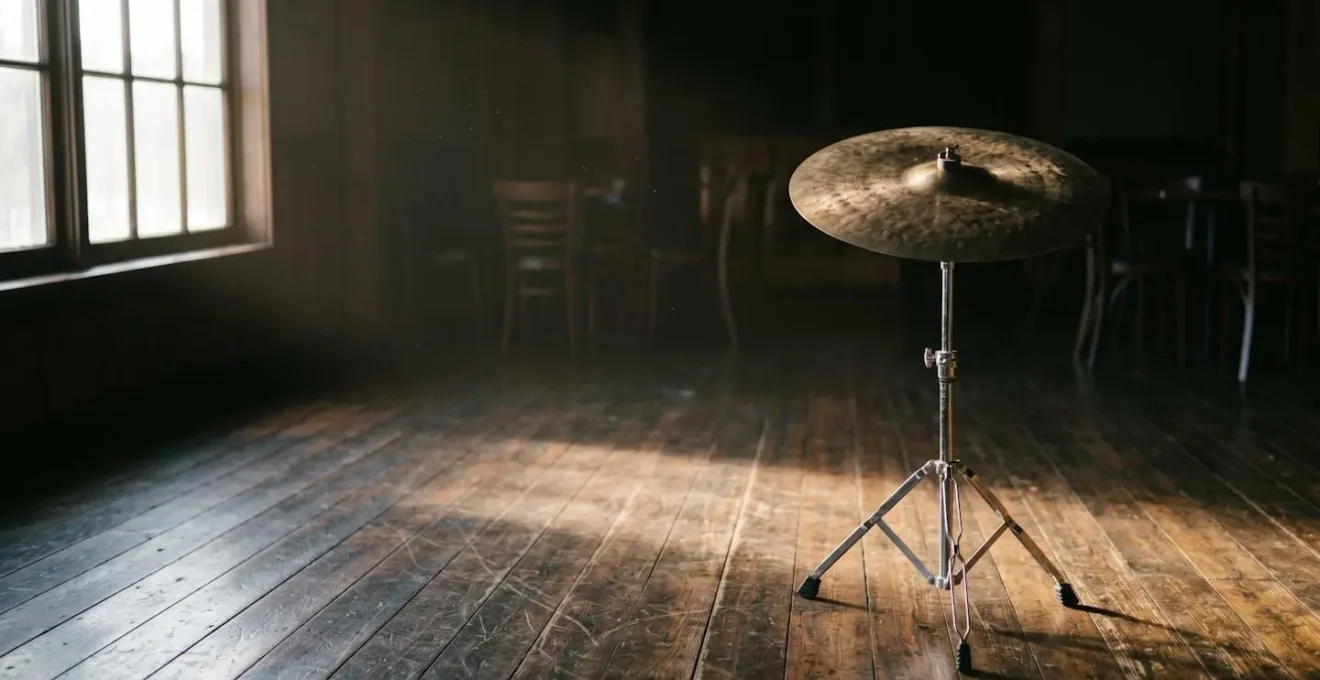
Think of the ride cymbal’s constant « ting-ti-ting » pattern as the surface of a river. A good soloist skips stones across it, touching down lightly and creating ripples. The player who accents the downbeats is dropping heavy rocks into the water, disrupting the flow. The goal is to make your lines dance around the main beats, creating tension and release by accenting the upbeats. This is one of the most common issues for developing players, and fixing it requires a conscious shift of your rhythmic focus away from the « one » and onto the « and. »
When Should You Stop Thinking About Swing and Trust Your Instincts?
There comes a point in your development where conscious thought becomes the enemy of feel. After months of deep listening, imitation, and practice, the mechanics of swing should begin to move from your analytical brain to your muscle memory. This is the ultimate goal: to reach a state where you are no longer « thinking » about swinging but are simply *swinging*. Continuing to consciously calculate ratios or placements at this stage will only keep you sounding stiff. The transition from conscious effort to subconscious instinct is the final, and most crucial, step.
This process is well-documented in the neuroscience of motor learning. As musicians become more skilled, their brains physically change. They begin to rely on what are called « feed-forward sensorimotor processes. » In simple terms, this means the intention to create a certain sound directly triggers the required motor command, without needing to consciously monitor the process. Your brain has built a powerful internal model of what « swing » sounds and feels like, and it can now execute it automatically. Clinging to conscious control at this point is like keeping the training wheels on a bicycle after you’ve learned to balance.
So, how do you know when to let go? The signs are often subtle. You might find yourself improvising and suddenly realize you haven’t been « counting » for the last few choruses. Or you’ll listen back to a recording of yourself and hear a phrase that sounds surprisingly authentic, even though you don’t remember consciously trying to shape it that way. These are signals that the feel is becoming part of your intuitive musical language. The key is to trust these moments. When they happen, lean into them. Intentionally turn off the analytical part of your brain and focus only on the sound and the story you want to tell. The swing will be there, held up by the hundreds of hours of listening and imitation you’ve already done.
Why Does Moving Notes Off the Grid Make Your Beat Sound Better?
The concept of the « grid »—the rigid, metronomic division of time—is useful for learning but toxic for performance. Authentic human rhythm is never perfectly on the grid. It’s this subtle, organic imperfection that we perceive as « feel » or « groove. » When a jazz musician swings, their eighth notes are not divided into a precise, mathematical ratio. The relationship between the on-beat and off-beat notes is fluid and constantly shifting, a phenomenon often referred to as micro-timing.
This variability is the secret ingredient. The idea that swing is a fixed triplet (a 2:1 ratio) is a vast oversimplification used for teaching. In reality, as demonstrated by measurements of classic jazz recordings, swing ratios vary from nearly straight eighths (1:1) to heavy, lopsided triplets (closer to 3:1) and everything in between. This ratio is not static; it changes based on a multitude of factors. Crucially, it’s highly dependent on tempo. As a general rule, swing ratios tend to be wider and more pronounced at slower tempos, and they become narrower and closer to straight eighths as the tempo increases. A bebop soloist playing at 300 beats per minute isn’t thinking in triplets; their lines are almost even, with the swing feel coming from accent and articulation.
This is why playing « off the grid » sounds better. It sounds human. When every note lands with perfect, quantized precision, our brains perceive it as artificial and robotic. The slight push and pull against the beat—a bassist playing slightly behind the beat, a saxophonist playing right on top of it—is what creates rhythmic tension and a feeling of forward motion. It’s a conversation. The goal isn’t to be « out of time, » but to be in a fluid relationship *with* the time. Mastering this means developing an internal clock that is strong yet flexible, allowing you to place notes with intention and feel, rather than with cold, mathematical precision.
Why Does « Thinking Less » Often Produce Better Solos Than « Thinking More »?
Every musician has experienced it: the solos you labor over, consciously constructing every line, often sound forced and uninspired. In contrast, the moments where you « just play » and let go often yield the most creative and fluid ideas. This isn’t a mystical phenomenon; it’s a reflection of how our brains are wired for complex motor tasks like musical improvisation. Excessive conscious thought, or « thinking more, » actively interferes with the highly trained, automatic processes that produce our best music.
Neuroscience research on musicians reveals a fascinating process. As we practice, the brain’s activity shifts. Early in the learning phase, the prefrontal cortex—the « thinking » part of our brain responsible for planning and analysis—is highly active. However, in a skilled performer, this area becomes *less* active during performance. The task is handed over to more automated, sensorimotor parts of the brain, like the cerebellum and supplementary motor area. According to a study in Frontiers in Neuroscience, decreased activation in certain cognitive control regions allows for a more seamless translation of musical ideas into physical movements. In essence, « thinking too much » re-engages the clunky, slow, analytical brain and disrupts the fast, fluid, and intuitive motor pathways you’ve spent so long building.
This state of « thinking less » is often described as « flow. » It’s a state of deep immersion where the sense of self seems to disappear, and the music simply happens *through* you. It’s not about being mindless; it’s about shifting from a verbal, analytical mode of thought to a more holistic, intuitive one. You’re not thinking, « Now I will play a G7 arpeggio with a flattened ninth. » Instead, you are hearing a sound in your head and your fingers are simply executing it. The key to accessing this state is trust: trust in your ears, trust in your preparation, and trust in the muscle memory you have painstakingly developed. The best solos are born not from calculation, but from letting the music speak for itself.
Key Takeaways
- Authentic swing feel is a physical, internalized language, not a mathematical ratio that can be written down or calculated.
- Developing feel requires deep, focused listening and imitation of masters, training your muscle memory to replicate their rhythmic placement and articulation.
- The biggest mistake is accenting the downbeats (1 and 3); true swing emphasizes the backbeat (2 and 4) and off-beats to create forward momentum.
Why Do Your Programmed Grooves Sound Like a Robot Despite Using Real Drum Samples?
The struggle to create a human-sounding groove isn’t limited to instrumentalists. Music producers face the exact same problem when programming beats. You can have the best, most realistic drum samples in the world, but if you just snap them to a perfect grid, the result will sound lifeless and mechanical. This is because, once again, the « human » element is not in the *sound* of the drum itself, but in the subtle imperfections of its performance. As the LANDR Blog points out, there’s a world of difference between how a symphony orchestra might interpret a written triplet and how a jazz drummer will feel a set of swung eighths, and it comes down to articulation and micro-timing.
To breathe life into a programmed groove, you need to deconstruct and manually re-introduce the elements of human feel. This process, often called « humanization, » goes far beyond a simple « swing » knob on your DAW. It involves thinking like a real drummer and considering three core components: Timing, Timbre, and Touch. By manipulating these three « T’s », you can transform a robotic pattern into a groove that breathes and moves. It’s a powerful exercise not just for producers, but for any musician wanting to understand the DNA of a great feel.
This deconstruction is the final key to understanding what your own playing might be missing. When you can build a living, breathing groove from scratch using sterile samples, you have truly understood the component parts of what makes music feel good. You’ve moved beyond simply knowing that swing « feels » a certain way and have graduated to understanding *why* it does, piece by piece.
Action Plan: The 3 ‘T’s’ of Humanizing Your Groove
- Timing: Move key elements slightly off the grid. Nudge the snare drum a few milliseconds late to create a « laid-back » feel. Push the hi-hats slightly ahead to create urgency. Don’t apply one swing setting to everything; vary the micro-timing of each instrument in the « rhythmic conversation. »
- Timbre: Never use the same sample twice in a row. A real drummer never hits a snare or cymbal in the exact same spot with the exact same force. Use multiple samples for each drum (a center snare hit, an edge hit, a rimshot) and alternate them to create natural sonic variation.
- Touch: Vary the velocity (volume) of each hit. No drummer plays every note at the same volume. The hi-hats on the backbeat (2 and 4) should be slightly louder. Ghost notes on the snare should be incredibly quiet. Create dynamic contours that mimic the shifting focus of a live player.
Now that you understand the mechanics of feel, the next step is to consciously apply these principles of Timing, Timbre, and Touch to your own instrument. Start listening for these details in the masters and, most importantly, in your own playing.