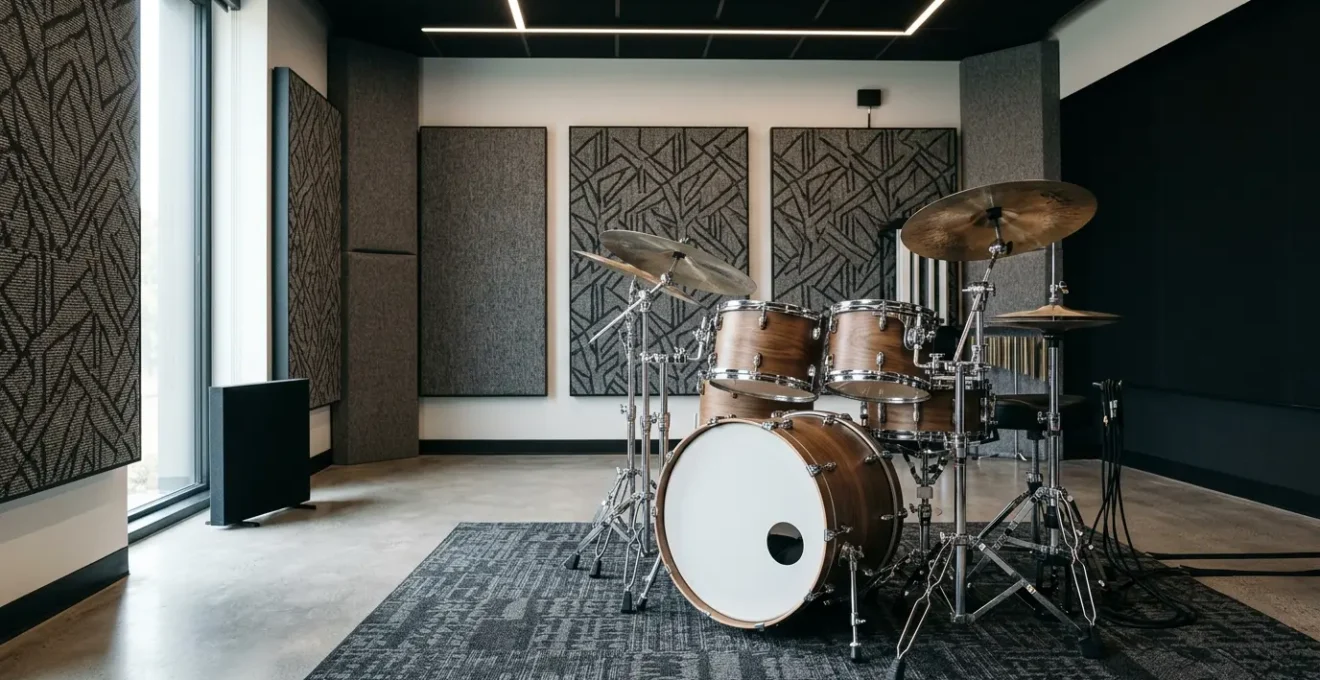
The frustrating inconsistency of your expensive drum kit has little to do with its quality and everything to do with the unresolved battle between its components and the room’s physics.
- Your drumheads and tuning are the primary voice of your kit, often having a greater impact on sound than the shells themselves.
- The acoustics of your space (from a small practice room to a large club) dictate how that voice is perceived, creating problematic reflections or frequency buildups.
Recommendation: Stop blaming your gear. Instead, learn to diagnose your room’s acoustic problems and adapt your setup—from heads to microphones—to work with the environment, not against it.
You’ve done it. You’ve saved up and invested in a high-quality drum kit, the one you’ve seen your heroes play. The shells are perfect, the finish is immaculate, and the hardware is robust. You set it up in your practice space, and it sounds incredible. Then you take it to a gig or a different rehearsal room, and the magic vanishes. The kick drum sounds thin, the toms have a strange, plastic-like attack, and the cymbals feel overwhelmingly harsh. You’re left with a frustrating question: why does my expensive, professional kit sound so drastically different—and often worse—than it should?
The common advice is often a frustrating loop: « tune your drums, » « try different mics, » or worse, « you need better acoustic treatment. » While these points hold some truth, they miss the fundamental issue. They treat the drum, the player, and the room as separate problems. The reality is that your drum kit and the space it occupies form a single, interconnected acoustic system. The problem isn’t your investment; it’s the ‘tonal mismatch’ between the voice you’ve crafted and the environment it’s speaking into. This isn’t about spending more money; it’s about understanding the physics at play.
This guide will move beyond the generic advice. We will diagnose the issue from the source outwards, treating you like the drum tech you need to become. We’ll start with the microscopic—the surface of the drumhead—and expand to the macroscopic—the walls of the room itself. By understanding how each component interacts, you will learn to control your sound in any environment, making your investment finally pay off with consistency and power, regardless of the venue.
This article breaks down the complex relationship between your gear and your environment into a clear, logical progression. Follow along to understand the critical checkpoints for diagnosing and fixing your drum sound, from the initial strike to the final recording.
Summary: A Drum Tech’s Guide to Consistent Sound in Any Environment
- Why Did Changing Drumheads Transform Your Sound More Than Your New Kit?
- How Should Your Drum Tuning Change Between Jazz Club and Rock Festival?
- Maple, Birch or Mahogany: Which Shell Wood Suits Your Playing Style?
- The Kit Configuration Mistake That Makes You a Worse Drummer
- Should You Buy an Intermediate or Pro Kit as Your First Serious Investment?
- Why Does Adding More Microphones Make Your Drum Recording Sound Thinner?
- How to Fix the Room Problems That Make Every Microphone Sound Bad?
- Why Does Your £500 Microphone Sound Amateur While Bedroom Producers Get Radio-Ready Results With £100 Mics?
Why Did Changing Drumheads Transform Your Sound More Than Your New Kit?
The single most overlooked and impactful component of your drum’s sound is the head. Drummers often obsess over shell wood and construction, but the drumhead is where the sound is born. It is the initial transducer, converting your physical energy into acoustic waves. As The Drum Ninja aptly puts it, « The drumhead is where the magic begins. » Choosing the right head is not about « good » or « bad »; it’s about selecting the correct material, thickness, and coating for the sound you want to achieve. A two-ply clear head will provide a focused, punchy attack with a shorter sustain, ideal for rock and funk, while a single-ply coated head will offer a warmer, more open tone with longer sustain, perfect for jazz and lighter styles.
Many drummers find that a simple head change can provide a more dramatic sonic shift than upgrading from an intermediate to a professional kit. This is because the heads dictate the fundamental characteristics of attack, sustain, and overtone profile. A high-quality maple shell kit will still sound choked and lifeless if paired with old, dented, or inappropriate heads. Conversely, a mid-range kit can be brought to life with a fresh set of heads chosen specifically for the desired musical context. Upgrading your kit is not just about the shells; it’s an opportunity to rethink the entire acoustic system, and that starts with the surface you strike.
The psychological impact is also significant. While not directly tied to acoustics, there is a clear link between gear quality and performance. Research suggests that drummers using premium equipment often feel more inspired. This isn’t just about price; it’s about having tools that respond predictably and musically, allowing for greater creative expression. When your kit sounds good *to you*, you play with more confidence and nuance.
How Should Your Drum Tuning Change Between Jazz Club and Rock Festival?
Tuning is the next logical step after selecting your heads, but a « perfectly » tuned drum in a controlled environment can sound dreadful in a live venue. This is the concept of environmental tuning: adapting your drum’s pitch and resonance not just to a musical note, but to the room it’s in. A small, reflective room (like many jazz clubs) will naturally amplify overtones and sustain. In this scenario, you may need to tune your drums slightly lower and use more dampening (gels, rings) to control the excessive resonance. The room is already providing the sustain, so your job is to add focus and warmth.
Conversely, a large or acoustically dead space (like an outdoor festival stage) will absorb your sound. Here, your drums need to project. This often means tuning higher to increase tension and produce a brighter, more cutting tone. You would use minimal or no dampening, allowing the shells to resonate freely to fill the space. The goal is to let the drum create its own sustain because the environment won’t help. Understanding this relationship is key to sounding consistent across different venues.
Case Study: George Lever’s Acoustic Experiments at Angelic Studios
To understand this interaction, look at the work of renowned producer George Lever. In a series of experiments at Angelic Studios, he recorded the same kit in three different acoustic settings: a large live room, the same room with acoustic baffles, and a small, tight booth. The results were telling. While the close-mic’d sound remained consistent, the overall character changed dramatically. The large room added epic reverb, the baffled room tightened the sound for more clarity, and the small room provided a unique, aggressive energy. This proves the room is as much an instrument as the drum itself.
This approach requires active listening. Before a gig, walk around the room and clap your hands. Listen for flutter echoes (a rapid, « zinging » sound) and boomy low-end frequencies. If the room is bright and reflective, prepare to control your drum’s resonance. If it’s dead and dry, prepare to let your drums sing out. Your tuning isn’t a static setting; it’s a dynamic response to your surroundings.
Maple, Birch or Mahogany: Which Shell Wood Suits Your Playing Style?
Once heads and tuning are understood, we can look at the core of the drum: the shell. The type of wood used is a crucial ingredient in the drum’s inherent voice. As John Good of DW Drums, a man who has dedicated his life to the subject, states in an interview with Sweetwater, « all those different materials have a different character. » This isn’t marketing speak; it’s physics. Different woods have different densities and grain structures, which affect how they vibrate and resonate. This choice is not about which wood is « best, » but which wood’s character best matches your playing style and typical musical environment.
A tonal mismatch between shell wood and musical genre is a common source of frustration. For instance, a drummer playing heavy rock with a mahogany kit might struggle to cut through dense guitar mixes. Mahogany has a warm, vintage tone with a rich low-end but muted highs—perfect for jazz or studio work, but it can get lost in a high-volume live setting. That same rock drummer would be better served by a birch kit, known for its boosted high frequencies and powerful low-end punch, which provides the natural EQ curve needed to be heard. Conversely, a jazz drummer playing a birch kit in an intimate club might find the sound too aggressive and lacking in warmth.
Understanding these fundamental tonal properties allows you to make an informed choice that complements your music. The table below, based on established knowledge from manufacturers like Yamaha, breaks down the core characteristics of common drum shell woods.
| Wood Type | Frequency Response | Tonal Character | Best Application |
|---|---|---|---|
| Maple | Even highs and mids, warm low-end | Warm, balanced, maximum resonance | Jazz, rock, pop, studio recording |
| Birch | Boosted highs, reduced mids, strong low-end | Bright, punchy, aggressive attack | Rock, metal, live performance projection |
| Mahogany | Muted highs, smooth mids, rich low-end | Warm, soft, substantial punch | Jazz, vintage tones, intimate settings |
| Oak | Soft highs, accurate mids, warm lows | Full-bodied, focused low fundamental | Studio and stage versatility |
This data, highlighted in resources like Yamaha’s guide to drum tonewoods, is not a set of rigid rules but a map to help you find your sound. Your shell is your foundation; choosing the right one prevents you from fighting your gear to achieve a tone it was never meant to produce.
The Kit Configuration Mistake That Makes You a Worse Drummer
Beyond the materials of your kit is its physical arrangement: ergonomics. A poorly configured kit doesn’t just sound bad; it actively hinders your ability to play well. The most common mistake is prioritising visual symmetry over the natural, asymmetrical mechanics of the human body. Drummers often set up their toms in a perfect, visually pleasing arc, forcing their body into awkward twists and turns to play fills. This leads to inconsistent striking velocity, poor timing, and even injury. Your kit should adapt to you, not the other way around.
The core of any ergonomic setup is the « power triangle »: your snare drum, hi-hat, and kick drum pedal. These should be positioned first, aligned with your body’s natural center of gravity when seated. Your non-dominant foot rests on the hi-hat pedal, your dominant foot on the kick pedal, and the snare sits comfortably between your legs without forcing them apart. All other components—toms, cymbals, and accessories—should then be placed around this foundation for comfortable, effortless reach without leaning or stretching. This approach promotes better balance, energy transfer, and ultimately, better and more consistent playing.
A well-configured kit also has sonic benefits. Consider these fundamental principles for an ergonomic and acoustically sound setup:
- Position toms relatively flat. Severely angled toms cause you to strike the head with the shoulder of the stick, not the tip. This not only chokes the drum’s resonance but also creates dents (« pitting ») in the head, drastically shortening its life.
- Scale the kit to your environment. In a small room, a massive kit is your enemy. It creates more sources of sound and reflection, making the acoustic space chaotic. A simple four-piece kit is often more powerful and clearer in a tight space.
- Prioritise playability over « perfect » tone placement. It’s tempting to move a crash cymbal a few inches to the left because it sounds better there, but if that position forces you to stretch awkwardly, you’ll hit it with less consistency and power. Find the most comfortable spot first, then make minor acoustic adjustments.
By building your setup around your body’s natural movements, you remove physical barriers to your playing. This allows your musical ideas to flow more freely and translates into a more powerful, confident, and consistent sound, regardless of the room.
Should You Buy an Intermediate or Pro Kit as Your First Serious Investment?
When making your first significant drum investment, the debate between « intermediate » and « pro » level kits is often framed incorrectly. The question isn’t just about budget; it’s about understanding what you’re actually paying for. Professional kits typically feature higher-quality woods, more precise bearing edges, and more robust hardware. However, a key differentiator often lies in the shell construction itself. As custom drum builder Matty Longo explains, « The thinner the shell, the lower the fundamental tone. The thicker the shell, the higher the fundamental tone. » Pro kits often offer a wider variety of shell thicknesses and construction methods, giving you more control over the drum’s fundamental voice before you even touch a tuning key.
However, an intermediate kit from a reputable brand can be a smarter investment for many drummers. These kits are often made with the same woods as their professional counterparts (like maple or birch) but utilise more cost-effective manufacturing processes. When paired with high-quality heads and proper tuning, a modern intermediate kit can sound phenomenal and is often indistinguishable from a pro kit to most listeners, especially in a live mix. The money saved can then be invested in the elements that offer a more immediate sonic return: a great set of cymbals, a variety of snare drums, or basic acoustic treatment for your practice space.
The decision should be guided by your goals. If you are a dedicated studio musician who needs a specific tonal character that only a high-end, thin-shelled maple kit can provide, then a pro kit is a justifiable investment. It provides that specific foundational voice. However, if you are a gigging drummer playing in various venues, a versatile and durable intermediate kit might be the more practical choice. It provides a solid foundation that can be adapted with different heads and tuning for any situation. Remember, drummers using premium sets often report a significant increase in confidence, but this confidence comes from having gear that sounds great and performs reliably, a quality that is not exclusive to the most expensive kits on the market.
Why Does Adding More Microphones Make Your Drum Recording Sound Thinner?
After perfecting your acoustic sound, the next challenge is capturing it. A common and frustrating problem in drum recording is that adding more microphones—a spot mic on the hi-hat, a second mic on the snare—can inexplicably make the overall sound weaker, thinner, and less powerful. This phenomenon is almost always caused by phase cancellation. Sound travels in waves, with peaks and troughs. When two microphones capture the same sound source from different distances, their sound waves can arrive at the recording device out of sync. If the peak of one wave aligns with the trough of another, they cancel each other out, typically wiping out low-end frequencies and resulting in a thin, hollow sound.
The most critical relationship to manage is between the overhead microphones and the close microphones (or « spot mics »). The overheads capture the overall picture of the kit, while the spot mics add focus and attack to individual drums. If a snare drum’s sound reaches an overhead mic slightly later than it reaches the snare’s spot mic, their waveforms will be out of phase. This is why a snare might sound huge on its own but disappears when you bring up the overheads in the mix.

To combat this, engineers use several techniques. The most fundamental is the 3:1 rule. This principle serves as a crucial starting point for microphone placement. It helps ensure that the sound from a source is significantly louder in its intended microphone than in any other, minimizing the potential for phase cancellation between them.
Case Study: The 3:1 Rule for Phase Coherence
Professional recording guidelines, such as those established by microphone authority Shure, codify the 3:1 rule as a foundational technique to prevent phase issues. As Shure’s in-depth guides explain, the rule states that the distance between any two microphones should be at least three times the distance from either microphone to its sound source. For example, if your snare mic is 2 inches from the snare drum, your hi-hat mic should be at least 6 inches away from the snare mic. This isn’t an unbreakable law, but it’s an essential starting point for achieving a full, powerful drum recording and avoiding the dreaded thinness that plagues so many home recordings.
How to Fix the Room Problems That Make Every Microphone Sound Bad?
You can have the best drums, the best tuning, and the best microphone technique, but if the room you’re in has acoustic problems, your sound will suffer. As The Drum Ninja notes, « The room you play in significantly impacts the perceived volume of your drums. » This also applies to tonal quality. Hard, parallel surfaces create a host of issues, including flutter echo (a metallic ringing caused by sound rapidly bouncing between walls) and standing waves (where low frequencies build up in some spots and cancel out in others). This is why your kick drum might sound massive in one corner and non-existent in the center of the room. Treating a room doesn’t have to mean spending thousands on professional installation. It means identifying the biggest problems and strategically applying treatment where it will have the most impact.
The most effective DIY approach focuses on the « Triangle of Power »: the two first-reflection points on the side walls and the ceiling area directly above the kit. First-reflection points are where sound travels from a source (like your snare drum), bounces off a wall once, and travels directly to your ears (or microphones). These are the most problematic reflections because they arrive just milliseconds after the direct sound, smearing its clarity and stereo image. You can find these points with a mirror: sit in your listening position and have a friend slide a mirror along the wall. Wherever you can see the drum kit in the mirror is a first-reflection point that needs an absorption panel.
In a small room, low-frequency buildup is also a major issue. Kick drums and floor toms produce long wavelengths that get trapped in corners, creating a boomy, undefined low end. This is where bass traps are essential. They are specifically designed to absorb low-frequency energy. Placing them in the corners of your room will do more to tighten up your kick and tom sound than any EQ adjustment ever could. Effective room treatment is a balancing act. The goal isn’t to make the room completely « dead » by covering every surface in foam, but to control the most problematic reflections while retaining some natural ambience. In fact, acoustic testing on drum enclosures shows that strategic placement can dramatically reduce perceived volume and chaotic reflections without eliminating all life from the room.
Your Action Plan: The Triangle of Power Room Treatment Strategy
- Identify First Reflections: Sit at your listening position and have a friend slide a mirror along the side walls. Place an absorption panel at every spot where you can see the drums in the reflection.
- Control Vertical Reflections: Install a ceiling « cloud » (an overhead absorption panel) directly above the drum kit to tame flutter echo and harsh cymbal reflections.
- Trap the Bass: Place bass traps in as many room corners as possible (floor-to-ceiling is ideal) to control the long, boomy wavelengths produced by your kick drum and floor toms.
- Perform a Diagnostic Clap Test: Before buying anything, walk around your room and clap loudly. Listen for the « zing » of flutter echo. Play your kick drum and walk around to find the « sweet spot » where the bass sounds most even. This maps your problem areas.
- Balance Absorption and Diffusion: Don’t just use foam panels. Once primary reflections are absorbed, consider adding diffusers to other surfaces. They scatter the remaining sound waves, which keeps the room sounding live and spacious without creating problematic echoes.
Key Takeaways
- Your drum sound is an acoustic system; the heads, tuning, shells, and room are all interconnected parts.
- The most significant sonic changes often come from the cheapest components: your drumheads and your tuning choices.
- Fix the sound at the source (the drum in the room) before you ever think about microphone choice or placement.
Why Does Your £500 Microphone Sound Amateur While Bedroom Producers Get Radio-Ready Results With £100 Mics?
This is the final, and perhaps most frustrating, piece of the puzzle. You’ve invested in a reputable, expensive condenser microphone, yet your recordings sound boomy, distant, and unprofessional. Meanwhile, you hear bedroom-produced tracks with massive, punchy drums that were seemingly recorded with budget dynamic mics. The secret isn’t the microphone’s price tag; it’s the application of the Source-First Principle. A radio-ready drum sound is 90% the quality of the source and 10% the quality of the capture gear. That « bedroom producer » has likely spent hours perfecting their drum’s acoustic sound *in the room* before hitting record.
An expensive condenser microphone is like a high-resolution camera. It captures everything with unforgiving detail. If your room has flutter echo and standing wave issues, your £500 mic will capture those problems beautifully. A cheaper dynamic microphone (like the ubiquitous Shure SM57) is less sensitive to distant sounds. By its very nature, it « rejects » more of the bad room sound and focuses on the close, direct sound source. This is why a simple, well-placed £100 mic on a well-tuned snare drum in a poorly treated room will often yield a better result than an expensive condenser mic placed a few feet away. The dynamic mic is inadvertently « solving » the room problem by ignoring it.
The goal is to combine the best of both worlds: a great source sound and a detailed capture. As the experts at Gearnews advise when recording in small spaces, « If we minimize the amount of negative colouration the room is adding, and try to capture the cleanest direct sound, we can achieve professional results. » This means applying everything we’ve discussed. It means choosing the right heads, tuning them to the room, treating the room’s first reflections and bass buildup, and *then* selecting a microphone. Your expensive mic isn’t the problem; it’s simply a truthful reporter telling you that your source sound isn’t yet ready to be recorded.
Start today by taking a systematic, source-first approach. Forget about buying new gear and instead diagnose your existing acoustic system. By mastering the interaction between your drums and your space, you can finally achieve the consistent, powerful, and professional sound your investment deserves, in any room you play.