The rejection of your music is not a failure of your art, but a failure of context; listeners hear ‘noise’ when their brains can’t find the familiar patterns they expect.
- The exact same sound can be perceived as ‘genius’ or ‘pretentious’ depending entirely on the venue and the expectations set.
- Your role isn’t to ‘dumb down’ your work, but to actively frame the listening experience, guiding the audience’s attention to your intended focus.
Recommendation: Stop expecting audiences to ‘get it’ on their own and start designing the perceptual journey into your music as carefully as you design the sounds themselves.
You’ve spent weeks, maybe months, wrestling with a new piece. Every texture, every drone, every jarring shift is meticulously placed. You perform it in a corner of a busy London pub, pouring your soul into the sound, only to be met with blank stares, polite but confused applause, or worse, the dismissive label of « just noise. » It’s a deeply frustrating experience shared by countless UK musicians pushing the boundaries of sound. The common advice feels unhelpful: « it’s an acquired taste, » or « you need to find your niche. » These platitudes place the burden on an audience that seems unwilling to listen.
But what if the problem isn’t the audience’s lack of education or your music’s inherent difficulty? What if the barrier is purely cognitive? The human brain is a pattern-matching machine, and when it’s presented with sounds that defy its expectations of melody, harmony, and rhythm, its default reaction is confusion and rejection. It’s a predictable neurological response, not a personal critique. The key, therefore, isn’t to change your music, but to change the context in which it’s heard. It’s about consciously building a new ‘perceptual contract’ with your listener.
This article will not tell you to simplify your work. Instead, it will provide a strategic framework for understanding the psychology of listening. We will explore why context is king, how to guide your audience without condescension, and how to structure your challenging work to gradually invite listeners in, rather than shutting them out. It’s time to move from being a composer of sounds to an architect of perception.
This guide offers a clear path to reframe how your unconventional music is received. By understanding the cognitive triggers behind audience rejection, you can develop practical strategies to build context and connection, turning confused listeners into engaged followers. The following sections break down this process step by step.
Summary: Why Your Experimental Music is Perceived as Noise and How to Fix It
- Why Does Prepared Piano Sound Like Genius in a Gallery but Pretentious in a Pub?
- How to Help New Listeners Access Your Experimental Music Without Dumbing It Down?
- Noise, Minimalism or Free Improvisation: Which Experimental Tradition Fits Your Vision?
- The Experimental Trap of Prioritising Obscurity Over Communication
- In What Order Should You Introduce Challenging Elements for Maximum Audience Retention?
- Why Does Music You Don’t Recognise Feel More Dissonant Than It Actually Is?
- Why Do Modular Users Say the Journey Matters More Than the Destination?
- Why Does Modern Classical Music Sound Like Random Noise to Untrained Ears?
Why Does Prepared Piano Sound Like Genius in a Gallery but Pretentious in a Pub?
The answer lies in a concept we can call cognitive framing. A listener entering a formal art gallery or concert hall has already accepted a specific perceptual contract. The silent, white-walled space, the program notes, the institutional authority—all these cues signal that what they are about to experience is ‘Art’. Their brain is primed to search for intention, innovation, and deeper meaning, even within unfamiliar sounds. The context provides a framework for appreciation. Take that same piece and place it in a pub, where the established context is socialising, background music, and familiar song structures, and the perceptual contract is broken. Without the institutional frame, the sounds are judged against the wrong criteria and are often dismissed.
This isn’t theory; it’s a demonstrable phenomenon. Research confirms that artists can fundamentally change how their work is received simply by managing the environment and the listener’s expectations. In a study on cultural source sensitivity, academics found that musicians can manipulate how their music is appreciated by altering its contextual frame, emphasizing details likely to resonate with an audience. It’s not about the sound itself, but about the story you tell around the sound.
Case Study: John Cage’s Prepared Piano and the Cornish School Context
In 1940, John Cage invented the prepared piano at Seattle’s Cornish School when a small stage couldn’t accommodate his percussion ensemble. By inserting household objects like screws and rubber bands between piano strings, he created strange, percussive sounds that were initially met with confusion. However, the context of an arts school—a place of experimentation—provided a crucial buffer. The same compositions later performed in formal concert halls and galleries were praised as revolutionary. The identical sonic material was perceived as either confusing noise or groundbreaking innovation, demonstrating how the physical venue and institutional framing dramatically altered the audience’s perception.
Therefore, the challenge for the experimental musician in a non-traditional venue is to become a « context builder. » You must create the frame that the gallery or concert hall would normally provide. This could be a brief spoken introduction, a visual projection, or even a title that offers a way into the piece. You are replacing the institutional frame with a personal one, giving the listener the tools they need to appreciate the work on its own terms.
How to Help New Listeners Access Your Experimental Music Without Dumbing It Down?
The fear of « dumbing it down » often prevents artists from helping their audience. But providing access is not about simplification; it’s about orientation. Imagine giving someone a map to a complex city. You aren’t changing the city; you are just helping them navigate it. This is the essence of guided listening. Instead of expecting a listener to decipher your sonic language from scratch, you provide signposts that direct their attention to what you, the artist, find most important. This builds a bridge of communication and turns a potentially alienating experience into a shared journey of discovery.
This approach acknowledges the findings of groundbreaking research on contemporary classical music audiences, which examined the tensions between experimentalism and accessibility. Providing a ‘way in’ is a crucial act of hospitality. You can do this verbally by saying something like, « In this next piece, I’m exploring the texture of a single sound as it decays, » or « Listen for the conversation happening between the high, sharp sounds and the low drone. » These simple instructions don’t change the music, but they focus the listener’s ear and give them a specific goal, replacing confusion with active engagement.

Visuals can also serve as a powerful guide. A projected abstract image that evolves with the music, or even a simple lighting change that signals a shift in the piece, can provide a non-verbal narrative. The goal is to anchor the listener’s perception. You are giving them a thread to hold onto as they venture into unfamiliar territory. This isn’t condescending; it’s a confident act of an artist who understands their work so deeply that they can illuminate its path for others.
Your Action Plan: Framing the Listening Experience
- Points of Contact: List every opportunity you have to frame the experience before and during a performance (e.g., event description, social media posts, your introduction on stage, a handout, visuals).
- Collect: Inventory your existing framing elements. Are your track titles purely abstract, or do they offer a hint? What do you currently say on stage? Be honest about what’s working.
- Coherence: Does your framing align with your artistic vision? If your music is about chaos, does your introduction create a sense of anarchic playfulness, or is it a dry, academic explanation?
- Memorability/Emotion: Identify one key idea or feeling you want the audience to leave with for each piece. Craft a single, simple sentence that encapsulates it (e.g., « This piece is about the sound of rust. »). This is your core signpost.
- Plan of Integration: Decide which framing tool is best for each point of contact. A compelling title for the event page, a one-sentence verbal cue on stage, a simple visual for the performance itself. Prioritise clarity over complexity.
Noise, Minimalism or Free Improvisation: Which Experimental Tradition Fits Your Vision?
Choosing an experimental tradition to work within isn’t just about aesthetic preference; it’s about choosing a set of communicative tools and historical conversations. Understanding where your work sits helps you articulate its purpose to an audience. Each tradition has its own implicit « perceptual contract. » By knowing which contract you’re working with—or breaking—you can better frame your music. Are you a noise artist exploring overwhelming sensory input, a minimalist focusing on subtle change over time, or a free improviser celebrating spontaneous interaction?
Let’s consider the different goals:
- Noise Music: Often confronts the listener with dense, powerful, and sometimes harsh textures. Its goal may be catharsis, exploring the limits of sound equipment, or creating an overwhelming, immersive physical experience. The framing here might focus on energy, texture, and physical sensation rather than melody.
- Minimalism: Focuses on gradual processes, repetition, and subtle variation. The listener’s attention is drawn to the minute details of change. Framing this work involves encouraging patience and deep, focused listening, highlighting the meditative or hypnotic qualities.
- Free Improvisation: The focus is on the real-time creation and interplay between musicians. The « art » is the act of listening and responding. To frame this, you would guide the audience to listen to the *relationships* and the *spontaneity* of the musical conversation as it unfolds.
Your choice of tradition informs the emotional and intellectual experience you are offering. Some traditions aim for a profound, meaningful engagement, while others might prioritise a more direct, pleasurable, or visceral reaction. Interestingly, research demonstrates that when music is perceived as meaningful, listeners are more driven to engage with it on a deeper level. One study found that 39.4% of listeners exposed to meaningful music expressed a desire to connect emotionally, compared to only 16.7% for music presented as purely pleasurable. Aligning with a tradition helps you clarify whether your goal is to provoke deep thought or provide immediate sensation, which in turn clarifies your framing strategy.
The Experimental Trap of Prioritising Obscurity Over Communication
There exists a fine line between creating challenging, innovative art and falling into the trap of prizing obscurity for its own sake. This happens when the artist’s primary goal shifts from communicating a unique vision to simply demonstrating a rejection of convention. The music becomes a secret handshake, accessible only to a small in-group who understands the complex theoretical rules being broken. While this can create a strong sense of community among initiates, it is a dead end for audience building. It’s a deliberate decision to sever the perceptual contract without any attempt to offer a new one.
History is filled with examples of this divergence. The composer Arnold Schoenberg, a titan of 20th-century music, provides a stark case study. He systematically dismantled tonality, the harmonic language that had governed Western music for centuries. While his methods were revolutionary and deeply influential among other composers, they failed to find a foothold with the broader public.
Case Study: Schoenberg’s Break with Tonality and its Public Reception
When Schoenberg published his Theory of Harmony in 1911, declaring that tonality was not a natural law of music, it sent shockwaves through the artistic world. His atonal and twelve-tone systems were adopted by innovators globally and remain a cornerstone of academic music. Yet, this radical innovation was met with near-total rejection from concert audiences, a reality that persists to this day. Mainstream orchestral programming features very few atonal works, and active appreciation remains largely confined to conductors, performers, and composers themselves. This illustrates the profound and lasting gap that can form between artistic innovation and audience communication when the break with convention is absolute and unguided.
This path was, for some, a conscious choice. The composer Elliott Carter, after completing a particularly dense and complex piece, famously stated, « I decided for once to write a work very interesting to myself and to say to hell with the public and with the performers too. » While there is an undeniable artistic freedom in this stance, it is not a strategy for connection. As biographer Stephen Walsh noted, this may be why Schoenberg’s music has struggled to find a permanent place in the performing repertoire, a unique fate for a composer of his stature. As he wrote when discussing Schoenberg’s legacy, « Schoenberg may be the first ‘great’ composer in modern history whose music has not entered the repertoire » nearly a century and a half after his birth. The lesson is clear: innovation without a bridge to the listener risks becoming a monologue in an empty room.
In What Order Should You Introduce Challenging Elements for Maximum Audience Retention?
Once you’ve embraced your role as an architect of perception, you can begin to think like one. A key strategy is sonic onboarding: the process of introducing challenging or unfamiliar elements in a structured way that allows the listener to acclimate and build understanding. Instead of throwing an audience into the deep end of a complex sonic world, you provide a gradual entry point. This method respects the listener’s cognitive limits while staying true to your artistic vision. It’s about sequencing, not simplification.
The core principles of sonic onboarding are straightforward:
- Start with an Anchor: Begin your piece or set with a sound, rhythm, or even a simple texture that is relatively familiar or easily grasped. This could be a steady drone, a repeating melodic fragment, or a recognizable timbre. This anchor serves as a ‘home base’ for the listener’s ear.
- Introduce One New Element at a Time: Once the anchor is established, introduce a single challenging element. This could be a dissonant harmony, an unconventional rhythm, or a strange new texture. By isolating the new element, you allow the listener to process it without being overwhelmed.
- Use Repetition to Build Familiarity: Repeat the new element. Repetition is the most powerful tool for turning the unfamiliar into the familiar. As the listener hears the ‘challenging’ sound again, their brain begins to categorise it and accept it as part of the piece’s vocabulary.
- Build Complexity Progressively: Once the first new element has been integrated, you can introduce another, building layers of complexity gradually. Each new sound is introduced in relation to the now-familiar elements that preceded it.

This process transforms the listening experience from a confusing barrage of noise into a journey of discovery. The listener is actively participating in the construction of the piece’s logic. They are learning your language as you speak it. This approach is not about making your music ‘easy’; it’s about making it ‘learnable’. By carefully sequencing the introduction of your ideas, you create a sense of internal coherence that can be perceived even by an untrained ear, fostering a much deeper and more rewarding engagement for your audience.
Why Does Music You Don’t Recognise Feel More Dissonant Than It Actually Is?
The feeling that unfamiliar music is harsh, chaotic, or more dissonant than it might technically be is a direct consequence of how our brains are wired. The brain is a prediction machine, constantly scanning the environment for familiar patterns to make sense of the world efficiently. When it comes to music, it has been trained over a lifetime to expect certain patterns related to melody, harmony, and rhythm. When these patterns are absent, the brain’s prediction models fail. This triggers a specific neurological response that is often misinterpreted as an aesthetic judgment.
This isn’t just a feeling; it’s a measurable, near-instantaneous biological event. Groundbreaking neuroscience research using EEG and pupillometry revealed that brain and pupil responses differentiated familiar from unfamiliar music within 750 milliseconds. Unfamiliar sounds immediately trigger brain regions associated with novelty detection, attentional capture, and cognitive load. In essence, the brain flags the new sound as an ‘unknown variable’ that requires more processing power. This heightened state of alert and cognitive effort can be physically taxing and emotionally unsettling, which we then label as ‘dissonant’ or ‘unpleasant’.
This cognitive friction is the source of the « noise » perception. The listener isn’t necessarily reacting to the specific harmonic intervals you’ve chosen, but to the overall failure of their predictive models. The music feels « random » because their brain can’t find the underlying logic. It’s a crucial insight for experimental artists because it depersonalises the rejection. The listener isn’t saying « your music is bad »; their brain is saying « I don’t have a category for this, and it’s making me work too hard. »
Understanding this biological basis is empowering. It means that you can help the listener by providing them with the patterns they are missing. Through repetition, clear structural signposting, and contextual framing, you are essentially giving their brain the new rules for the game. You are helping it build a new predictive model for your specific sonic world, reducing cognitive friction and allowing them to move from a state of alert confusion to one of engaged appreciation.
Why Do Modular Users Say the Journey Matters More Than the Destination?
The popular mantra among modular synthesiser enthusiasts—that the process of creating a patch is more important than the final musical result—holds a profound lesson for all experimental musicians. This philosophy is a perfect embodiment of context-building in action. By focusing on, and often sharing, the « journey » of creation, these artists are providing a rich narrative framework that makes their often abstract and unconventional « destination » (the music) far more accessible and meaningful to an audience.
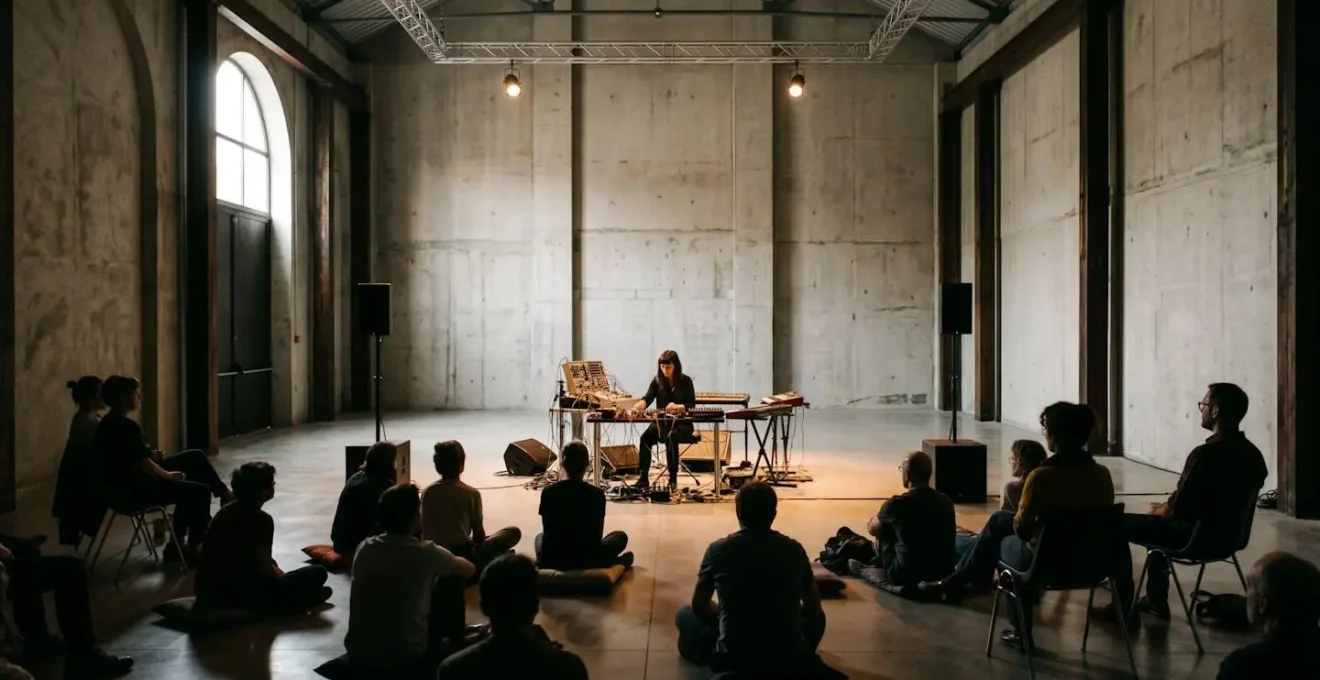
When an audience sees a modular performance, they are not just hearing sounds; they are witnessing a process. They see the artist patching cables, turning knobs, and responding to the machine’s emergent behaviour. This visual and procedural context provides a wealth of information that an audio-only recording lacks. It answers the implicit questions in a listener’s mind: « How is that sound being made? » and « What is the artist’s intention? » The performance becomes a story of exploration and discovery, and the audience is invited to follow along. The physical actions provide a tangible anchor for the abstract sounds.
Case Study: John Cage’s Prepared Piano as Process-Performance
The legacy of John Cage’s prepared piano works extends beyond the sound itself. Live performances of his ‘Sonatas and Interludes’ remain relatively rare, partly because most concert venues are resistant to placing metal screws and bolts inside their valuable grand pianos. The setup and takedown can require hours of meticulous, ritualistic work. Yet, this very process—the visible, painstaking transformation of a familiar instrument into something new—became as conceptually vital as the final music. Performers who document or even perform the preparation process for an audience report that viewers gain a much deeper appreciation. Witnessing the journey of sonic transformation provides a narrative that makes the predetermined, and often strange, result far more engaging.
This « show your work » mentality is a powerful tool for any experimental artist. It could mean talking an audience through your setup, performing in a way that makes your techniques visible, using live video projections of your hands, or even just telling the story of how a piece was composed. By revealing the journey, you are giving the audience a behind-the-scenes pass. You are framing the work not as a finished, inscrutable object, but as the result of a human process of curiosity, struggle, and discovery. This humanises the abstract and builds a powerful connection that a disembodied sound rarely can.
Key Takeaways
- Frame Before You Perform: Context is not optional. The perception of your music is determined by the expectations you set in the venue, in your introduction, and even in your track titles.
- Guide, Don’t ‘Educate’: Provide listeners with ‘signposts’—a key texture to listen for, a structural idea to follow—to help them navigate your sonic world without simplifying your art.
- Embrace ‘Sonic Onboarding’: Introduce complex or unfamiliar elements gradually, using anchors and repetition to turn the strange into the familiar, making your music learnable.
Why Does Modern Classical Music Sound Like Random Noise to Untrained Ears?
The perception of much modern classical or atonal music as « random noise » is the ultimate culmination of all the principles we’ve discussed. It is the direct cognitive result of a deliberate and systematic breaking of the traditional Western musical contract. As one formal definition puts it, « The repertory of atonal music is characterized by the occurrence of pitches in novel combinations, as well as by the occurrence of familiar pitch combinations in unfamiliar environments. » This double-whammy of unfamiliarity is profoundly disorienting for a brain trained to anticipate tonal resolution and harmonic progression.
For centuries, the listener’s brain learned that certain chords lead to others and that a musical phrase would ultimately resolve to a « home » chord (the tonic). This created a sense of tension and release that was both emotionally satisfying and cognitively predictable. Atonal music removes this foundational framework. Without a tonal centre, there is no « home » to return to, and without traditional harmonic progressions, the brain’s predictive models completely fail. Every new sound arrives as a surprise, leading to high cognitive friction. When the brain is overwhelmed with unpredictable data, its shortcut is to categorise the entire experience as chaotic or « random. »
This isn’t an aesthetic failing on the listener’s part; it is the predictable outcome of removing the navigational stars from the musical map. It validates the artist’s experience of being misunderstood, but it also places the responsibility firmly in their hands. If you choose to remove the old rules, you must provide new ones. This could be a rhythmic pattern, a timbral narrative, or a process-based structure, as seen with modular synthesis. Without any new framework, you are asking the listener to float in a sea of pure abstraction, an experience that most find more exhausting than enlightening.
Ultimately, your music is a world you have built. As its architect, you know its hidden logic, its emotional core, and its points of beauty. The listener, arriving for the first time, does not. They see an imposing, unfamiliar structure and are unsure where the door is. The artist who succeeds in building an audience is the one who doesn’t just build the world but also graciously holds the door open, points the way to the first room, and gives the visitor a reason to want to explore further.
Start today by taking control of the narrative around your music. Frame your next performance, guide your next audience, and begin the rewarding process of turning passive, confused listeners into an active, engaged community that seeks out the unique sonic worlds only you can create.