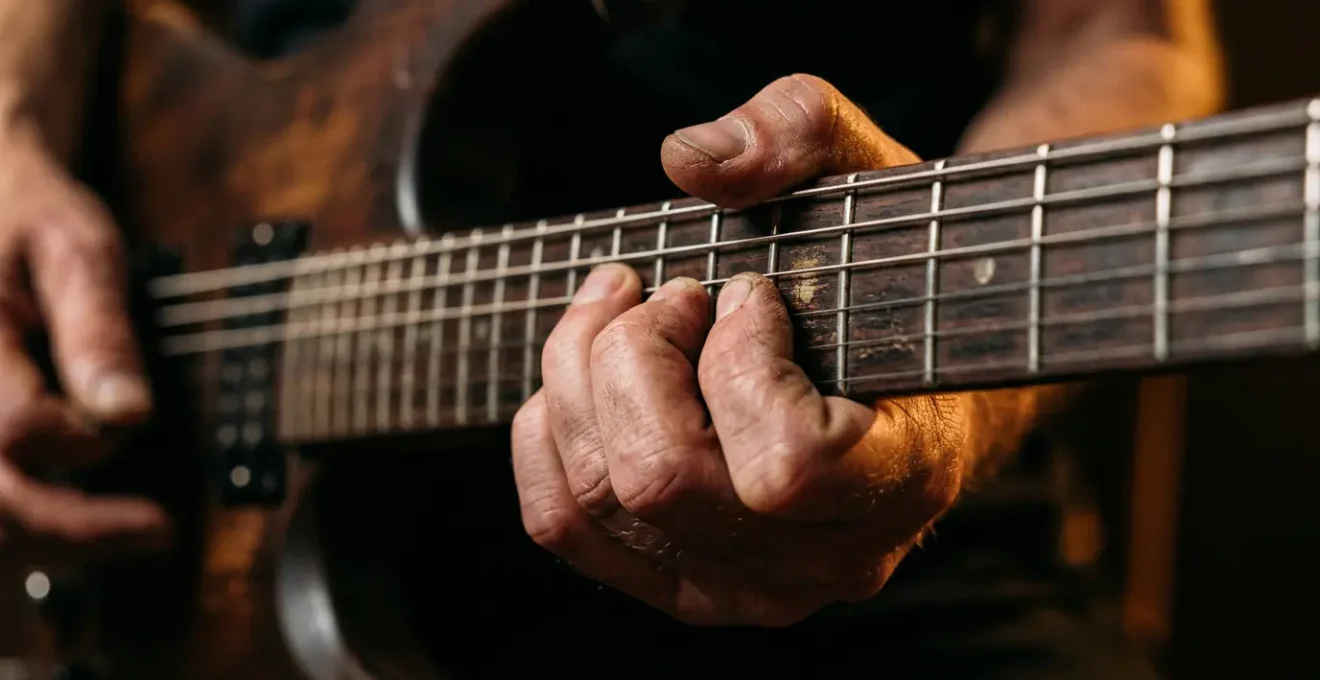
You’ve been told to master the blues scale to sound authentic. But the truth is, emotional blues playing isn’t about hitting the right notes—it’s about intentionally bending pitch into expressive ‘blue zones’ that mimic the human voice. This guide shifts your focus from technical accuracy to soulful intention, transforming sterile licks into genuine musical statements.
You’ve done the work. You’ve memorised the blues scale, you can run through your pentatonic boxes at speed, and you’ve transcribed a few licks from your favourite players. Yet, when you play, something is missing. Your notes are correct, but they feel hollow, like a well-recited speech with no emotion behind it. Your solos sound less like a heartfelt cry and more like a technical exercise. This is a deeply frustrating place for any musician, especially one in the UK trying to connect with the raw, emotional core of the blues tradition.
The common advice is often to just « listen more » or « play with more feeling, » which is rarely helpful. The problem isn’t a lack of effort; it’s a misunderstanding of the fundamental nature of blues expression. We are often taught to think of notes as fixed, precise targets on the fretboard, like rungs on a ladder. We learn that being « in tune » is the primary goal, and any deviation is a mistake. But what if the very soul of the blues lies in the rejection of that idea?
The real key to unlocking emotional expression is to stop chasing perfect notes and start exploring imperfect, expressive pitch zones. This article will guide you away from the mechanical mindset of a scale-runner and towards the soulful intuition of a storyteller. We will deconstruct why blue notes defy standard tuning, how a single note can carry more weight than a flurry of fast ones, and how to build solos that tell a compelling story of tension and release. It’s time to transform your technically correct playing into something that truly communicates.
To guide you on this journey from sterile exercises to soulful expression, this article is structured to build your understanding step by step. Below is a summary of the key areas we will explore to reshape your approach to the blues.
Summary: Unlocking the Emotional Heart of Your Blues Playing
- Why Can’t You Play Blue Notes in Tune Like Other Notes?
- How to Make a Single Blue Note Communicate More Than a Dozen Fast Licks?
- How Do Blues Guitarists and Jazz Saxophonists Use Blue Notes Differently?
- The Blue Note Trap of Using Them So Often They Lose All Emotional Power
- When in a Solo Should Blue Notes Create Drama and When Should They Resolve?
- How to Learn Jazz Vocabulary Without Sounding Like You’re Playing Memorised Licks?
- How to Write a Major Key Song That Makes People Cry Instead of Smile?
- Why Do Your Fast Solos Sound Like Exercises While Slower Players Sound Musical?
Why Can’t You Play Blue Notes in Tune Like Other Notes?
The fundamental reason your blue notes might feel lifeless is because you’re trying to play them « in tune. » The secret is that blue notes aren’t fixed pitches like the notes of a major scale; they are flexible, expressive pitch areas or « zones of feeling. » They exist in the emotional space *between* the rigid notes of Western tuning. Trying to nail a blue note with the precision of a digital tuner is like trying to capture the meaning of a sigh with a single dictionary word—it misses the entire point.
This isn’t just a romantic notion; it’s backed by science. A comprehensive study of 1,101 notes from classic blues recordings confirmed that players and singers consistently land in these microtonal areas. As the Empirical Musicology Review’s study on the topic notes, these are not random errors but intentional choices:
Blue notes exist in pitch areas, not as fixed points. The blue lowered third has been found empirically to center at 6/5 (316 cents, a minor third in just intonation) based on cluster analysis.
– Empirical Musicology Review study, Microtonal Analysis of Blue Notes and the Blues Scale
Think of the flattened third, fifth, and seventh notes of the blues scale not as destinations, but as territory to be explored. The emotional power comes from the journey—the slow bend up to the note, the subtle wavering of pitch, and the slight « sourness » that creates a delicious tension against the underlying chords. Researchers at the University of Rochester found a similar pattern when studying pop vocalists like Michael Jackson; singers who are perfectly capable of hitting precise notes will deliberately land between them for expressive effect. Your goal is not to be perfectly in tune, but to be perfectly expressive.
How to Make a Single Blue Note Communicate More Than a Dozen Fast Licks?
Speed impresses, but soul communicates. A flurry of perfectly executed notes can sound like typing, whereas a single, well-phrased note can tell an entire story. The difference lies in treating each note not as a fleeting moment, but as an event with its own narrative arc: a beginning (attack), a middle (sustain), and an end (release). By consciously shaping these three phases, you give the note a vocal quality that speaks directly to the listener’s emotions.
This is where the real artistry of players like B.B. King or David Gilmour comes from. They don’t just pick a note; they give it life. The way a note is attacked—a gentle pluck versus an aggressive strike—sets the initial emotional tone. How it’s sustained, especially with vibrato, is where it breathes and sings. The speed and width of your vibrato can make a note sound anxious, mournful, or triumphant. Finally, how you release the note provides the punctuation. Does it fade away with a sigh, or is it cut short with a sharp gasp?
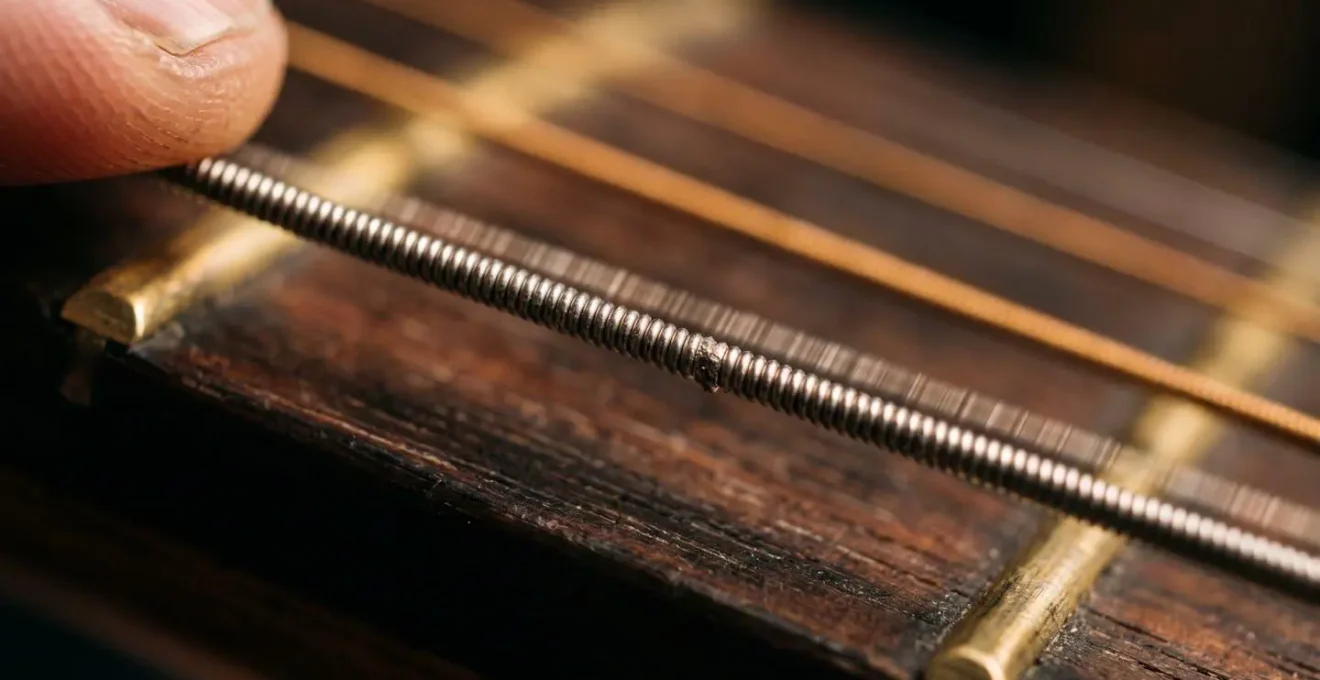
As you can see in the subtle movement of the string, vibrato isn’t just a decorative effect; it is the physical manifestation of emotion. To make a single note powerful, you must focus on its internal dynamics. Experiment with these four components to give every note its own unique character:
- Attack: Choose between pick versus fingers, and vary dynamic intensity to create different note entries that shape emotional character.
- Sustain: Control the speed, width, and timing of vibrato to add vocal-like expressiveness during the note’s duration.
- Timbre: Manipulate tone controls or pickup selection during the note itself to change the tonal color mid-sustain.
- Release: Decide whether to let the note fade naturally, cut it short for punctuation, or use a slow fall-off bend for a crying effect.
How Do Blues Guitarists and Jazz Saxophonists Use Blue Notes Differently?
While both blues and jazz share a common ancestry and a love for blue notes, their application reveals a fundamental difference in philosophy. Understanding this distinction can help you use them with greater purpose. In short, blues uses blue notes for emotional tension, while jazz often uses them for harmonic sophistication. A blues guitarist uses a blue note to cry out against a relatively simple chord, while a jazz saxophonist might use it as a bridge to get to the next complex one.
As one music theory analysis puts it, the context is everything:
In traditional blues, the blue note is often a point of expressive tension against a relatively simple I-IV-V harmony. In jazz, a saxophonist often uses it as a chromatic passing tone to smoothly navigate complex, fast-moving chord changes.
– Music Theory Analysis, Blues harmony and jazz phrasing comparison
For a blues player, the flat third rubbing against a major chord is the heart of the sound. It’s a raw, unresolved feeling. The goal is to dwell in that dissonance and wring every drop of emotion from it. In contrast, a bebop-era jazz player might use that same flat third as a stepping stone, a « passing tone, » to smoothly outline a more complex chord like a G7(b9). The note isn’t the destination; it’s part of the journey to a more complex harmonic statement. According to analysis by music educator Ethan Hein, blues players even treat these pitch zones differently across octaves, often using more major-sounding thirds in lower registers and more minor-sounding thirds in higher ones within the same song to vary the emotional texture.
The Blue Note Trap of Using Them So Often They Lose All Emotional Power
The power of a blue note comes from its ability to surprise the listener. It is a moment of beautiful « wrongness » that creates tension and emotion. Your brain, conditioned by a lifetime of listening to Western music, expects the notes of the standard major or minor scale. The blue note is a delicious violation of that expectation. However, if you lean on it constantly, you fall into a common trap: the surprise vanishes. The blue note becomes the new normal, and its emotional power is completely neutralized.
This is a critical concept in music cognition. A sound’s impact is defined by its context. If every other note you play is a bent, « blue » one, you are no longer creating tension; you are simply playing in a different, less-defined scale. The blue note stops being a moment of spice and becomes the main ingredient, making the whole dish bland. The most soulful players understand that the power of a blue note is magnified by the « straight » notes that surround it. They set up an expectation with consonant, diatonic notes, and then, at the perfect moment, they introduce the blue note to break the spell.
As one music cognition analysis explains, this effect is rooted in psychology. The emotional impact is directly tied to the element of surprise. When you overuse a device, you remove the surprise and, with it, the emotion.
The emotional impact comes from a violation of expectation. Your brain expects notes from the standard scale; the blue note is a surprise. If you use it constantly, it becomes the new expectation, and its power to surprise is completely lost.
– Music cognition analysis, Blue Notes and Microtones – The Ethan Hein Blog
When in a Solo Should Blue Notes Create Drama and When Should They Resolve?
A great solo is a story, not just a collection of licks. It has a narrative arc with moments of tension and moments of release. Blue notes are your primary tool for controlling this narrative. Knowing when to use them to create dramatic tension and when to resolve them to provide a sense of relief is the key to telling a compelling musical story. The most intuitive framework for this is the classic blues structure of call and response.
Think of your solo as a conversation. The « call » is a musical phrase that asks a question. This is the perfect place to use tense, unresolved blue notes. By landing on a bent flat third or a hanging flat seventh at the end of a phrase, you create a sense of unease, leaving the listener waiting for an answer. The « response » is the answering phrase. Here, you provide resolution. You can do this by playing more consonant notes from the underlying chord or by resolving a blue note—for example, by bending a flat third up to the major third, or letting a flat seventh fall to the fifth. This journey from tension to release gives your solo a satisfying, conversational flow.
Case Study: Call and Response in a 12-Bar Blues
In a typical 12-bar blues, the first four bars are a great place for a « call. » A guitarist might play a lick ending on a tense, slightly sharp flat five. This creates a question. The next four bars might be a « response » where the lick resolves satisfyingly to the root or third of the IV chord. This call-and-response structure turns a chord progression into a dynamic narrative. The technique involves using tense, unresolved blue notes in the ‘Call’ phrase to pose a musical question, then using more consonant notes or resolving blue notes in the ‘Response’ phrase to provide a satisfying answer.
Use blue notes to pose questions during the « call » phases of your solo, and use resolution and consonance to provide answers during the « response » phases. This simple shift in thinking will transform your solos from a series of disconnected statements into a coherent and emotional conversation.
How to Learn Jazz Vocabulary Without Sounding Like You’re Playing Memorised Licks?
While our focus is blues, a critical lesson from the world of jazz can directly solve the « exercise » problem. Many players learn licks by rote, memorizing the finger movements without understanding the musical idea behind them. This leads to playing that sounds like a cut-and-paste job, where licks are dropped into a solo without fitting the context. The key to authentic playing—in jazz, blues, or any genre—is to learn the underlying concept, not just the specific phrase.
Instead of just memorizing a B.B. King lick, you should ask: what is he *doing*? Is he enclosing a chord tone? Is he using a rhythmic motif? Is he targeting a specific note of the chord? When you extract the concept, you gain a tool you can use to create your own original licks. You move from being a parrot to being a poet. This is the path to developing your own voice. As the experts at Learn Jazz Standards advise, passive mimicry is the enemy of true vocabulary.
It’s important to try to figure out what the underlying procedures, methods, devices, and concepts are that the improviser is using, as opposed to just passively mimicking specific musical phrases or licks.
– Learn Jazz Standards, The Whole Truth About Jazz Vocabulary
This process of deep learning, or internalization, is essential. When you truly understand a concept, you can apply it in any key, over any chord, and with any rhythm. It becomes part of your musical DNA. Instead of having a library of 20 licks, you have a set of 5 concepts that can generate thousands of licks spontaneously.

Your Action Plan: Internalising Concepts, Not Just Copying Licks
- Extract the core concept: Instead of memorizing a complete 2-bar lick, identify the underlying harmonic concept, such as an enclosure around the 5th of a chord.
- Practice creating variations: Use only that extracted concept but with different rhythms and note orders to build your own original lines from scratch.
- Internalize through singing: Confirm you can hear the lick in your head by singing it, rather than relying solely on muscle memory from your instrument.
- Apply rhythmic transmutation: Practice the lick with at least five different rhythmic feels to break the muscle-memory connection to its original rhythm.
How to Write a Major Key Song That Makes People Cry Instead of Smile?
The idea of using « wrong » notes for emotional effect isn’t limited to the blues scale. A powerful technique used by songwriters across all genres is modal interchange, or « borrowing » chords from a parallel key. This is how a song in a « happy » major key can suddenly deliver a moment of profound sadness or nostalgia. By strategically introducing a chord that doesn’t belong, you create a sudden emotional shift that can be incredibly moving.
Think of the key of C Major. Its standard chords are bright and stable (C, F, G, etc.). Now, imagine borrowing the F Minor chord (Fm) from the parallel key of C Minor. When that Fm chord appears in the C Major progression, it feels like a dark cloud passing over a sunny day. It’s unexpected, poignant, and deeply emotional. This technique allows for a much more nuanced emotional palette than sticking strictly to the chords of one key.
Case Study: Adele’s ‘Someone Like You’ and the Power of the Minor Four
A perfect mainstream example is Adele’s smash hit ‘Someone Like You.’ The song is in a major key, but at key moments in the chorus, it uses the iv chord (the minor four chord, borrowed from the parallel minor key). This single « borrowed » chord is what gives the song its signature bittersweet, nostalgic feeling. It injects a powerful dose of melancholy without completely abandoning the song’s hopeful major-key foundation, creating a complex and relatable emotional state.
This is the same principle as the blue note, just applied to harmony instead of melody. It’s a « violation of expectation » that triggers an emotional response. As an analysis of the technique explains, it’s a primary tool for modern songwriters seeking complex emotions. The following table, based on data about common chord substitutions, shows some common borrowed chords and the feelings they tend to evoke.
| Borrowed Chord | Source Mode | Emotional Effect | Common Usage |
|---|---|---|---|
| iv (minor 4) | Parallel Minor | Melancholy, bittersweet nostalgia | Creates poignant contrast in otherwise bright progressions |
| bVI (flat 6 major) | Parallel Minor | Dramatic, cinematic, soft resolution | Adds emotional depth and gentle release |
| bVII (flat 7 major) | Parallel Minor | Rootsy, folk-leaning, mysterious | Creates modal ambiguity and unexpected color |
| bIII (flat 3 major) | Parallel Minor | Dark yet stable, unexpected brightness | Shifts perspective while maintaining tonal center |
What to Remember
- Emotional expression comes from intentional pitch manipulation in « blue zones, » not hitting fixed notes.
- A single note can be powerfully expressive if you shape its attack, sustain (vibrato), and release like a human voice.
- True vocabulary comes from understanding the concepts behind licks, not just memorising finger patterns.
Why Do Your Fast Solos Sound Like Exercises While Slower Players Sound Musical?
The final piece of the puzzle, and perhaps the most important, is phrasing. Phrasing is the art of grouping notes together to form musical sentences. It’s what separates a meaningful statement from a stream-of-consciousness ramble. A fast player who ignores phrasing sounds like someone reading a dictionary as fast as they can; a slower player with great phrasing sounds like a captivating storyteller. The notes are the words, but phrasing is the grammar, punctuation, and vocal inflection.
Phrasing encompasses everything we’ve discussed: the dynamic shape of each note, the use of tension and release, and the rhythmic placement of your ideas. It’s about where you place accents, where you leave space, and how you connect one idea to the next. As guitarist Stephen Aron puts it, it’s about making your musical ideas understandable and compelling.
Case Study: Paul Franklin on Dynamic Nuance
Legendary steel guitarist Paul Franklin explains that the gap between amateur and professional playing is almost always dynamic nuance. Many musicians learn the notes of a solo perfectly but fail to notice that the original artist played some notes hard and others soft. They miss the subtle swells in volume and the accented notes that give the phrase its shape and emotional punch. Without this dynamic variation—this control over volume and attack—even a technically perfect performance will sound flat and mechanical, regardless of speed.
Stop focusing on how many notes you can fit into a bar and start focusing on making each phrase a complete, compelling thought. Record yourself playing and listen back, not for wrong notes, but for the shape of your lines. Are they all played at the same volume? Do they breathe, or are they a constant stream of sound? This focus on musicality over mechanics, on phrasing over speed, is the ultimate key to transforming your playing from an exercise into an art form.
The journey from a technical player to an expressive one is a shift in mindset. It’s about moving your focus from the fretboard to the feeling, from the notes to the narrative. By embracing the beautiful imperfection of blue notes, shaping each one with intention, and weaving them into compelling phrases, you will finally unlock the soul your playing deserves.