Contrary to popular belief, learning to love symphonies isn’t about knowing music theory; it’s about training your ear to hear the composer’s architectural ‘game’ of tension and release.
- Most symphonies follow predictable structures, like sonata form, which are designed to create and resolve dramatic conflict.
- Active listening is a trainable skill that transforms passive hearing into an engaging exploration of musical patterns and surprises.
Recommendation: Instead of collecting hundreds of recordings, choose one symphony and listen to it repeatedly with focus, tracking a single melody to start unlocking its secrets.
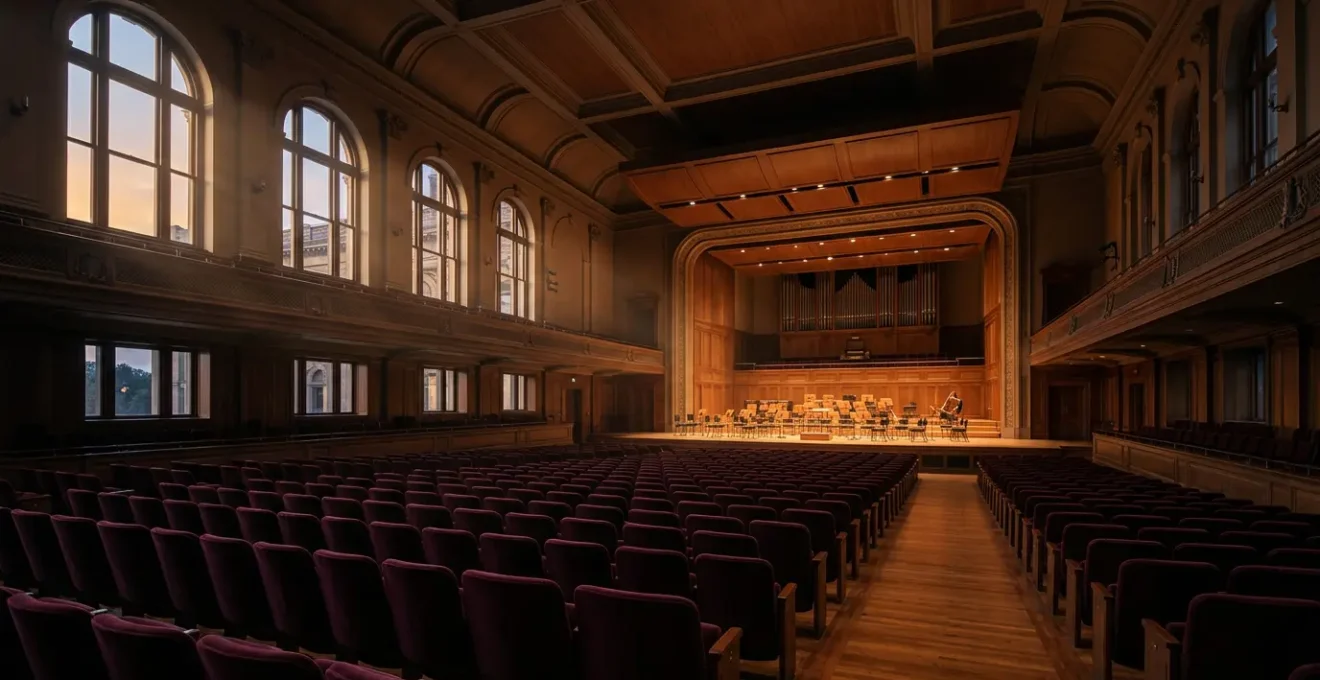
You settle into your concert hall seat, the lights dim, and a wave of sound from seventy musicians washes over you. For a while, it’s thrilling. But soon, the intricate threads of the music begin to blur. It can feel like being adrift in a beautiful but incomprehensible ocean of sound, leaving you with the nagging question: why do so many symphonies seem to sound the same? Is there a secret language everyone else understands? Many listeners share this frustration, feeling that a deep appreciation for this monumental art form is just out of reach. It’s a common misconception that the key lies in academic study or innate talent. The truth is far more accessible.
First, a crucial distinction: the orchestra is the group of musicians; the symphony is the piece of music they play. Understanding this is the first step away from confusion. The next is to move beyond the typical advice to simply « listen for the themes » or « read the composer’s biography. » While helpful, these tips don’t train your ear to navigate the music itself. They are like reading a city guide without ever learning how to read the map. The real journey into the heart of a symphony begins when you learn to hear its structure not as a rigid container, but as a dynamic playground for drama, emotion, and intellect.
This guide offers a different approach. We will treat the symphony as an architectural marvel built on a universal principle: tension and release. By learning to recognise the composer’s structural games, you can transform your listening from a passive experience into an active, exhilarating engagement. You will learn not just what to listen for, but *how* to listen, turning what once felt like a homogenous wall of sound into a landscape of distinct, emotionally charged events. This article will equip you with the tools to follow the composer’s argument, anticipate their moves, and feel the profound satisfaction when a musical idea, introduced at the beginning, triumphantly returns at the end.
To guide you on this journey of aural discovery, this article is structured to build your understanding step by step. We will explore the core components of the symphonic form, compare the approaches of different masters, and provide practical techniques to sharpen your listening skills.
Summary: Your Roadmap to Deeper Symphonic Understanding
- Why Is the First Movement of Most Symphonies the Most Dramatic?
- How Do Beethoven, Brahms and Shostakovich Use the Symphony Form Differently?
- Live Concert or Reference Recording: Which Teaches You More About Symphonies?
- The Listening Mistake of Collecting Symphonies Without Really Learning Any
- Should You Start With Haydn or Jump Straight to Mahler?
- What Musical Features Do 90% of Canonical Masterpieces Share?
- Why Does the London Symphony Sound Different From the Berlin Philharmonic Playing the Same Work?
- Why Does Live Orchestral Music Feel Different From the Same Recording?
Why Is the First Movement of Most Symphonies the Most Dramatic?
The first movement of a symphony is intentionally designed to be the most dramatic because it operates on a powerful blueprint known as sonata form. Think of it not as a rigid mould, but as a three-act play engineered for conflict and resolution. It is the primary engine of the « architectural game » that composers have used for centuries. According to the Grove Dictionary of Music and Musicians, sonata form is ‘the most important principle of musical form’ from the Classical period well into the 20th century, precisely because it is such a compelling vehicle for musical storytelling.
The first « act » is the Exposition, where the composer introduces the main characters: typically two contrasting themes. The first theme is often bold and assertive, establishing the home key. The second theme, in a different key, is usually more lyrical or gentle, creating an immediate sense of instability and tension. The entire purpose of the Exposition is to present this fundamental conflict. The second « act, » the Development, is where the drama truly ignites. The composer takes fragments of the themes, breaks them apart, pits them against each other, and travels through various keys. This section is characterised by its volatility and unpredictability; it is the heart of the musical argument.
Finally, the Recapitulation serves as the third act. Here, the opening themes return, but with a crucial difference: both themes are now presented in the home key. The conflict introduced in the Exposition is resolved. The return to familiar territory, after the turmoil of the Development, creates a profound sense of homecoming and psychological release for the listener. This journey from stability, through conflict, to a final, more profound stability is what gives the first movement its inherent dramatic power. As the great conductor and composer Leonard Bernstein explained it, the entire structure is built on a simple yet profound idea.
Balance and contrast—in these two words we have the main secrets of the sonata form.
– Leonard Bernstein, Young People’s Concerts: What is Sonata Form?
Understanding this dramatic arc is the first major key to unlocking the symphonic repertoire. It trains your ear to listen for conflict and its eventual, satisfying resolution.
How Do Beethoven, Brahms and Shostakovich Use the Symphony Form Differently?
Once you understand the basic architectural ‘rules’ of the symphony, you can begin to appreciate the genius of composers who bent, honoured, or broke those rules for expressive purposes. The symphonic form is not a static museum piece; it’s a living tradition that evolved through the unique visions of its greatest practitioners. Comparing Beethoven, Brahms, and Shostakovich reveals a fascinating story of revolution, evolution, and subversion.
Beethoven was the great revolutionary. He took the elegant, balanced structures of Haydn and Mozart and supercharged them with unprecedented emotional force and personal drama. He expanded the development sections, making the musical argument more intense and complex. For Beethoven, the symphony became a vehicle for expressing the human journey from struggle to triumph, transforming the form from polite entertainment into a profound philosophical statement.
In contrast, Brahms is often seen as the great traditionalist, but this view is too simplistic. He was a master of evolution, working within the classical structures established by Beethoven but enriching them with a dense, autumnal harmonic language and intricate rhythmic complexity. His work shows that profound originality can exist within established forms.
Case Study: Brahms’s First Symphony: Wrestling with Beethoven’s Shadow
Brahms famously struggled for over twenty years to complete his First Symphony, painfully aware of working in Beethoven’s shadow. His works demonstrate that progressive content could inhabit traditional structures, answering critics who dismissed him as conservative by showing how sophisticated musical thinking could honour the past while remaining vital. His symphony is a testament to honouring a legacy while forging a unique voice.
Then there is Shostakovich, who used the symphonic form for subversion. Composing under the oppressive Soviet regime, he turned the symphony into a vessel for coded messages of dissent, irony, and profound despair. A triumphant fanfare might be laced with a grotesque harmony, or a seemingly simple melody might carry a weight of unbearable sadness. His music operates on two levels: the public facade and the private, often terrifying, truth.
As the critic Norman Lebrecht observes, this coded language of suffering has a power that transcends its original political context.
Shostakovich’s painting of angst because of living in a spiritually empty and hostile world is shared by numerous people who never had to live under a totalitarian, criminal regime.
– Norman Lebrecht, The Symphony’s Indian summer – The Critic Magazine
These three composers show that the symphony is not a single sound, but a flexible and powerful framework for expressing the entire spectrum of human experience.
Live Concert or Reference Recording: Which Teaches You More About Symphonies?
For the aspiring symphony enthusiast, a crucial question arises: is it better to learn from the pristine perfection of a studio recording or the visceral energy of a live concert? Each offers a unique and valuable pathway to understanding. Recordings provide the immense benefit of control and repetition, which is indispensable for deep learning. You can pause, rewind, and isolate sections, allowing you to trace a theme’s development or dissect a complex passage until it becomes familiar. This is how you build a mental map of the work.
The polished nature of studio albums can also make the composer’s architecture easier to perceive. Interestingly, this edited perfection often aligns with listener preference. For instance, research from the Paris Conservatoire found that listeners preferred edited studio versions 44% of the time, compared to first studio takes (29%) and concert performances (27%). This suggests our ears are drawn to the clarity and flawlessness that studio post-production can provide. A reference recording, chosen for its interpretive insight and sonic excellence, can serve as a reliable guide and a foundational stone for your understanding of a piece.
However, no recording can ever fully replicate the experience of a live performance. A concert hall is a space of shared focus and palpable energy. The physical sensation of sound waves moving through the air, the sight of the conductor shaping the music, and the collective breath of the audience create a multi-sensory experience that is fundamentally different from listening at home. Recent science confirms this is more than just a feeling. A 2024 ecologically valid concert study found that audience members of a string quartet live concert reported significantly more musical absorption than a livestream audience. Live concerts foster deeper engagement and stronger physiological entrainment—our bodies literally sync up with the music and each other in a way that recordings cannot facilitate.
Ultimately, the two are not competitors but essential partners. The recording is your textbook, your laboratory where you can dissect and analyse the music at your own pace. The live concert is the ultimate demonstration, where the architectural blueprint you studied comes alive with risk, spontaneity, and a unique, unrepeatable emotional current. The recording teaches you the work; the concert teaches you what the work can *be*.
The Listening Mistake of Collecting Symphonies Without Really Learning Any
In the age of streaming, it’s easy to become a digital collector, amassing vast playlists of symphonies without ever truly getting to know any of them. We listen with half an ear while working, commuting, or scrolling. This passive consumption creates a sense of familiarity but prevents the deeper connection that comes from active, focused listening. It’s the musical equivalent of speed-reading a dozen novels and being unable to recall a single character’s name. The greatest barrier to appreciating symphonic music is not its complexity, but our own divided attention.
To truly learn a symphony, you must give it the one thing it demands: your undivided focus. This doesn’t require hours of formal study, but rather short, dedicated sessions of what musicians call « deep listening. » This is a practice of engagement, where you treat the music not as background noise, but as the primary event. By doing so, you begin to build an intimate relationship with the piece, noticing details and connections that were previously invisible. You start to hear the internal logic, the call-and-response between instruments, and the subtle transformations of a melody over time.
This practice is not just a mental exercise; it’s a way of physically rewiring your brain for musical appreciation. As music educator Kayla Collingwood notes, this is a cumulative process.
Deep listening is cumulative. Each time you engage with music attentively, you strengthen neural pathways, build aural memory, develop what musicians call ‘inner hearing’: the ability to imagine and manipulate sound mentally.
– Kayla Collingwood, Sound Garden Classical: Deep Listening and Classical Music
Instead of superficially sampling a hundred symphonies, the path to true appreciation lies in choosing one and listening to it five, ten, or even twenty times. With each repetition, the fog of complexity lifts, and the magnificent architecture of the work reveals itself. To get started, you can follow a simple but powerful set of practices.
Your Action Plan for Deeper Listening: A Practical Checklist
- Start with short, focused sessions: Ten to fifteen minutes of attentive listening is more valuable than an hour of divided attention.
- Internally ‘sing’ what you hear: Follow the melodic line and notice if it moves by small steps or large leaps, whether it climbs or descends.
- Track one main theme: Instead of trying to follow everything at once, identify one main melody in the first movement and actively hunt for its return and transformation.
- Notice physical responses: Pay attention to how the rhythm affects your body, whether ascending lines create a sense of lift, or dissonant chords create tension.
- Engage in repeated listening: Each time through, you recognise more patterns and experience new layers of satisfaction as your brain predicts and appreciates compositional surprises.
Should You Start With Haydn or Jump Straight to Mahler?
For a newcomer to the symphonic world, the sheer breadth of the repertoire can be intimidating. Where do you begin? The choice often boils down to two opposing philosophies: start with the foundational « architect » of the form, Joseph Haydn, or dive headfirst into the colossal emotional universe of a late-Romantic like Gustav Mahler. There is no single right answer, as the best path depends on your personal learning style: do you prefer to understand the blueprint before seeing the skyscraper, or do you want to be awestruck by the view from the top first?
Starting with Haydn, or his brilliant student Mozart, is the « architectural » approach. Their symphonies are marvels of clarity, elegance, and wit. The structures are transparent, making it easier to hear the « game » of sonata form in action. Listening to Haydn is like learning the fundamental grammar of the symphonic language. You develop an ear for balance, proportion, and logical development. This provides a solid foundation that makes the innovations of later composers, like Beethoven’s revolutionary expansions or Mahler’s vast canvases, all the more impactful when you encounter them.
Jumping straight to Mahler or Shostakovich is the « emotional immersion » approach. Their symphonies are sprawling, deeply personal works that contain, as Mahler himself said, « the whole world. » They offer an immediate and overwhelming emotional payoff. This path can be incredibly exciting, as it connects you directly to the immense power and expressive range of a full orchestra. The potential drawback is that without an understanding of the underlying forms, these vast works can feel chaotic or rambling, risking the very « wall of sound » effect you’re trying to overcome. The blueprint is still there, but it’s buried under layers of complex orchestration and psychological drama.
Perhaps the ideal solution is a bridge between these two worlds. A composer who combines the structural clarity of the Classical era with the emotional fire of the Romantic. For this, there is no better starting point than Beethoven.
Case Study: Beethoven’s Fifth as the Perfect Symphonic Entry Point
Beethoven’s Fifth Symphony blazes from turbulence to triumph, its structure unfolding from a single, unforgettable four-note motif. The entire work achieves remarkable cohesion by referring to the opening rhythmic motif at key moments, even using it as a subdued timpani pulse which links the third movement to the glorious finale. This makes it an ideal bridge: it has the clear Classical-era structure that is easy to follow, combined with a revolutionary Romantic emotion that is impossible to ignore.
What Musical Features Do 90% of Canonical Masterpieces Share?
While symphonies by Haydn and Shostakovich may sound worlds apart, the enduring masterpieces of the canon share a set of fundamental principles that speak directly to how our brains process information and emotion. These are not arbitrary rules, but deep-seated techniques that composers intuitively discovered and refined. The most crucial of these is the masterful manipulation of listener expectation. The entire structure of Western tonal music is built on creating and resolving tension, a process that is deeply satisfying on a psychological level.
A masterpiece doesn’t just present beautiful melodies; it plays a sophisticated game with them. It establishes patterns, makes us expect certain outcomes, and then either fulfills those expectations in a deeply gratifying way or thwarts them for dramatic effect. This element of surprise, grounded in a predictable framework, is what keeps us engaged. As the experts at Sound Garden Classical put it, the composer’s job is to create a dynamic puzzle for the listener.
Composers are essentially creating elaborate games of expectation and fulfilment. The more familiar you become with a piece, the more your brain can predict what comes next, and paradoxically, the more you can appreciate when the composer surprises you.
– Sound Garden Classical, Deep Listening and Classical Music: How to Develop Your Ear Over Time
This process of « predictive hearing » is not just an intellectual exercise; it is a physical one. Our bodies subconsciously engage with musical patterns. When a melody rises, we can feel a sense of lift; when a harmony becomes dissonant, we feel tension. In fact, neuroscientific studies demonstrate that when we listen to melody, our larynx (voice box) subtly activates, as if we are preparing to sing along. This shows that our brains are not passively receiving sound but actively trying to model and predict the musical patterns they perceive.
Beyond this game of expectation, masterpieces also exhibit a remarkable sense of economy and development. They are often built from a small number of musical ideas (motifs) that are explored, transformed, and developed throughout the work. Think of the famous « da-da-da-DUM » of Beethoven’s Fifth, a simple rhythmic seed from which an entire 30-minute drama grows. This structural cohesion, where everything feels connected and purposeful, is a hallmark of great symphonic writing. It ensures that no matter how complex or emotional the journey, there is an underlying logic that our minds can follow and appreciate.
Why Does the London Symphony Sound Different From the Berlin Philharmonic Playing the Same Work?
You listen to two recordings of the same Brahms symphony, one by the London Symphony Orchestra and another by the Berlin Philharmonic. The notes are identical, yet the experience is strikingly different. The Berlin performance feels weighty, rich, and blended, while the London one sounds more agile, brilliant, and with more distinct instrumental colours. This is not an illusion. It is the result of what can be called « aural terroir »—the unique sonic identity of an orchestra, shaped by decades of tradition, training, and even the physical instruments themselves.
Just as the soil and climate give a wine its unique character, an orchestra’s sound is influenced by its national and pedagogical heritage. These traditions dictate everything from bowing techniques in the string section to the type of vibrato used by the woodwinds. As one analysis notes, the symphony’s evolution is intertwined with these local flavours: « The symphony has evolved dramatically from the poised elegance of Haydn to the vast canvases of Mahler and Shostakovich, yet it has always remained a crucible for orchestral imagination. National traditions of playing significantly impact orchestral character: the ‘dark,’ weighty sound of German string sections contrasts with the agile brightness of French woodwinds. » An orchestra like the Berlin Philharmonic is a direct inheritor of that deep, blended German string sound, while a French orchestra might be celebrated for the particular refinement of its woodwind section.
The conductor plays a huge role in shaping this sound, but they are working with a collective instrument that has its own inherent tendencies. The philosophy of the principal players, passed down through generations, also has a profound effect. Does the principal horn player strive for a heroic, brassy tone or a warmer, more lyrical one? These individual choices, multiplied across the entire ensemble, create a distinct orchestral personality.
Finally, the actual instruments matter. A German-made bassoon has a different character from a French one. Orchestras like the Vienna Philharmonic even use unique instruments, such as the Viennese horn, which are not found elsewhere and contribute to their famously warm, rounded sound. Recognising this « aural terroir » adds another fascinating layer to listening. You begin to appreciate not only the composer’s work but also the unique voice of the orchestra interpreting it, celebrating the fact that a single masterpiece can contain a multitude of equally valid and beautiful truths.
Key Takeaways
- Symphonies are not just a wash of sound; they are highly organised ‘architectural games’ built on the principle of tension and release.
- Active, focused listening is a trainable skill that unlocks the structure and emotional narrative of a musical work, far more than passive hearing.
- The live concert experience is biologically unique, fostering a level of engagement and physiological connection that recordings cannot replicate.
Why Does Live Orchestral Music Feel Different From the Same Recording?
There is an undeniable magic to a live concert that even the highest-fidelity audio system cannot capture. It’s a feeling of presence, of shared experience, and of a direct connection to the creation of sound. This difference is not merely psychological; it is rooted in physics, sociology, and even our own neurobiology. When you listen to a recording, you are hearing a finished, perfected product. In a concert hall, you are witnessing a unique, unrepeatable event, with all its inherent risk and spontaneity. The slight possibility of a cracked note or a tempo fluctuation adds a thrilling edge of human fallibility that makes the moments of collective perfection all the more breathtaking.
The physical experience of sound is also fundamentally different. At home, sound comes from two or more fixed points. In a concert hall, you are immersed in a complex, three-dimensional sound field. You don’t just hear the sound with your ears; you feel the vibrations of the cellos and double basses through the floor and your seat. This full-body sensory input creates a far more visceral and immersive experience. Furthermore, you are part of a community of listeners, all focusing their attention on the same artistic moment. This shared focus creates a powerful collective energy, a silent communication between the stage and the audience that amplifies the emotional impact of the music.
Most profoundly, recent scientific discoveries are beginning to explain this « magic » at a neurological level. The act of experiencing live music appears to trigger powerful processes in the brain that go beyond simple auditory processing. It’s an experience that actively promotes brain health and well-being. According to one summary of current findings, research suggests live music releases brain-derived neurotrophic factor that promotes neurogenesis (the growth of new neurons) and can even have measurable physiological benefits like lowering blood pressure and relieving pain. This suggests that the « feeling » of live music is the result of a cascade of beneficial neurochemical events.
The next step is to put all this into practice. Choose one symphony—perhaps Beethoven’s Fifth—arm yourself with these new ways of hearing, and attend a concert or dedicate a quiet evening to a good recording. Listen actively for the architectural games, the moments of tension and release, and discover the vibrant, dramatic world of sound waiting just beneath the surface.