
The common belief is that authentic performance requires strictly following historical rules; the reality is that it comes from embracing the music’s original physical and conceptual constraints as a source of creative expression.
- Instead of metronomic precision, early music thrives on a flexible, human pulse tied to breath and text.
- Period instrument « flaws, » like the rapid decay of a harpsichord note, are not weaknesses but invitations for expressive articulation and ornamentation.
Recommendation: Stop trying to make early music fit modern expectations of perfection and instead explore how its historical limitations can unlock a more vibrant and authentic performance.
Every dedicated musician has felt it: the deep frustration of playing a piece by a medieval or Baroque master, hitting every note on the page with technical precision, only for the performance to feel lifeless, rigid, or simply… wrong. You’ve followed the score, maintained a steady tempo, and yet the music’s soul remains elusive. The common advice is often to switch to period instruments or to simply avoid vibrato, but these are merely symptoms, not the cure.
This widespread issue stems from a fundamental misunderstanding. We often try to impose modern sensibilities of rhythmic rigidity, tonal uniformity, and notational infallibility onto music that was born from a completely different world. The composers of these eras were not working with perfectly regulated pianos and digital metronomes; they were surrounded by the tangy, complex sounds of gut strings, the inherent unevenness of hand-made woodwinds, and a system of notation that was more of a guide than a rigid blueprint.
But what if the key to unlocking this music wasn’t in adding more rules, but in understanding the original context? What if the « limitations » of historical instruments and notation were, in fact, their greatest expressive strengths? This article will guide you through this paradigm shift. We will explore how to move beyond the « right notes » and discover the authentic, living pulse of early music by treating its historical constraints not as problems to be solved, but as the very source of its unique colour and vitality.
This exploration will take us from the rhythmic heart of medieval chant to the colourful textures of the Baroque orchestra. By understanding the ‘why’ behind the sound, you can begin to transform your own playing from technically correct to historically resonant and emotionally compelling.
Summary: Unlocking the Expressive Core of Historical Performance
- Why Does Medieval Music Sound Mechanical When Performed with Modern Rhythmic Precision?
- How to Decode 12th-Century Notation Without a Musicology Degree?
- Which Medieval Manuscript Version Should You Use When Sources Contradict?
- The Modern Habit That Immediately Reveals You Don’t Understand Medieval Music
- Should You Learn Gregorian Chant Notation Before Mensural Notation?
- Why Do Baroque Pieces Sound More Colourful on Period Instruments?
- Why Is There No « Correct » Version of a Traditional Folk Song?
- Why Does Baroque Music Sound Stiff When Modern Orchestras Play It?
Why Does Medieval Music Sound Mechanical When Performed with Modern Rhythmic Precision?
The primary reason medieval music sounds stiff when played with modern precision is our contemporary obsession with the metronome. We are trained to internalise a relentlessly even beat, a « tyranny of the bar line » that is foreign to the medieval musical mind. For them, rhythm was more organic, fluid, and intimately tied to the human body and the spoken word. The core concept here is tactus, a flexible pulse that governs the music’s flow.
As the renowned performer and scholar Andrew Lawrence-King explains, tactus is not a rigid click track but a physical gesture. He defines it as the « slow, steady beat that guides Early Music, shown by a down-up movement of the hand, approximately one second each way. » This physical, breathing motion creates a fundamentally different feel from a mechanical beat. It has an inherent flexibility, allowing for the natural ebb and flow of musical phrases, much like the rhythm of poetry. The goal is not mathematical perfection but rhetorical power. This approach is underpinned by a system medieval theorists later codified, where they recognized a system of six rhythmic modes based on poetic meters, further linking music to the cadences of language.

Embracing tactus means shifting your focus from counting to feeling. It means connecting the music to your own breath, to the rise and fall of a sung phrase. When you let go of the metronomic grid and embrace this human pulse, the music stops being a series of isolated notes and starts to breathe, gaining the suppleness and rhetorical shape it was always meant to have. It’s a move from a machine’s pulse to a human heartbeat.
This shift in mindset is the first and most crucial step toward a performance that feels not just accurate, but alive.
How to Decode 12th-Century Notation Without a Musicology Degree?
Staring at a page of 12th-century neumatic notation can be intimidating. The floating, unmeasured shapes seem a world away from our modern five-line staff. The secret to decoding it without a PhD is to stop thinking of it as a precise, scientific blueprint. Instead, view it as a sophisticated memory aid for melodies that were primarily learned and transmitted orally. It shows melodic contour and gesture, not exact pitches and rhythms in the modern sense.
The key is pattern recognition. Rather than trying to identify each individual note, learn to see the common « chunks » or melodic formulas. Neumes like the *scandicus* (a rising three-note figure) or the *climacus* (a descending one) are not just three separate notes; they are a single, unified gesture. By the 13th century, this system became more standardized as « the neumes of Gregorian chant were usually written in square notation on a staff with four lines, » making relative pitch clearer. However, the core principle of gestural reading remains.
Your goal is to build a vocabulary of these melodic shapes. This approach moves you from a note-by-note translation to a more holistic understanding of the musical phrases, allowing you to perform them with the intended shape and direction, even without modern rhythmic markings. It transforms the page from a set of abstract symbols into a map of musical energy.
Your Action Plan: A Pattern-Recognition Approach to Reading Neumes
- Focus on Chunks: Concentrate on identifying common neume groups like the scandicus (ascending) and climacus (descending) as single melodic gestures, not individual notes.
- Sing It First: Before playing, use your own breath to sing a phrase. This helps you internalise its natural contour, articulation, and breathing points, grounding the music in your body.
- Embrace Relativity: Recognize that neumes primarily show relative pitch relationships and melodic direction. They are a memory aid for a melody you should strive to know by ear.
- Study the Shapes: Use online resources or facsimiles to learn the names and basic shapes of core neumes like the punctum (dot), virga (stemmed dot), pes (foot), and clivis (bent).
- Compare and Contrast: Access digital manuscript libraries (like the St. Gall database) to see how the same chant is notated in different regional styles, observing variations and commonalities.
This practical, pattern-based approach demystifies the process and connects you to the way medieval musicians themselves thought about and remembered their music.
Which Medieval Manuscript Version Should You Use When Sources Contradict?
One of the most perplexing challenges for the modern performer of medieval music is the existence of multiple, often contradictory, manuscript sources for the same piece. One version might have a different melodic turn, an altered rhythm, or a different text underlay. The modern instinct is to ask, « Which one is correct? » This, however, is the wrong question. It presupposes a single, authoritative « Urtext » that rarely existed in an era before the printing press.
A better question is, « What do these differences tell me? » Contradictions are often not scribal errors but evidence of vibrant, living regional traditions. A piece performed in a French monastery would naturally evolve differently from the same piece sung in a Swiss abbey. These variations are a feature, not a bug. Understanding them is key to an informed performance. This allows the performer to make an editorial choice based not on a search for a single ‘truth’, but on a deeper understanding of historical practice and musical logic.
Case Study: St. Gall vs. Aquitanian Neume Traditions
A classic example is the difference between notation from the Abbey of St. Gall (9th-11th c.) and Aquitanian notation from southwestern France (10th-12th c.). St. Gallen notation uses angular, « heighted » neumes whose vertical position gives a clue to relative pitch. In contrast, Aquitanian notation uses more rounded, flowing shapes with a cursive quality. These are not ‘right’ and ‘wrong’ versions of the same system; they are distinct visual languages representing equally valid regional performance traditions. A performer choosing to sing a piece from an Aquitanian source is choosing to engage with a specific French musical dialect, one that might favour a more flowing and legato delivery compared to the more articulated style suggested by the St. Gall neumes.
So, how do you choose? You become an editor. You can decide to perform a version from a single, consistent source to represent a specific time and place. Or, you can create a composite version, choosing the reading from Manuscript A for one phrase and Manuscript B for another, based on criteria like « singability » or how well the music fits the text. The crucial part is to make these choices consciously and be able to justify them based on musical and historical logic. This active engagement is at the heart of a truly historical performance.
It moves you from being a passive reader of notes to an active participant in the music’s ongoing life.
The Modern Habit That Immediately Reveals You Don’t Understand Medieval Music
Beyond any single technical flaw, the one modern habit that instantly signals a misunderstanding of medieval (and much of Baroque) music is the unthinking application of continuous, wide vibrato and the assumption of equal temperament tuning. These two elements, cornerstones of modern orchestral playing, are fundamentally at odds with the sonic world of early music. The music was conceived for pure, clear intervals and the unique timbres of instruments that didn’t hide behind a constant wobble.
Vibrato in the modern sense—a constant, uniform oscillation on every long note—is an anachronism. While some forms of ornamental vibrato did exist, they were used sparingly as a specific expressive device, like a trill. As one article on the topic notes, in the early music revival, « many advocates of HIP aimed to eliminate vibrato in favour of the ‘pure’ sound of straight-tone singing. » The reason for this is acoustic. Early music is built on the perfect mathematical ratios of Pythagorean or meantone tuning systems. In these systems, intervals like the perfect fifth and major third have a ringing, resonant purity that is completely obscured by vibrato. Using a straight tone allows these pure intervals to lock in and glow, creating a clarity and sonority that is a core part of the music’s aesthetic.
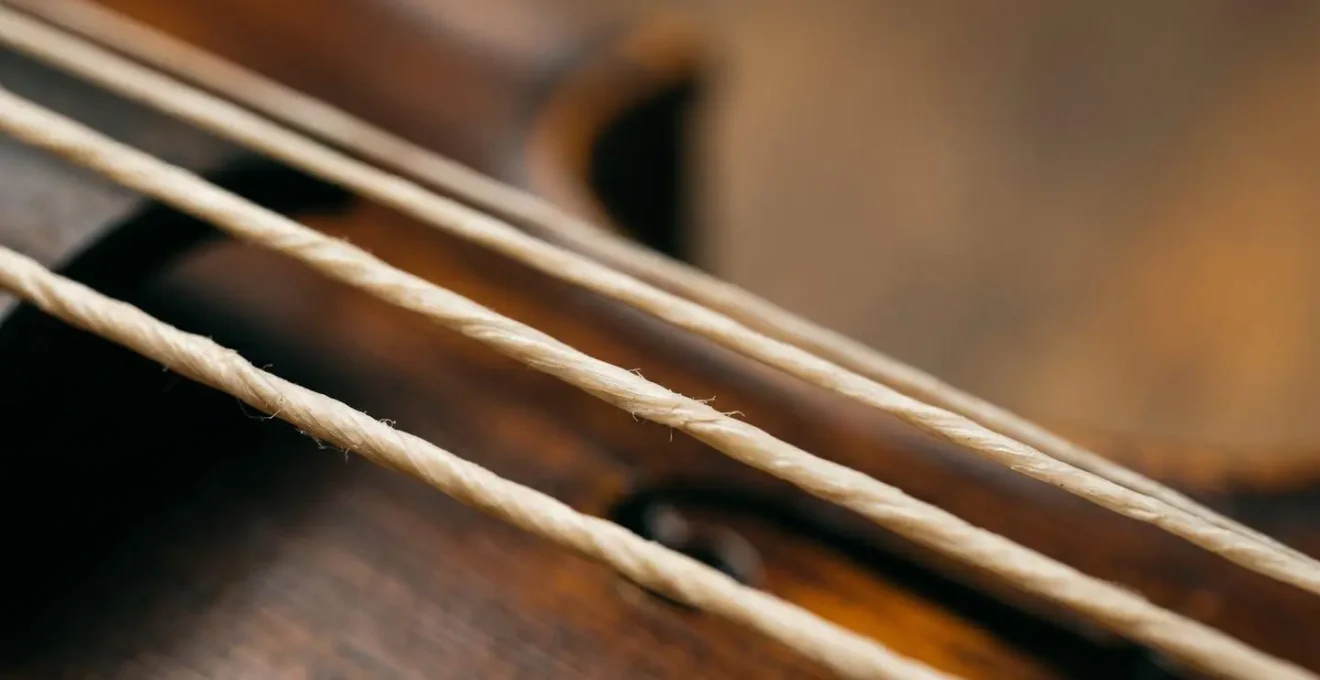
This is intrinsically linked to the instruments themselves, particularly the use of gut strings. Unlike modern steel or synthetic strings, gut has a warmer, more complex, and less sustaining tone. Its texture and physical properties encourage a style of playing that focuses on the attack and articulation of the note, rather than a long, homogenous sound. Playing on gut strings with a pure, straight tone allows the natural overtones to blossom and the subtle colours of the instrument to speak, revealing a sonic richness that modern instruments often homogenise.
Shedding the habit of constant vibrato and tuning your ear to pure intervals is not about stripping the music of expression; it’s about discovering the different, more subtle and powerful expression that lies at its core.
Should You Learn Gregorian Chant Notation Before Mensural Notation?
For a performer diving into early music, the question of where to start with notation is a practical one. Should you follow history chronologically, starting with the unmeasured neumes of Gregorian chant (c. 9th-11th century) before moving to the rhythmically precise mensural notation (c. 13th-16th century)? Or is it better to jump straight to the notation relevant to your target repertoire? There is no single correct answer; the best path depends on your goals as a musician. As one overview puts it, neumatic notation was the root system that « eventually evolved into modern musical notation. »
The chronological « Historian Path » argues that understanding chant is foundational. It teaches you the primacy of text, the feel of melodic contour, and the rhythmic freedom that underpins all later Western music. Starting here builds a deep-rooted understanding of musical lineage. Conversely, the « Pragmatist Path » argues for efficiency. If your goal is to sing a 15th-century chanson by Dufay, why spend months on 10th-century chant? This approach gets you to your performance goal faster.
However, a third way, the « Feedback Loop Method, » may be the most enriching. By alternating between the two systems, you allow each to illuminate the other. The rhythmic complexities of mensural notation can give you a new appreciation for the subtle, text-based rhythmic flexibility of chant. Conversely, a firm grounding in the melodic contours of chant can help you see the larger phrases and gestures within a complex mensural piece. The following table breaks down these approaches.
| Learning Approach | Starting Point | Core Philosophy | Best For | Main Advantage |
|---|---|---|---|---|
| Historian Path | Gregorian chant notation (9th-11th c.) | Chronological progression through notational development | Scholars and performers seeking comprehensive historical understanding | Teaches primacy of text and rhythmic freedom foundational to all early music |
| Pragmatist Path | Notation closest to performance goal (e.g., 15th c. mensural for Renaissance music) | Goal-oriented, repertoire-specific learning | Performers with specific repertoire objectives | Faster path to performing target repertoire |
| Feedback Loop Method | Alternating between chant and mensural notation | Iterative learning where each system illuminates the other | Advanced students seeking deeper understanding | Mensural rhythmic complexity deepens appreciation for chant’s rhythmic subtlety |
Whichever path you choose, the goal is the same: to read the notes not as abstract symbols, but as keys to a forgotten sound world.
Why Do Baroque Pieces Sound More Colourful on Period Instruments?
Baroque music played on period instruments often possesses a vibrant, textured, and almost spicy quality that can seem muted on their modern counterparts. This isn’t just nostalgia; it’s a direct result of the instruments’ physical properties. The « colour » comes from a combination of unique timbres, a wider dynamic range at a micro level, and inherent instabilities that force creativity from the performer. A key factor is that during the baroque period, string instruments used gut strings made from animal intestines, which produce a warmer, more complex tone with a distinct initial « chiff » compared to the brighter, more powerful sound of modern steel strings.
This concept of embracing instrumental quirks as expressive tools is central to the Baroque aesthetic. Modern instruments are often engineered for homogeneity, power, and ease of playing across all registers. Period instruments are specialists. A Baroque flute (traverso) has a reedy, breathy low register and a piercingly sweet high register; a modern flute is designed to sound the same from top to bottom. This « unevenness » is not a defect.
The unevenness of tone in a baroque flute or the rapid decay of a harpsichord are not flaws; they are features that force the player to be more inventive with articulation, ornamentation, and phrasing.
– Article Contributors, Analysis of baroque period instruments
This quote perfectly encapsulates the mindset. A harpsichordist cannot play louder by hitting the keys harder, so they create dynamics through articulation, timing, and ornamentation. A traverso player uses the flute’s different tonal colours to shade different phrases. These « flaws » are the very source of the music’s colour. The instruments themselves are active partners in the music-making, constantly suggesting new expressive possibilities. They demand more from the player, and in return, they offer a far richer and more varied sonic palette.
Playing on period instruments is not just a historical exercise; it’s an exploration of a world where instrumental limitations become the catalyst for boundless creativity.
Why Is There No « Correct » Version of a Traditional Folk Song?
The idea of a single « correct » version of a piece of music is a relatively modern obsession, born of the printing press and recording technology. In the world of traditional folk music, the concept is meaningless. A folk song is not a fixed artefact but a living, breathing entity that changes with each singer, each performance, and each generation. As Encyclopaedia Britannica notes, « Where a folk song originated is rarely known to its community, and thus the anonymity of the creative process was once considered a major criterion. » The song belongs to the community, and its variation is a sign of health, not corruption.
This « folk process » of oral transmission naturally smooths out awkward melodic corners and simplifies complex passages, adapting the song to be more memorable and singable. It’s a form of musical evolution in action. Research has shown that this is not a random process; certain musical elements are more prone to change than others. For example, a study on Dutch folk songs found that shorter phrases with highly expected melodic material varied less than more complex or surprising passages. The parts of the song that are easiest to remember and sing are the ones that survive.
Case Study: The Natural Evolution of « Oh! Susanna »
The process of oral transmission actively shapes music. A fascinating study by Shanahan and Albrecht (2019) simulated the oral transmission of Western folk songs. Singers would hear a tune, replicate it, and then teach it to others. The results were clear: cadence points—the ends of musical phrases—were significantly more likely to lose the seventh scale degree (the ‘leading note’). This phenomenon, known as pentatonicization, makes the cadence simpler and more stable. This experiment proved that variation in folk music is not just random error but a predictable byproduct of the cognitive and physiological act of singing and remembering, creating a more robust and memorable melody over time.
Understanding this is surprisingly relevant to early « art » music. Before the 18th century, the line between folk and art music was far more blurry. A manuscript was often just one person’s version of a tune that was widely known. Thinking about a medieval motet through the lens of the « folk process » can be liberating. It allows us to see different manuscript versions not as mistakes, but as snapshots of a living tradition, encouraging us to perform them with the freedom and creative spirit they deserve.
This frees the modern performer from the tyranny of the Urtext and invites them into a more creative relationship with the score.
Key Takeaways
- Rhythmic authenticity comes from embracing the flexible, human pulse of tactus, not a rigid metronome.
- Early notation for neumes should be read as melodic gestures and contours, not as a series of precise, individual notes.
- The « flaws » and « unevenness » of period instruments are actually expressive features that demand creative articulation and ornamentation from the performer.
Why Does Baroque Music Sound Stiff When Modern Orchestras Play It?
When a large, modern symphony orchestra attempts a piece by Bach or Vivaldi, the result can often sound heavy, homogenous, and rhythmically « stiff, » even with a skilled conductor. The problem lies in scale, balance, and timbre. A modern orchestra is a 19th-century invention, built for the power and blended sound required for Brahms or Tchaikovsky. Applying this sonic tool to Baroque music is like using a sledgehammer for intricate woodwork.
The typical Baroque orchestra was a much smaller, more agile ensemble. At its core were the strings and, crucially, the continuo group (usually harpsichord/organ and cello/bassoon), which provided the harmonic and rhythmic foundation. As one source states, « A continuous bass was the rule in Baroque music. » This continuo group is the engine room of the ensemble, providing not just the bass line but also improvising harmonies that fill out the texture. In a modern orchestra, this vital, flexible role is often lost or rendered inaudible by the sheer number of other instruments. While some ensembles grew in size, even then, the balance was completely different; a late Baroque orchestra might include over 30 players, but it was still built around this continuo core and featured a wider variety of timbres like lutes, oboes d’amore, and violas da gamba.
The stiffness also comes from a lack of hierarchy. In a smaller Baroque ensemble, there is a constant, lively dialogue between the soloists, the different sections, and the continuo. It’s a chamber music mentality. In a modern orchestra, with 16 first violins playing in perfect, powerful unison, this conversational element is lost. The sound becomes a beautiful but monolithic block, rather than a dynamic interplay of individual voices and colours. The music’s intricate counterpoint and rhetorical gestures are smoothed over by the sheer weight of the sound, resulting in a performance that feels impressive but emotionally distant and rhythmically inflexible.
To make Baroque music dance, you need an ensemble that is light on its feet, built for conversation, not for overwhelming power.