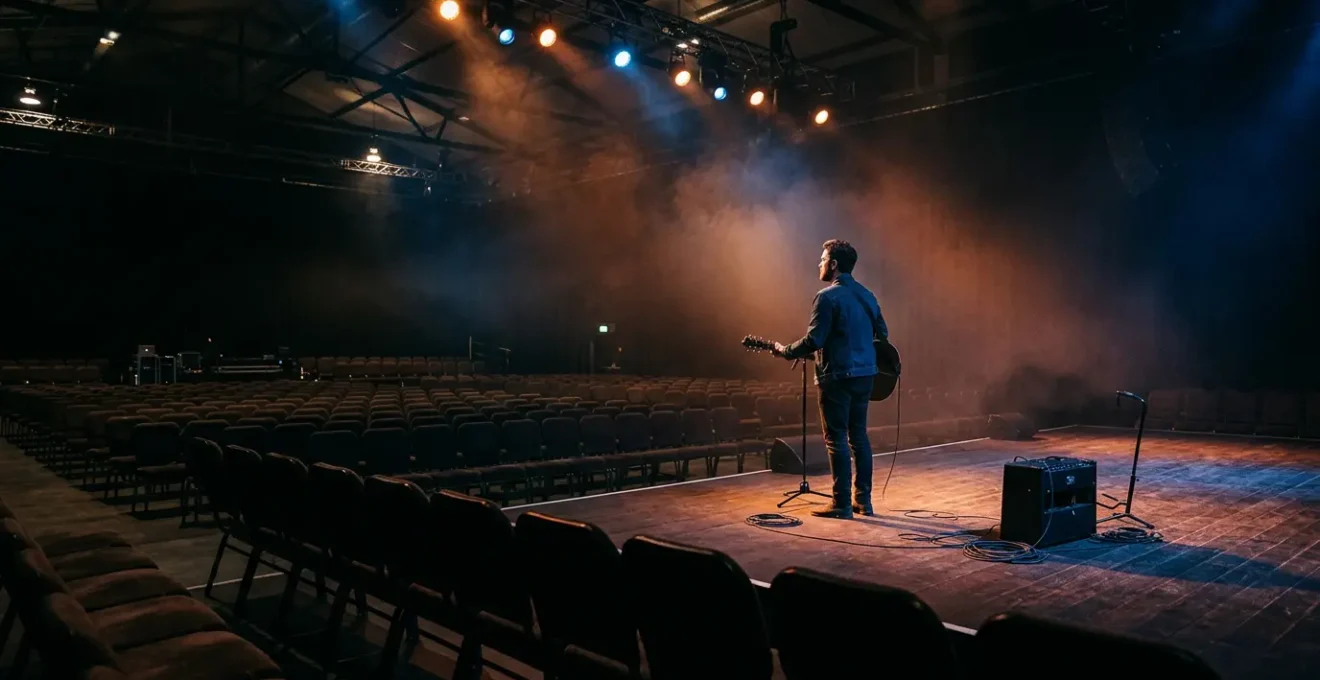
You’re a skilled musician playing every note perfectly, yet the audience remains disengaged. The problem isn’t your technical ability; it’s the lack of an energetic connection. This guide reframes performance from a musical recital into an « energetic transaction, » teaching you the art of stagecraft, intentional presence, and emotional vulnerability to finally captivate the room and create a memorable show.
You’ve done the work. Hours in the practice room, every chord progression memorised, every solo polished to a mirror shine. You step onto the stage, deliver a technically flawless set, and are met with polite applause. The room feels static, the audience is physically present but emotionally distant. It’s a deeply frustrating experience for any performer: you’re giving them perfect music, but the show is failing to connect. The common advice— »have more energy, » « move around more »—is frustratingly vague and often misses the point entirely.
The truth is that technical proficiency is merely the price of entry for a live performance; it is not the main event. What separates a sterile recital from a captivating live experience is the invisible, dynamic exchange between the artist and the audience. It’s an energetic transaction, a shared journey. The mistake many technically gifted performers make is focusing entirely on the musical output, broadcasting their skill, rather than inviting the audience into a shared emotional space.
This isn’t about faking charisma or learning choreographed dance moves. It’s about understanding the psychology of connection and the subtle language of the stage. It requires a fundamental shift in mindset: from « How well can I play this? » to « How can this note make someone feel? » This is the art of stagecraft, and it is a skill that can be learned, practiced, and mastered just like an instrument.
This guide will deconstruct the elements of this energetic transaction. We will explore why raw, imperfect performances can be more compelling than polished ones, how to build presence from the inside out, and how to structure your entire show to guide the audience’s energy. We will move beyond the notes to uncover what truly makes a live performance unforgettable.
Summary: Mastering the Art of Live Performance Connection
- Why Do « Messy » Live Performers Often Captivate More Than Precise Ones?
- How to Develop Commanding Stage Presence Without Natural Charisma?
- Scripted Performance or Spontaneous Response: Which Approach Works Better Live?
- The Stage Habit of Emotional Hiding That Prevents Audience Connection
- In What Order Should Songs Appear for Peak Audience Energy by Set End?
- Why Do Audiences Lose Interest During Your Performance Even When You Play Well?
- Why Do Some Tours Leave Musicians Destroyed While Others Leave Them Energised?
- Why Do Some Musicians Captivate Before Playing a Single Note?
Why Do « Messy » Live Performers Often Captivate More Than Precise Ones?
The paradox of live music is that audiences often connect more with a performer who is raw and « messy » than one who is technically perfect. This isn’t because audiences prefer mistakes; it’s because what we perceive as « messiness » is often a sign of something far more valuable: emotional presence and risk. A perfectly executed performance can feel sterile, like a pre-recorded track, because the performer is so focused on avoiding errors that they forget to inhabit the music. They are executing a task, not sharing an experience.
The « messy » performer, in contrast, is often fully present in the moment. A cracked voice, a flubbed note, or a moment of raw, unpolished energy signals to the audience that what they are witnessing is real, unscripted, and happening right now. This vulnerability creates an immediate bond. The performer is not hiding behind a wall of perfection; they are sharing a human moment. This creates an electric atmosphere of unpredictability and authenticity that is the very essence of live art.
As the LedgerNote Music Performance Guide astutely points out, the hierarchy of a great performance isn’t what most musicians think it is:
You can flub your vocals, screw up your guitar solo, or even struggle with the sound guy messing up everything. But if you command the stage with charisma and raise the entertainment factor through the roof, nothing else matters.
– LedgerNote Music Performance Guide, 13 Stage Presence Rules That Capture & Enrapture Your Audience
This « entertainment factor » is the energetic transaction in action. It’s the performer’s ability to hold the audience’s attention, to tell a story through more than just notes, and to create a shared world for the duration of the set. Technical precision is the canvas, but the emotional energy is the paint. Without it, you’re just left with a blank, albeit perfectly stretched, canvas.
How to Develop Commanding Stage Presence Without Natural Charisma?
« Charisma » feels like an innate, magical quality that you either have or you don’t. But on stage, what we call charisma is often a set of learnable skills rooted in intentionality and body language. You don’t need to be a born extrovert to command a stage; you need to learn how to communicate confidence and presence through your physical self. The performance is not just auditory; it’s profoundly visual. In fact, studies confirm that a musician’s body language profoundly impacts an audience’s perceptions and judgments.
The key is to replace nervous, unintentional movements with deliberate, purposeful ones. Instead of pacing aimlessly or fidgeting, learn the power of stillness. An artist who can stand perfectly still at the center of the stage, holding the audience’s gaze before a song begins, exudes far more power than one who is constantly in motion. This controlled stillness builds tension and focuses the entire room’s energy on you. It communicates that you are in complete control, not a victim of your own nervous energy.
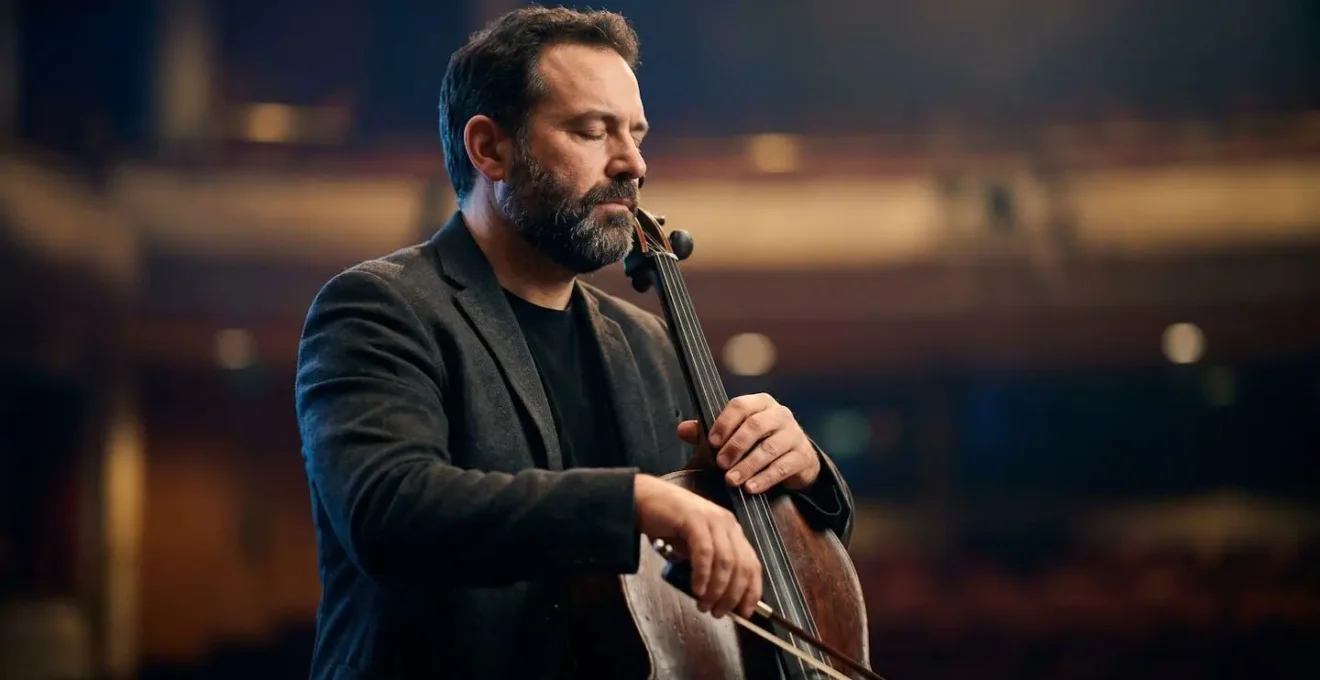
As this image demonstrates, presence is found in the details: the deliberate placement of hands, a grounded posture, a focused gaze. Every part of your body should be part of the performance. Practice how you stand, how you hold your instrument when not playing, and how you use your eyes. Look at individual people in the audience, not over their heads. Let your facial expressions reflect the emotion of the song. These are not grand, theatrical gestures, but small, intentional acts that signal to the audience that you are fully present with them.
Start by recording yourself. Watch your performance with the sound off. What is your body communicating? Are you open and inviting, or are you closed off and defensive? By shifting from unconscious habits to conscious choices, you begin to build a physical vocabulary of command. This isn’t about faking confidence; it’s about embodying it until it becomes real.
Scripted Performance or Spontaneous Response: Which Approach Works Better Live?
Musicians often feel trapped between two extremes: the tightly rehearsed, note-for-note show and the completely chaotic, improvised jam session. The most captivating performances, however, exist in the space between. The ideal approach is not one or the other, but a structured foundation that allows for spontaneity. A fully scripted show can feel rigid and lifeless, while a completely unscripted one can feel self-indulgent and alienate an audience.
Think of your setlist and song structures as the architecture of a house. The walls and foundation are solid, providing safety and predictability. This is your rehearsed material. But the windows are open, allowing the energy of the audience—the breeze, the weather of the room—to flow in and change the atmosphere. This is your spontaneity. It might be a momentary deviation from the setlist because the crowd is responding to a particular vibe, a longer instrumental section, or a genuine, unplanned interaction with the audience.
This structured spontaneity is a powerful tool for creating the energetic transaction. It tells the audience, « We have a plan for you, but we are also here *with* you, right now. » It makes them feel seen and included in the creative process.
Case Study: The Power of Participatory Improvisation
The value of this approach is backed by research. In a study on classical music performances, musicians who improvised based on audience requests created a remarkably strong connection. As demonstrated in research on participatory experiences in classical music, audience members reported feeling like they « became part of the creativity » and experienced intense empathy for the performers. Crucially, this effect was not tied to the musicians’ individual skill at improvising, but to the act of spontaneous, collaborative creation itself. The shared risk and in-the-moment problem-solving forged a powerful bond that a perfectly executed, pre-written piece could not.
This doesn’t mean you need to take random requests. It simply proves that allowing moments for genuine, in-the-moment response makes the show unique and memorable. The audience becomes a co-creator of the evening, not just a passive observer. This transforms the performance from a one-way broadcast into a two-way conversation.
The Stage Habit of Emotional Hiding That Prevents Audience Connection
The single biggest barrier to audience connection is not a lack of skill, but a lack of vulnerability. Many performers, consciously or not, engage in a form of emotional hiding on stage. They use their instrument, the microphone stand, or a wall of sound as a shield. Their focus is directed inward, on their own anxiety and the technical execution of the music. This creates an invisible barrier between them and the audience, turning a potential connection into a one-sided observation.
This habit often stems from stage fright. The fear of judgment causes performers to retreat into themselves. As performance coach Karen A. Hagberg explains, the solution is a shift in focus from the self to the shared experience:
Stage fright is exaggerated when your attention is focused solely on yourself. Learning to become centered on the music itself and on the performance at hand is essential for players who want to minimize stage fright.
– Karen A. Hagberg, Stage Presence from Head to Toe: A Manual for Musicians
To connect with an audience, you must be willing to be seen. This means allowing the genuine emotion of the song to register on your face and in your body. It doesn’t require over-the-top theatrics, but rather the courage to let your authentic feelings show. A subtle furrow of the brow during a somber lyric or a genuine smile during a joyful chorus is a micro-expression of vulnerability that acts as a bridge to the audience’s own emotions. It gives them permission to feel along with you.
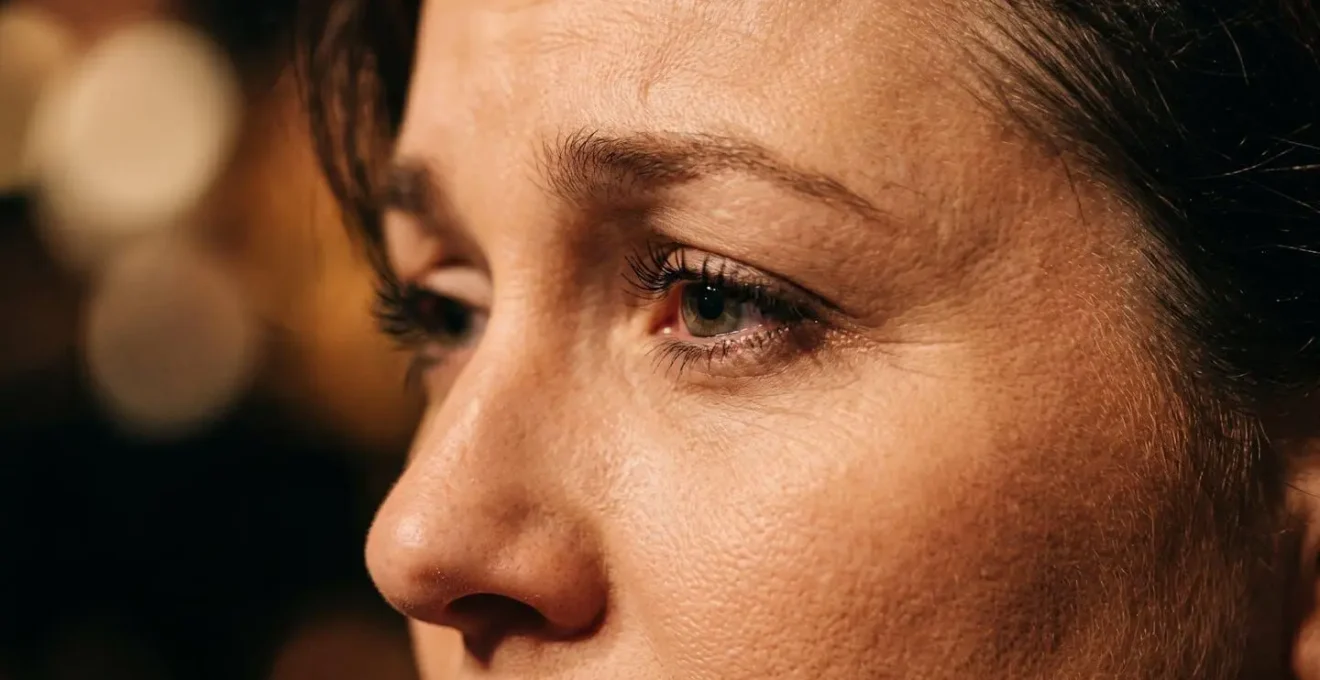
This image captures the essence of emotional availability. It’s in the small, uncontrollable moments that an audience truly connects. They don’t just hear the sadness in the lyric; they see it in your eyes. This is the heart of the energetic transaction. You are offering a genuine piece of your emotional state, and in return, the audience offers their focused attention and empathy. Breaking the habit of emotional hiding is about learning to serve the song’s emotion, not your own anxiety.
In What Order Should Songs Appear for Peak Audience Energy by Set End?
A great live set is more than just a collection of good songs; it’s a narrative with a beginning, a middle, and an end. The order of your songs is the primary tool you have for sculpting the audience’s emotional journey. A poorly structured set can squander energy and lead to a flat, anticlimactic finish, no matter how well you play. The goal is to create a dynamic « energy arc » that builds momentum, provides moments of reflection, and culminates in a powerful peak.
Too many bands make the mistake of front-loading all their high-energy songs, leading to a mid-set slump from which the audience never recovers. Others create a jarring emotional rollercoaster with no logical flow. A well-designed energy arc, however, guides the audience intentionally. You start strong to grab their attention, create a valley in the middle to provide dynamic contrast and emotional depth, and then build to a powerful finale that leaves them wanting more.
This arc isn’t just about tempo; it’s about emotional intensity, lyrical themes, and musical texture. The transitions between songs are just as important as the songs themselves. Dead air is an energy killer. A seamless transition, whether through a musical interlude, a brief story, or even just a shared look between bandmates, maintains the immersive experience and keeps the audience locked in.
Your Action Plan: The Energy Arc Framework
- The Hook: Start with 2-3 fast and energetic songs that establish your core sound and demand immediate attention.
- The Valley: Move towards slower, more intimate, or atmospheric songs for the middle of the performance to create dynamic contrast and invite sing-alongs or quiet reflection.
- The Climb: Begin building the energy back up with mid-to-up-tempo tracks that regain momentum.
- The Peak: Place your most powerful, anthemic, or high-energy songs in the final 1-2 slots to create a memorable finale.
- Momentum Management: Plan your transitions to keep gaps under 15 seconds. Use musical links, banter, or instrument changes to maintain a continuous flow of energy.
Crafting this arc is an art, not a science. The right shape depends on your genre and your specific songs. But having a deliberate plan for the audience’s journey is the difference between playing songs *at* people and creating an experience *with* them.
Why Do Audiences Lose Interest During Your Performance Even When You Play Well?
When you see an audience lose interest, the instinct is to assume they’re bored. You might see people checking their phones or heading to the bar. As LedgerNote’s analysis states, « Nothing is more boring than hearing song after song with nothing else happening. » This is often true. Gaps between songs, a lack of visual engagement, or a monotonous energy level can absolutely cause an audience to disconnect. If your show is just an auditory experience, you’re competing with every other distraction in the room.
However, there’s a counter-intuitive side to this. Sometimes, what a performer interprets as « losing interest » is actually a sign of deep engagement. A completely still and silent audience isn’t always a bored one. In many cases, it’s a captivated one. When an audience is truly immersed in a performance, their physical movement decreases. They are so focused on listening and watching that they become still. This is the highest form of compliment.
This phenomenon is not just anecdotal. When an audience is deeply engaged, they become physically still. In fact, as research quantifying audience motion found, stillness during a performance is consistently interpreted by performers, observers, and even audience members themselves as clear evidence of engagement. The study noted that during the most preferred musical pieces, audience motion decreased even further.
The challenge for you as a performer is to learn to distinguish between disengaged stillness and captivated stillness. Disengaged stillness feels vacant; the audience’s eyes are glazed over, and their posture is slumped. Captivated stillness is electric; their eyes are fixed on you, their posture is alert, and you can feel their focused energy. The key is to stop projecting your own anxiety onto the crowd and instead learn to read the room’s true energetic state. Are they still because they’re bored, or are they still because they’re holding their breath, waiting for the next note?
Why Do Some Tours Leave Musicians Destroyed While Others Leave Them Energised?
The concept of an « energetic transaction » is not just a metaphor; it’s a physical and psychological reality. Performing is an act of giving massive amounts of energy. When this exchange is positive—when you receive energy back from a captivated audience—it can be exhilarating. But when the exchange is negative or you are simply pouring energy into a void, it is profoundly draining. This is why some tours leave musicians feeling energised and alive, while others leave them utterly destroyed.
The life of a touring musician is a unique pressure cooker of intense highs and crushing lows, isolation, and constant scrutiny. This emotional rollercoaster, combined with the physical demands of travel and inconsistent schedules, takes a severe toll. The statistics are alarming: the lifestyle puts artists at a significantly higher risk for mental health crises. For instance, in a stark reminder of the pressures involved, where a 2020 survey found that 39.4% of professionals in the international touring scene demonstrated high scores for suicidality, with depression levels matching clinical risk cutoffs.
An energising tour is one where the performer has established a sustainable energy management system. This goes far beyond on-stage performance. It involves protecting your personal energy so that you have something to give in the first place. It means establishing firm boundaries, learning to say ‘no’ to draining social obligations, and creating non-negotiable routines for mental and physical recovery. This includes a post-show wind-down to manage the adrenaline comedown, daily habits that ground you (like exercise or meditation), and building professional support systems like therapy into your tour schedule.
Ultimately, a performer who is running on empty cannot create an energetic connection with an audience. They are in survival mode, not performance mode. Protecting your well-being is not a selfish act; it is a prerequisite for a long and successful career in live music. An energised performer can give freely to the audience, creating a positive feedback loop that fuels both parties. A depleted performer is simply trying to get through the night.
Key Takeaways
- Connection Over Perfection: An audience connects with authentic, vulnerable moments, not just flawless execution. Rawness often signals presence.
- Presence is a Skill: Commanding stage presence isn’t magic; it’s built through intentional body language, the strategic use of stillness, and direct eye contact.
- The Show is an Energy Arc: Structure your setlist as an emotional journey with a clear beginning, middle, and end to guide the audience’s energy and finish strong.
Why Do Some Musicians Captivate Before Playing a Single Note?
The performance does not begin with the first note. It begins the moment you become visible to the audience. The walk from the wings to the microphone is a critical, and often overlooked, part of your show. In these few seconds, the audience makes hundreds of subconscious judgments about your confidence, your passion, and your authority. This is the « walk-on contract »: an unspoken agreement where you establish the terms of the engagement before the music even starts.
Some musicians squander this moment. They rush on stage with their head down, avoiding eye contact and fidgeting with their equipment. This non-verbally communicates anxiety, apology, or indifference. It immediately puts them at a disadvantage, forcing them to spend the first few songs trying to win back an audience they have already signaled they are not ready to lead. Others, however, understand the power of the entrance. They walk on with purpose, their posture open and confident, a hint of a smile on their face, and they make eye contact with the crowd. They own the space.
Case Study: The First Impression
The impact of the walk-on is not just theory. Research on stage presence for classical performers has shown significant links between the visual cues a performer gives during their entrance and the audience’s overall perception of the performance quality. Performers who practiced their walk-on—approaching the stage with calm confidence, making eye contact, and smiling before they bowed—were perceived as giving a higher quality performance, regardless of what followed musically. They established immediate authority and set a positive, engaging tone from the outset.
This is your first and most powerful opportunity to initiate the energetic transaction. By showing the audience that you are confident, happy to be there, and in complete control, you invite them into your world. As author and performance expert Gerald Klickstein advises, the message must be clear:
When you first step on stage, smile, move confidently, and show listeners that there’s no place else you’d rather be. Broadened shoulders, open arms, and a lengthened spine convey warmth and ease.
– Gerald Klickstein, 6 Tips to Improve On-Stage Body Language
Treat your entrance as the first song of your set. Rehearse it. Decide what you want to communicate and embody that message from the moment you step into the light. You can captivate an entire room before you ever play a single note.
Stop treating your performance as a recital of your technical skill. Start designing it as an energetic and emotional experience for your audience. Apply these principles of intentional presence, vulnerability, and energy management not as rules, but as a new philosophy for your live show. The next time you step on stage, your goal isn’t just to play correctly; it’s to connect deeply. That is the shift that will finally make the room feel alive.