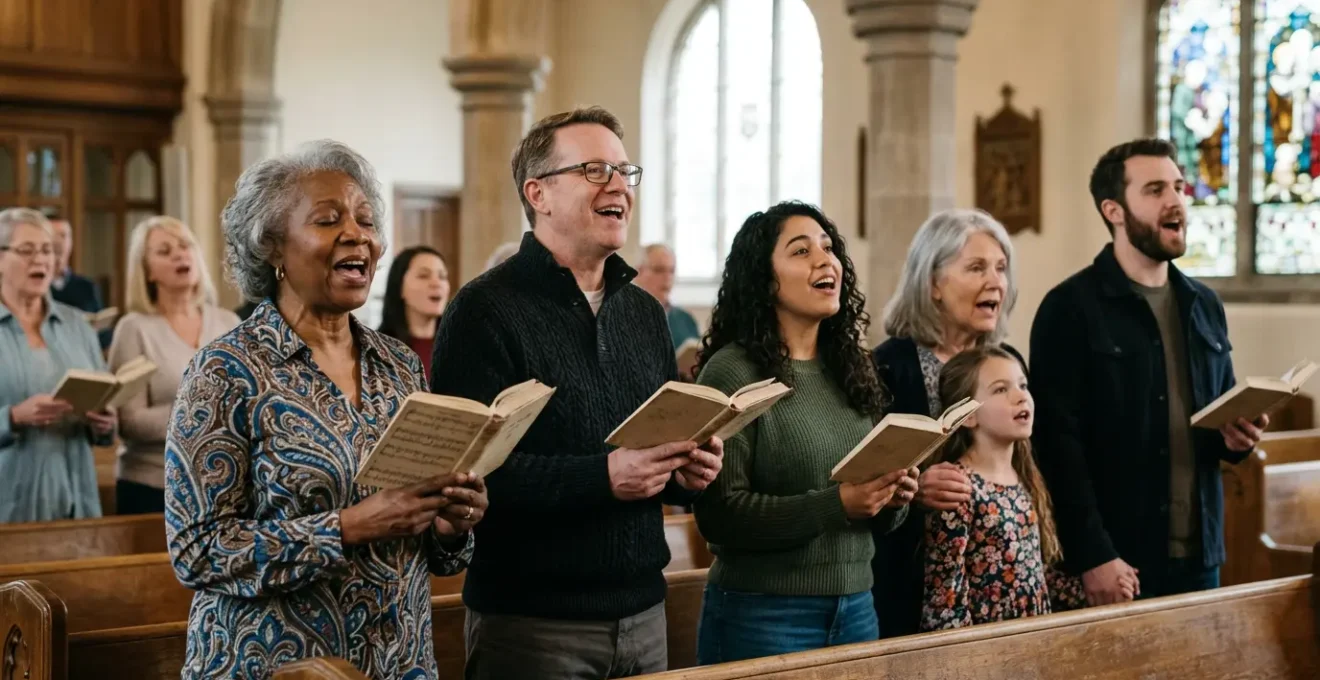
The tension between old hymns and new songs isn’t about theological depth or musical style; it’s a problem of practical, physical participation.
- Modern worship often fails due to unsingable vocal ranges and volumes that discourage communal singing.
- Historic hymns succeed by design, using accessible melodies and structures that invite the entire congregation to join in.
Recommendation: Focus on the ‘singability’ of a song—its key, range, and acoustic context—before introducing it to your congregation.
We’ve all seen it. A new, powerful worship song plays on the radio, and the worship leader, full of passion, introduces it on Sunday. Yet, the congregation remains muted, their voices tentative, a stark contrast to the full-throated singing that accompanies a classic hymn like « Amazing Grace » just moments later. The immediate temptation is to frame this as a debate over style versus substance, or modern emotion versus traditional theology. We talk about repetitive lyrics or complex theology as the root cause of the divide.
But what if the real issue is far more fundamental and practical? What if the difference lies not in the words, but in the very mechanics of congregational participation? The truth is, the success of a corporate worship song has less to do with its age or genre and more to do with its vocal ergonomics and the psychological space it creates. Many contemporary worship songs, often written as solo artist recordings, are simply not designed for the untrained voice. Traditional hymns, on the other hand, were crafted over centuries with a singular purpose: to be sung by the many, not performed by the few.
This isn’t an argument to discard the new in favour of the old. It’s a call for worship leaders to become discerning musical architects, understanding the science behind what makes a song truly congregational. It’s about shifting our focus from performance to participation, from the sound on the stage to the sound in the pews.
This article will deconstruct the practical elements that make a hymn or worship song effective. We will explore the technical aspects of singability, the impact of different church traditions, the common mistakes that silence a congregation, and how to weave music into the church year to deepen its meaning, providing a clear framework for fostering vibrant, unified worship in your own community.
Summary: Unlocking the Secrets of Congregational Singing
- Why Can Untrained Voices Sing Some Hymns but Not Others?
- How to Introduce New Worship Music Without Alienating the Congregation?
- Anglican, Methodist or Evangelical: What Can Each Tradition Teach About Effective Hymnody?
- The Mistake of Worship Bands That Makes Congregations Stop Singing
- How to Plan Hymns for the Church Year So Music Deepens Seasonal Meaning?
- English, Scottish, Welsh or Irish: How Do Oral Traditions Differ Across Britain?
- Why Do Professional Major Key Songs Sound Rich While Yours Sound Like Nursery Rhymes?
- Why Do Folk Songs Change Every Time Someone Sings Them?
Why Can Untrained Voices Sing Some Hymns but Not Others?
The answer lies in two critical, often-overlooked concepts: vocal range and tessitura. A song’s range is the distance between its lowest and highest notes. Its tessitura is where the melody spends most of its time. A traditional hymn is specifically designed with a narrow range and a comfortable, mid-range tessitura. This is not an accident; it’s a feat of ergonomic design for the human voice. A foundational study confirmed that 84% of congregants can reliably sing within the octave-and-a-third from G3 to B4. Hymns like « Be Thou My Vision » or « Great Is Thy Faithfulness » live almost entirely within this sweet spot.
Conversely, many contemporary worship songs are written by and for recording artists with professional vocal training. They feature wide melodic leaps and a high tessitura that might sound powerful in a solo performance but place an impossible strain on the average congregant. When a song repeatedly forces people to sing at the very top or bottom of their comfortable range, they simply stop trying. It’s not a spiritual failure; it’s a physical one.
Furthermore, the very structure of hymn melodies is often more intuitive. They typically move by step (scalic motion) rather than by large, difficult-to-pitch leaps. The rhythm is often straightforward and follows the natural cadence of the lyrics, making it easy to pick up. A new worship song, with its syncopated rhythms and unpredictable melody, can feel like a moving target. The congregation isn’t just learning words; they’re trying to solve a melodic puzzle in real-time, which is a barrier to genuine worship.
Ultimately, a song’s singability isn’t a matter of taste but a matter of design. By choosing or writing songs that respect the physical limitations and intuitive nature of the untrained voice, we create an environment where participation is not just possible, but natural.
How to Introduce New Worship Music Without Alienating the Congregation?
The key to introducing new music is to shift the mindset from « performance » to « invitation. » A congregation is not an audience; they are co-participants. When a new song is presented as a finished, polished piece, it creates a barrier. People feel they are being asked to critique a performance rather than join an act of worship. The most effective approach is to deliberately « de-perform » the song, breaking it down and teaching it as a community.
Instead of a full-band arrangement on the first hearing, try a simple acoustic introduction. Play the chorus through once, then invite the congregation to sing it with you. Use a call-and-response method. This transforms the experience from a passive one to an active, learning one. It gives people permission to be unfamiliar with the music and removes the pressure of « getting it right » on the first try. This simple act of teaching fosters a sense of shared ownership and vulnerability.
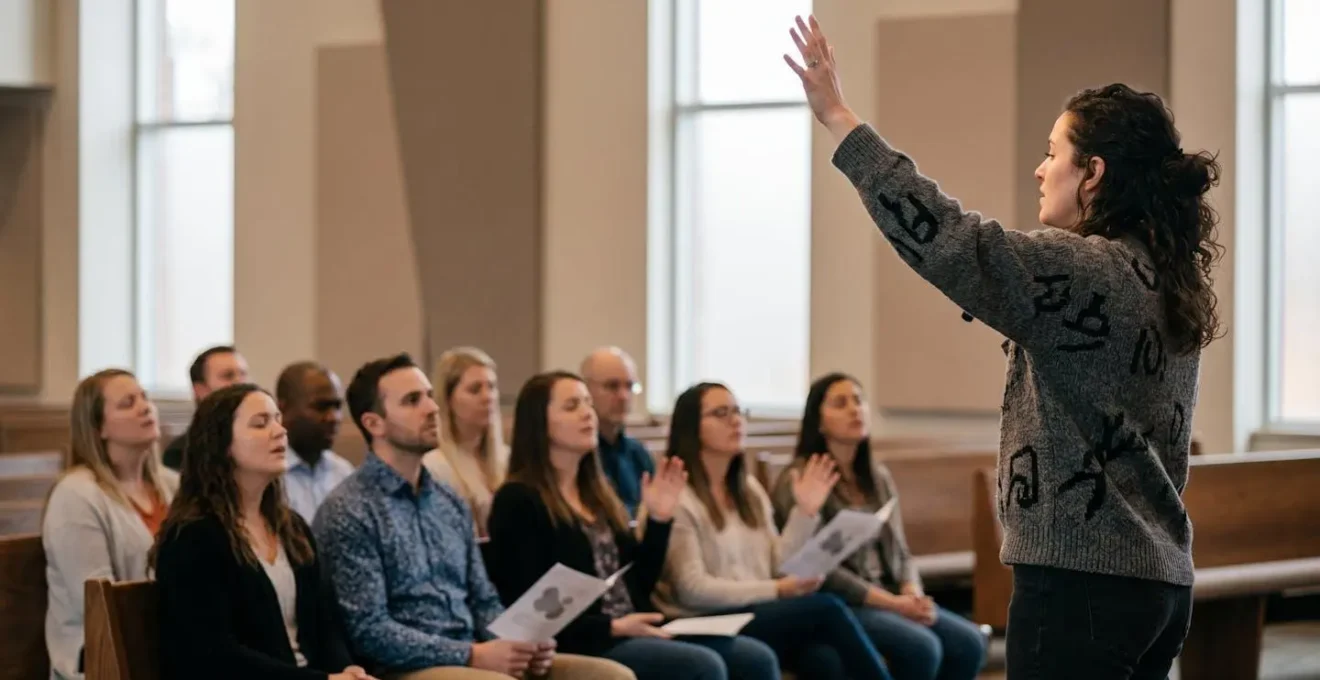
This teaching moment is also the perfect time to address the most common technical barrier: the song’s key. Songs are often recorded in keys that suit a specific professional singer’s voice but are far too high for a general congregation. Transposing a song down to a congregational-friendly key (where the melody sits comfortably between A3 and D5) is perhaps the single most impactful change a worship leader can make. It communicates that the song is for *them*, not for the band.
Your Action Plan: The « De-Performance » Strategy for New Songs
- Transpose for the People: Lower the key from the artist’s recording. Aim for melodies that primarily live in the A to D range for the congregation.
- Analyse the Tessitura: Consider where most notes are. Avoid songs that keep the congregation straining at the top of their range for extended periods.
- Match Energy to Key: Lean toward slightly lower keys for slower, more contemplative ballads and slightly higher (but still accessible) keys for energetic, up-tempo songs.
- Do a « Stand-Up » Test: Before finalising the key, test it yourself while standing, using full breath support, to simulate a congregational experience.
Repetition is also your friend, but it must be intentional. Plan to reuse the new song in the following weeks. Familiarity breeds confidence, and a song that was once foreign will soon feel like an old friend, fully integrated into the church’s unique voice.
Anglican, Methodist or Evangelical: What Can Each Tradition Teach About Effective Hymnody?
Every church tradition holds a piece of the puzzle for creating effective congregational music. By looking beyond our own walls, we can learn valuable lessons. The Anglican tradition, particularly its high-church choral expression, teaches us the power of awe and transcendence. The complex harmonies and soaring descants of a cathedral choir aren’t meant to be copied by the congregation, but to lift their hearts and minds towards the majesty of God, creating a sacred space where the people’s simpler hymn-singing can reside.
From the Evangelical tradition, we learn the importance of immediacy and personal testimony. Modern worship music at its best captures a sense of intimate, heartfelt response to God’s presence *right now*. It prioritises emotional connection and accessibility, reminding us that worship is not just an intellectual exercise but a profound encounter. Its weakness can be a lack of theological depth, but its strength is a passionate, present-tense engagement that can be incredibly powerful.
Perhaps no tradition offers a more compelling synthesis than the Methodists, thanks largely to the prolific work of Charles Wesley. His hymns are a masterclass in bridging the gap between deep theological concepts and fervent personal emotion. He provided a robust musical and lyrical framework for the entire Christian life, from conviction to salvation to sanctification.
Case Study: Charles Wesley’s Model of Integrated Hymnody
Charles Wesley masterfully combined robust theological concepts with intensely personal and emotional language in over 6,500 hymns. As detailed in a study of his work, he created a model that bridges deep doctrine (like prevenient grace and sanctification) with passionate « heart religion. » For example, « And Can It Be » unpacks profound substitutionary atonement theology while framed as a personal, astonished cry of faith. This provides a timeless template for modern songwriters seeking to create music with both intellectual substance and emotional resonance, proving that the head and the heart can, and should, sing together.
A truly effective worship leader is a curator, drawing the best from each stream: the reverence of the Anglicans, the passion of the Evangelicals, and the masterful head-and-heart integration of the Methodists. The goal is not a bland compromise, but a rich, layered tapestry of worship that speaks to the whole person.
The Mistake of Worship Bands That Makes Congregations Stop Singing
It’s the most common and destructive mistake a worship band can make: being too loud. When the volume from the stage overwhelms the sound from the pews, it sends a clear, albeit unintentional, message: « Your voice doesn’t matter. We are here to perform for you. » This single error is responsible for silencing more congregations than any theological disagreement or stylistic preference. The reason is rooted in basic acoustics and human psychology.
People need to hear themselves and their neighbours to feel like they are part of a group. Singing becomes a communal act when you can perceive the collective voice. When the band is too loud, that collective voice is masked. An individual is left feeling like they are singing a solo against a wall of sound, which feels exposed and intimidating. Participation plummets. Research backs this up, showing that above 90 decibels, congregational participation drops off dramatically. This isn’t a preference; it’s a measurable phenomenon. For context, 90dB is equivalent to the noise of a lawnmower.

The problem is often compounded by poor « sonic arrangement, » or a failure to consider how different instruments occupy the frequency spectrum. If the electric guitar, keyboard pads, and bass guitar all live in the same mid-range frequencies as the human voice, they will inevitably drown it out. A skilled band leader and sound engineer work to create sonic space, carving out specific frequency bands for each instrument so that the congregational voice has its own dedicated space to exist and be heard.
When people can hear themselves and others around singing, it creates permission. Singing stops feeling like a solo attempt against a wall of sound and starts feeling communal.
– WorshipFlow, How Volume Affects Congregational Participation in Worship
The solution requires humility and a shift in priority. Turn down. Mix for the room, not the stage. Use the sound system to gently support the congregation’s voice, not to replace it. A successful Sunday is not one where the band sounded amazing, but one where the people sang their hearts out.
How to Plan Hymns for the Church Year So Music Deepens Seasonal Meaning?
Planning music for the church year is not about filling slots; it’s about liturgical weaving. It’s the art of using music to tell the grand story of salvation over the course of a year, allowing the congregation to inhabit the emotional and theological landscape of each season. This deepens their understanding and transforms the calendar from a series of dates into a lived spiritual journey. Careless planning, like singing Easter hymns in Advent, flattens this narrative and robs the seasons of their unique power.
The journey begins in Advent. This is a season of longing, expectation, and hopeful anticipation. The music should reflect this « already but not yet » tension. Hymns like « O Come, O Come, Emmanuel » with its minor key and yearning melody are perfect. It is not yet time for the joyous carols of Christmas; it is a time to prepare our hearts for the King’s arrival.
Christmas and its following season of Epiphany are times of incarnation and revelation. The music shifts to pure joy and wonder. This is the time for « Hark! The Herald Angels Sing » and « Joy to the World. » Epiphany hymns focus on the manifestation of Christ to the world, like « As with Gladness, Men of Old. » Then, the mood shifts dramatically to Lent. This is a penitential season of reflection, self-examination, and solemnity. The music should be more subdued and introspective. Hymns like « Rock of Ages » or « When I Survey the Wondrous Cross » are ideal, encouraging a posture of humility. Singing triumphant, celebratory songs during Lent is a profound category error.
This path of solemnity makes the explosion of joy at Easter all the more powerful. The music should be triumphant, bold, and victorious. « Christ the Lord Is Risen Today » with its alleluias is the quintessential Easter hymn. Finally, the long season of Ordinary Time is not « unimportant time. » It is the season of discipleship, growth, and living out the Christian life. This is where hymns about service, sanctification, and the Church have their place, grounding the high points of the liturgical year in the day-to-day walk of faith.
This intentional planning moves music from being a mere preliminary to the sermon to being an integral part of the church’s formation and worship, deepening the meaning of each Sunday.
English, Scottish, Welsh or Irish: How Do Oral Traditions Differ Across Britain?
The rich tapestry of hymnody across Britain is woven from distinct national threads, each with its own unique colour and texture rooted in its folk music traditions. Understanding these differences can bring new depth to our hymn choices. The English tradition, exemplified by composers like Ralph Vaughan Williams who collected folk songs, often carries a pastoral, spacious, and slightly melancholic feel. The melodies are often flowing and lyrical, evoking the rolling hills of the English countryside. Think of « He Who Would Valiant Be » – it’s sturdy, dependable, and deeply rooted.
Travel north, and the Scottish tradition introduces a more rugged, stark, and often pentatonic (five-note scale) character. The rhythm can be sharper, with the characteristic « Scotch snap. » There’s a sense of resilience and deep-seated conviction, often tied to the metrical psalms which were the heart of Scottish worship for centuries. Hymns like « The Lord’s My Shepherd (Crimond) » have an unadorned strength and gravity that is unmistakably Scottish.
In Wales, music takes on a different fire. The Welsh tradition is defined by immense passion, a natural inclination for four-part harmony, and a profound sense of longing known as *hiraeth*. Welsh hymn tunes are often grand, soaring, and built for massed voices, creating a powerful wall of sound. The tune « Cwm Rhondda » (Guide Me, O Thou Great Redeemer) is the quintessential example, a passionate, collective plea that builds to a thunderous conclusion.
Finally, the Irish tradition brings a gift for ornamentation and storytelling. Irish melodies, often modal and flowing, are incredibly expressive. They can be both deeply mournful and joyfully dance-like. Hymns like « Be Thou My Vision » (to the tune Slane) or « St. Patrick’s Breastplate » carry this lyrical, narrative quality. The melody is the vessel for a story, and each singer is invited to add their own subtle ornamentation, making the song new each time it’s sung.
By being mindful of these distinct traditions, a worship leader in the UK can curate a repertoire that is not just a collection of songs, but a celebration of the diverse and powerful ways faith has found its voice across these islands.
Why Do Professional Major Key Songs Sound Rich While Yours Sound Like Nursery Rhymes?
The frustrating gap between the sound in your head and the sound from your piano often comes down to one thing: harmonic expectation. Nursery rhymes and basic songs operate almost exclusively on three primary chords (the I, IV, and V – or C, F, and G in the key of C). This creates a simple, predictable, and ultimately childish-sounding harmonic landscape. Your ear knows exactly what’s coming next, so there is no tension and very little emotional depth.
Professional songs, even simple-sounding ones, sound rich because they masterfully play with this expectation. They use a broader harmonic palette, introducing secondary chords that create moments of tension, surprise, and ultimately, a more satisfying release. They don’t just stay in the shallow end of the pool; they explore the deeper waters of harmony.
The most common and effective tools for this are the « minor » chords within the key. The supertonic (ii), mediant (iii), and submediant (vi) chords add colour and emotion. The simple progression C-G-Am-F (I-V-vi-IV) is the backbone of countless pop hits precisely because the inclusion of the ‘vi’ chord (A minor) adds a touch of melancholy and sophistication that C-G-C-F cannot match. This is the first step out of the nursery.
To achieve a truly professional sound, songwriters go further, using « borrowed » chords from the parallel minor key or introducing secondary dominants. A secondary dominant is the V chord of a chord other than the tonic. For instance, in the key of C, the V chord is G. The V chord of G is D major. Slipping a D major chord into a song in C (e.g., C – D – G – C) creates a powerful pull towards the G chord, adding drive and harmonic interest. It’s like adding a new, vibrant spice to a familiar recipe. These are the sounds that make a progression feel « rich » and « full, » because they are constantly creating and resolving small pockets of harmonic tension, engaging the listener’s ear on a much deeper level.
By moving beyond the three primary chords and thoughtfully incorporating secondary and borrowed chords, you can transform a simple melody from a childish jingle into a compelling piece of music with genuine emotional weight.
Key Takeaways
- Prioritise singability by choosing songs within the comfortable congregational range of G3 to B4 to ensure maximum participation.
- Keep worship volume below 90 decibels. Congregations stop singing when they cannot hear themselves or their neighbours.
- Introduce new music by teaching it, not just performing it. Transpose keys for the congregation, not for the original recording artist.
Why Do Folk Songs Change Every Time Someone Sings Them?
The reason folk songs, and by extension many older hymns, seem to evolve with each singer is that they originate from a fundamentally different musical world: the world of oral tradition, not fixed text. A modern worship song is almost always a « fixed text. » It’s tied to a specific recording by a specific artist. The melody, harmony, rhythm, and instrumentation are all part of a definitive version. Any deviation is seen as a mistake.
An oral tradition song, however, is more like a living organism. It is passed down from person to person, ear to ear, voice to voice. There is no single « correct » version. The core of the melody and the story of the lyrics are the skeleton, but each singer and each community fleshes it out in their own way. A singer might add an ornament here, slightly alter a rhythm there, or substitute a word that makes more sense in their local context. This isn’t an error; it’s the very process that keeps the song alive and relevant.
This process of variation and adaptation is the song’s lifeblood. It allows the music to bed down into the soul of a community, to be shaped by their unique voice and experience. This is why a hymn like « Amazing Grace » can be sung as a slow, mournful lament, a rousing gospel anthem, or a simple folk ballad, and all versions feel equally authentic. The song is robust enough to contain all these interpretations.
When we treat all worship music as fixed text, demanding slavish imitation of a recording, we rob it of this potential for organic life. We turn participation into mimicry. The great power of traditional hymnody and folk music is its invitation to make the song your own. The inherent flexibility in the melody and rhythm creates space for the congregation’s voice to become a true and integral part of the music, not just a layer added on top of a pre-existing performance.
Instead of constantly chasing the latest pre-packaged song, the most fruitful path forward may be to rediscover the principles of communal songcraft. Begin by auditing your church’s existing repertoire not for its age, but for its inherent ‘singability’ and its capacity to become the unique voice of your people.